
Revised by
By Robert Hokin, Managing Partner, Fundraising101
I was recently asked by an enterprising fintech start-up to join their advisory board. The conversation got me thinking about best practices, and about how consistently founders underestimate this lever. So here are some thoughts, specifically for UK founders who are getting ready to raise.
The Accelerator Trade-Off
Today’s founders have more support resources available to them than at any point in the history of entrepreneurship. Tech incubators and accelerators exist in virtually every major UK city, and in a growing number of smaller towns too. Many of them do genuinely good work. Scottish EDGE, Techscaler, Converge, Sustainable Ventures, Barclays Eagle Labs, these are serious programmes with serious networks.
But not all are free. Most accelerators take equity, sometimes a meaningful chunk of it, in exchange for the support, mentoring, and introductions they provide. For founders at the earliest stages, that dilution can feel disproportionate to what’s received, and it’s permanent.
So the question worth asking is: is there a way to build similar value without giving away a significant portion of your company before you’ve even raised your first round?
There is. It’s called an Advisory Board.
What an Advisory Board Actually Is … and Isn’t
An Advisory Board is not a Board of Directors. This distinction matters. Your Board of Directors has formal governance authority, they can scrutinise decisions, vote on resolutions, and in certain circumstances, remove you from your own company. Advisory Board members have none of that power. They don’t work for you. They have no fiduciary duty and no legal standing in your business.
What they do have, when assembled well, is domain expertise, industry networks, and hard-won experience that you currently lack. Their job is to share it with you, openly, and without agenda. When it works, it’s one of the highest-leverage, lowest-cost things a founder can do.
Mark Zuckerberg has spoken publicly about the role Steve Jobs played as a mentor during Facebook’s formative years. Closer to home, research from the UK’s ScaleUp Institute consistently identifies access to networks and mentoring as among the most significant differentiators between start-ups that scale and those that stall. The British Business Bank’s Small Business Finance Markets report highlights that founders with structured support networks raise capital faster and at better valuations than those without. That’s not anecdote. That’s data.
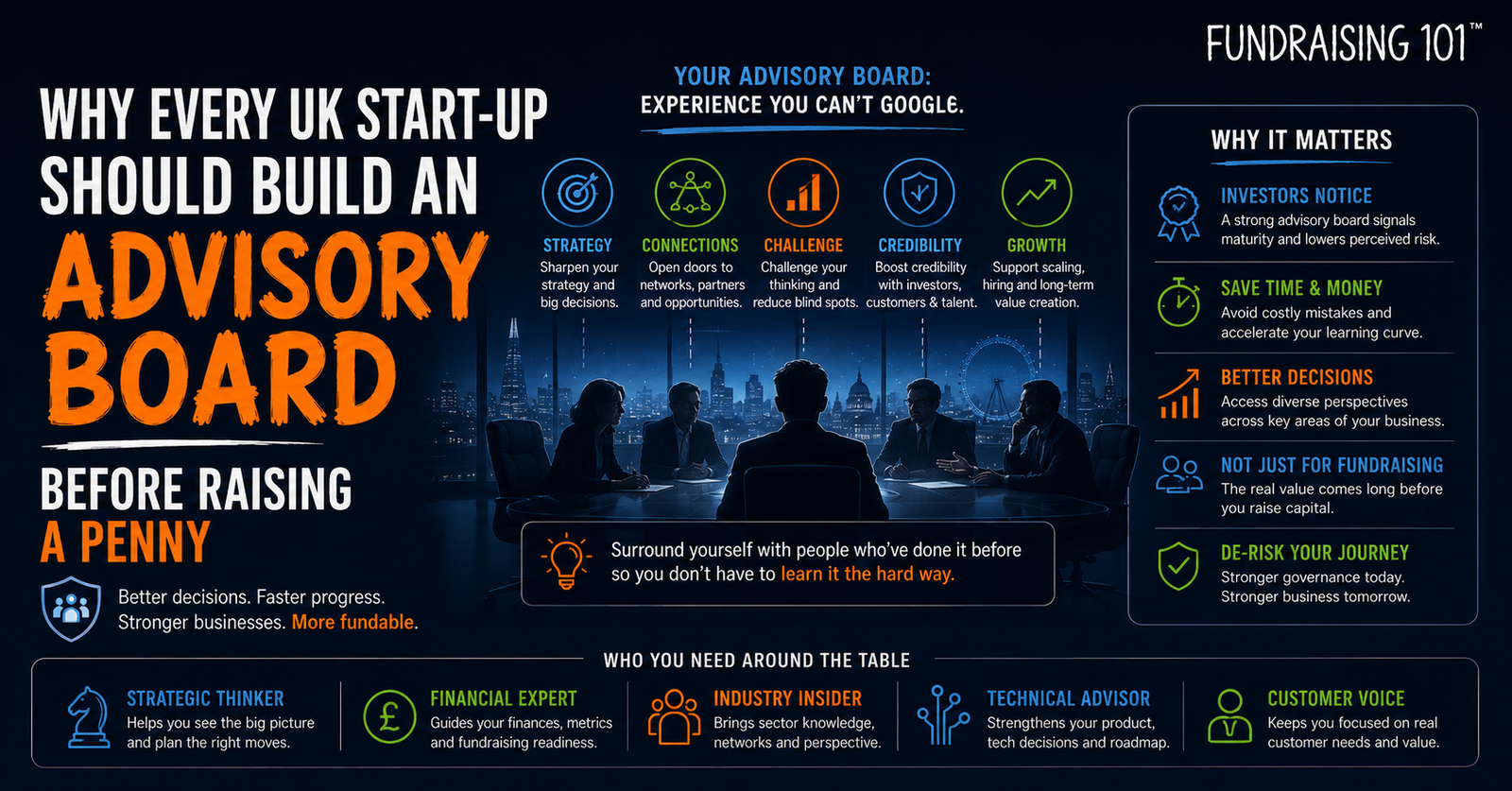
At Fundraising101™, we consistently find that funds score companies with functioning advisory boards higher than those without one. It signals maturity, self-awareness, and an understanding that building a company is a team sport. Many funds explicitly screen for it.
How to Build One — The UK Approach
- Start with the Gaps, Not the Names
The instinct is to go after the most impressive names you can find. Resist it. Start instead by mapping the genuine expertise gaps in your founding team. Where are you weakest? Where do you most need external challenge and support?
For most early-stage UK founders, the critical gaps tend to cluster around: commercial and sales leadership, international expansion (especially US market entry), regulatory navigation (FCA, MHRA, FDA depending on sector), supply chain and operations, and fundraising and investor relations.
Build the board around those gaps. An advisor with the right expertise in one area will add far more value than a prestigious name who has no relevant experience in your space. - Keep It Small and Selective
Three to five advisors is the right size at early stage. Fewer than three and you lack genuine breadth of perspective. More than five and you’ll struggle to get meaningful time from each of them, meetings become unwieldy, and the signal-to-noise ratio drops.
Be selective. An advisory board of three exceptional people who are genuinely engaged is worth more than a roster of eight impressive names who never respond to emails. - Recruit for Engagement, Not Ego
The best advisors are almost never the ones who want to be advisors. The people who actively seek or request advisory board positions are often motivated by the equity, the CV line, or the connection to other board members but not by genuine interest in your business. The ones who really perform are typically those who encountered your company, saw something genuinely interesting in what you’re doing, and want to help.
When you approach a potential advisor, lead with a specific, substantive conversation about the business. Show them a real problem. Ask for their perspective. If they engage immediately and with genuine insight, you’ve found someone worth pursuing.
A good rule of thumb: never appoint someone as an advisor if their primary pitch for joining is that they’re a professional advisor. - The Role Specification
Treat this like any other hire. Write a brief role specification for each advisory position that defines the specific expertise you’re looking for, the contribution you expect (introductions, sounding board, diligence support, fundraising guidance), the time commitment (more on this below), and the compensation structure.
Being specific here protects both parties and sets clear expectations from the outset.
Remuneration: Getting It Right in the UK Context
This is the area where UK founders most consistently get things wrong, usually by either giving away too much, too early, or by trying to get advisors to work for nothing and then being surprised when they disengage.
Equity: The UK Market Standard
For UK start-ups, the market rate for advisory board equity sits between 0.1% and 1.0%, with most early-stage arrangements landing in the 0.25%–0.5% range. The right number depends on the seniority of the advisor, the expected time commitment, and the stage of the business. A world-class operator with deep domain expertise and genuine network value in your target market might warrant 1.0% or slightly above. A generalist mentor at early stage is typically 0.25%.
Never give advisory equity without a vesting schedule. The UK standard is a two-year vest with a six-month cliff: meaning the advisor earns nothing in the first six months, then vests the remainder monthly over the following 18 months. This protects you if the relationship doesn’t work out, and aligns the advisor’s interests with the business over time.
EMI Options: The Right Structure for UK Advisors
If your company qualifies, and most UK start-ups with fewer than 250 full-time equivalent employees and gross assets under £30M do, consider issuing advisory equity through Enterprise Management Incentive (EMI) options rather than direct share grants.
EMI options are highly tax-efficient for both the company and the advisor. For the advisor, gains on EMI options typically qualify for Business Asset Disposal Relief (formerly Entrepreneurs’ Relief), meaning they pay 10% Capital Gains Tax on exit rather than income tax at marginal rates. For you, there’s no immediate PAYE or National Insurance liability on grant. This matters when you’re talking to a high-earning professional about joining your advisory board – the after-tax value of an EMI option is materially better than an equivalent direct equity grant.
Consult your accountant or solicitor before granting advisory equity in any form. The setup cost is modest and the protection is significant.
SEIS and EIS Considerations
One important nuance: if you are raising a SEIS or EIS round (which you should be, if you’re eligible – it halves the effective cost of investment for UK angels), be aware that advisory board equity grants can affect your SEIS/EIS status if not structured carefully. Advisors who hold shares and provide services to the company may be treated as employees by HMRC in certain circumstances, which can jeopardise EIS certification. Get advice before you grant equity to anyone who is also actively working with the business.
Cash Compensation
Most early-stage advisory board arrangements are equity-only. That’s appropriate. If an advisor is asking for a cash retainer in addition to equity at seed stage, they are not the right person for this role.
As the business scales and advisors become more central to specific programmes of work, investor introductions, key hires, market entry – it is entirely reasonable to move some engagements to a hybrid model. But at the early stage, equity is the currency.
Take Them to Dinner
This is not a throwaway suggestion. In the early stages, when your advisory board is small and your cadence is quarterly, if you can and they can join, take your advisors out to dinner. Not a video call. Not a coffee. A proper dinner.
The quality of conversation that happens around a table with good food and a glass of wine is categorically different from what happens on a structured agenda call. Problems get surfaced that wouldn’t otherwise come up. Connections get made between advisors who discover shared networks or complementary views. And you, as a founder, get to see how these people think when they’re not performing for a meeting.
Budget for it. It’s deductible, it’s relationship-building, and the advice you’ll receive over a dinner table is often the most valuable you’ll get all year. Bring a notepad or a digital notetaker!
Meeting Cadence and Governance
Every other month is optimal at early stage. Quarterly is the minimum to maintain genuine engagement. Monthly is too frequent. Advisors have jobs, other commitments, and their own businesses. Respect their time and they’ll give you more of it.
For each meeting, circulate a brief pre-read: no more than two pages, covering recent progress, key decisions coming up, and specific questions you want the board’s input on. This is not a board pack in the governance sense. It’s a prompt for focused conversation.
Keep formal minutes, even informally. You will want a record of what was discussed, what was recommended, and what you decided. As the business grows, this record becomes valuable.
Governance Basics
Draft a simple advisory board agreement for each member. This should cover:
- The equity grant and vesting schedule
- Expected time commitment (typically 4–8 hours per quarter)
- Confidentiality obligations
- Conflict of interest provisions (an advisor who sits on a competitor’s board is a problem)
- IP assignment: any advice or introductions made in the context of the advisory role belong to the company
- Termination: you should be able to remove an advisor who is not performing, without drama
A good UK start-up solicitor can draft this in an hour. Use one.
What to Do if You’re Not Ready
If you’re genuinely not yet at the stage where an advisory board makes sense, perhaps you haven’t yet found product-market fit, or you’re pre-revenue, consider joining someone else’s advisory board first. It’s a highly effective way to understand how the best ones function, build your own network, and develop the judgement you’ll need to recruit well when the time comes.
If you have peers in adjacent industries with complementary expertise, a quiet, informal conversation “I’d value your perspective on this from time to time” is often the best first move. Many productive advisory relationships begin before any formal agreement is in place.
The Bottom Line
An advisory board, assembled with care and structured correctly, is one of the most cost-effective investments a UK founder can make before they go out to raise. It fills expertise gaps, strengthens your investor narrative, surfaces networks you don’t yet have, and signals to funds that you are building a business with rigour and support rather than going it alone.
The founders who are too busy to build one are often the same founders who are least raise-ready when the time comes.
Don’t be that founder.
Robert Hokin is the Managing Partner of Fundraising101™ Academy, a Glasgow-based pre-seed investment readiness practice supporting early-stage tech founders across Scotland and the North of England. Get Raise-Ready.
Pre-seed tech founder in Scotland? There’s a difference between deck-ready and Raise-Ready. We can help you get there. Fast. With No BS. Visit fundraising101.academy