And What It Means For Your Raise

Robert Hokin | Managing Partner, Fundraising101™
Definition of risk, n.“(Exposure to) the possibility of loss, injury, or other adverse or unwelcome circumstance; a chance or situation involving such a possibility.”
Oxford English Dictionary, Third Edition.
That definition is worth sitting with. The OED doesn’t say risk is bad. It says risk is exposure to possibility. That framing, possibility, not certainty, is exactly how professional investors think about it. Risk is not a wall. It’s terrain.
Why This Matters
Having spent 30 years on the investor side of the table in UK venture capital and technology investment, I’ve sat across from hundreds of founders at every stage; from raw pre-seed pitches with a deck and a dream to Series B companies with product, revenue, and a team. The single most consistent mistake founders made when they walked into a funding conversation is trying to convince me their company has no risk.
That’s the wrong conversation. It signals one of two things: either they don’t understand what I’m actually buying, or they’ve already given away the upside in the process of reducing the risk. Neither is good.
Investors don’t avoid risk. Risk is our product. It’s what we sell to our LPs. What we’re doing in every meeting, every deck review, every diligence process, is assessing whether the risk in front of us is the right kind of risk, at the right price, with the right team attached to it. Once you understand that, you stop trying to de-risk your narrative and start having the conversation that actually moves an investor: whether your risk profile is understood, manageable, and worth the potential return.
This article covers how investors actually think about risk — what they scrutinise, how they measure it, how that thinking differs across geographies, and what you can do with that knowledge before your next pitch.
Risk Is Priced in, Not Avoided
Professional venture capital operates on a portfolio model. A fund expects the majority of its investments to return little or nothing. It expects a small number to return multiples that cover everything else. The top 6–8% of investments in a typical VC portfolio generate effectively all of the returns.
That means investors are not looking for the safest bet. They’re looking for the bet with the best expected value — which requires genuine upside potential, which in turn requires genuine risk. An investor who passes on a deal because it’s “too risky” has usually failed to understand the risk correctly. An investor who passes after properly understanding it has concluded the upside doesn’t justify the exposure. Different things entirely.
The practical consequence: risk-minimisation language will kill your raise. “We’re de-risked because X” tells me you’ve already done one of two things — misunderstood what I’m buying, or traded away the upside to reduce the risk. Show me you understand the risk. Show me you have a credible plan to navigate it. Show me the return justifies taking it on. That’s the conversation I want to have.
UK and European Investors: Rigour, Caution, and the Governance Premium
The UK and European VC market has matured considerably. But it still carries characteristics pre-seed and seed founders need to understand before they raise.
British VCs, particularly those aligned with institutional capital or government-backed programmes, apply a higher weight to governance and structure than their American counterparts. This is partly cultural, partly regulatory, and partly a legacy of the debt-financing tradition that shaped UK financial services for generations. Equity investing at the pre-seed stage is still relatively young as a mainstream asset class in Britain compared to the US.
What that means in practice: greater scrutiny on how well you know your numbers, how clean your corporate structure is, and whether your IP is actually owned by the entity you’re raising into. I have watched deals stall — and occasionally die — because a founder had done nothing about IP assignment or EIS advance assurance before walking into a room with a UK investor. Don’t be that founder.
EIS and SEIS are a defining feature of the UK ecosystem that investors will explore carefully. EIS relief has made early-stage investing materially more attractive, but it comes with conditions, advance assurance, qualifying trade, share structure — that create a parallel due diligence track. Get this in place before you start raising, not after.
Across Europe the picture varies. German investors are known for deep technical due diligence and conservative valuation frameworks. French VCs, particularly those connected to the BPI ecosystem, tend to want proof of commercial traction before they’ll lead a round. Nordic investors have a strong appetite for deep tech and climate solutions but are methodical and patient. The raise cycle is longer and the documentation demands are higher than most founders expect. That’s not a problem. It’s something to plan for.
The United States: Move Fast, Think Big, Fail Faster
American venture capital operates on a fundamentally different risk philosophy. The default position is that risk is acceptable — even desirable — if the market is large enough and the team is compelling enough. The power law shapes everything. A $10M seed investment that returns 100x covers twenty investments that return nothing.
US investors make decisions fast. The decision cycle at top-tier US seed funds can be days, not months. The documentation threshold to get a term sheet is lower. The willingness to back a pre-revenue company on the strength of the team and the thesis alone is substantially higher. This creates a funding environment that is, in many ways, more founder-friendly — but it also inflates valuations, compresses genuine diligence time, and produces a higher frequency of spectacular failures.
Market size is treated as almost a prerequisite for the conversation to happen at all. If you can’t credibly articulate a $1B+ addressable opportunity, many US VCs will pass without engaging further, regardless of how strong everything else looks. A $500M fund needs portfolio companies that can individually return $1B+ to justify the model. That maths drives behaviour at every level of the conversation.
One cultural difference worth noting: in the US, a prior failed startup is often treated as experience. In the UK and Europe, it can still generate caution — occasionally stigma. That difference shapes how founders present their backgrounds and how investors respond to setbacks in portfolio companies.
Asia Pacific and India: Context-Specific Risk and the Scale Imperative
Asia Pacific venture capital is not a single market. Singapore-based investors operating across Southeast Asia are navigating a dozen regulatory environments simultaneously. Australian VCs are working with a small domestic market and an export imperative built into most investment theses. Japanese corporate venture capital brings strategic rather than purely financial return objectives.
India deserves separate treatment. The Indian venture ecosystem has grown dramatically and now sits somewhere between the US and UK models in its risk tolerance. Indian VCs are comfortable with pre-revenue bets, particularly in B2B SaaS and fintech, but they apply rigorous scrutiny to unit economics and path to profitability — hard lessons from the 2021–2022 correction. The domestic market is large enough that many Indian founders don’t need to think internationally at early stages, which creates a different TAM conversation than UK founders typically face.
What unifies Asia Pacific investors is the primacy of local context. Regulatory risk is treated as a first-order concern, not an afterthought. UK and European founders expanding into APAC markets need to have done their homework in a way that goes well beyond the market sizing slides most decks contain.
The Five Risk Categories Investors Actually Scrutinise
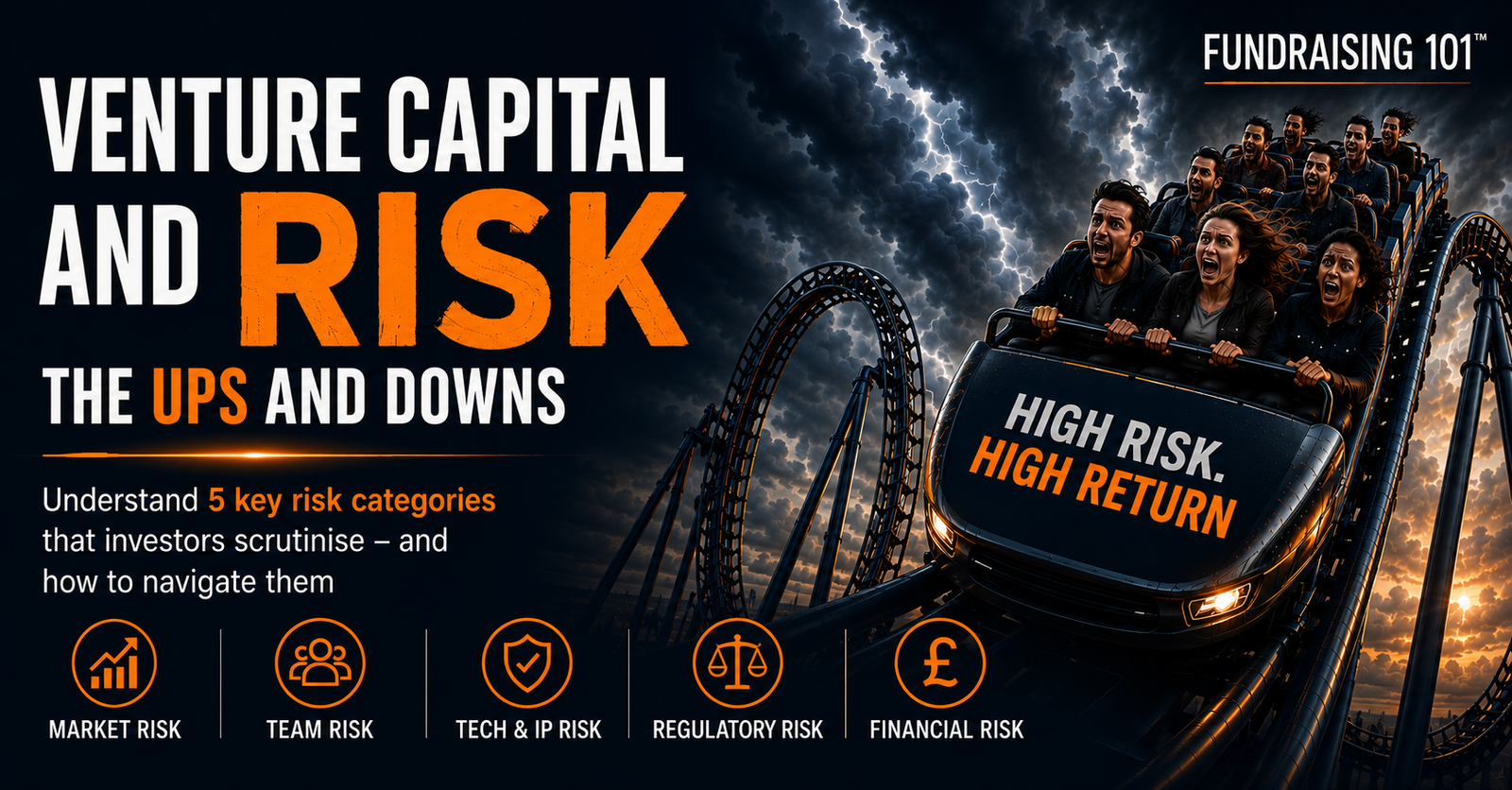
These five categories are not a sequential checklist. They interact. A weak team amplifies technology risk. A complex regulatory environment amplifies financial risk. Investors think about them as a system. You should too.
1. Market Risk
Market risk is the question of whether the problem is real, whether the market is large enough to justify a venture-scale return, and whether the timing is right.
US investors will reject on insufficient market size faster than almost anything else. UK and European investors are somewhat more willing to engage with smaller initial markets if the beachhead is credible and the adjacencies are clear. Indian investors want evidence of willingness to pay in the specific market segment. APAC investors want route-to-market detail in each territory.
The mistake I see constantly: founders confusing TAM with market opportunity. A large addressable market on a slide is not a market opportunity. Show me you know who your first hundred customers are, what it costs to reach them, and how that scales.
2. Team and Founder Risk
This is the category most experienced investors weight most heavily at pre-seed and seed. It’s not close.
The business model will change. The product will change. The market will evolve in ways none of you can predict. The team is what I’m actually investing in. When I look at a founding team I’m asking one question: are these the right people to navigate this specific opportunity? Not “do they have CVs I can show my LP advisory board,” but genuinely — do they have the knowledge, the resilience, and the self-awareness to take this from here to an exit?
UK and European investors scrutinise team completeness — whether the founding team covers the technical, commercial, and domain expertise the opportunity requires. American investors are more willing to back a single exceptional founder and trust the team will be assembled around them. Whatever the geography: gaps in the founding team are not disqualifying. Unacknowledged gaps are.
3. Technology and IP Risk
Technology risk asks whether the underlying technology works, is defensible, and — critically — is actually owned by the entity you’re raising into.
IP assignment is the most consistently under-addressed issue in early-stage fundraising. I have found this problem in diligence more times than I can count. IP developed before the company was incorporated, or by co-founders who have since departed, must be formally assigned to the company. Not “we’ll get to it.” Done. Before you raise.
Deep tech investors will spend significant time on technology readiness level, the patent landscape, and freedom-to-operate. This is particularly acute in biotech, medtech, cleantech, and defence tech. Asian corporate VCs are especially alert to IP that originated in academic institutions without clear commercial licensing in place.
4. Regulatory and Legal Risk
Regulatory risk is the most geography-specific of the five. US investors have historically treated regulatory complexity as a moat — a barrier that rewards first movers. European investors treat regulation as a cost and a constraint. UK investors, in the post-Brexit environment, face a dual compliance reality that is still evolving across financial services, data, healthcare, and food tech.
GDPR, AI Act compliance, FCA authorisation, CE/UKCA marking — these are not details for the appendix. Investors in regulated sectors want to see that you understand the regulatory pathway, have taken qualified legal advice, and have budgeted for compliance. Founders who treat regulation as something to deal with later create a specific category of risk that sophisticated investors price harshly.
Indian and APAC investors treat regulatory risk as table stakes. They will probe this early and probe it hard. Know the landscape before you walk in.
5. Financial and Capital Risk
Financial risk covers valuation, burn rate, runway, use of funds, and the path to the next milestone and the next raise. At pre-seed and seed, detailed modelling matters less than financial coherence. I want to know you understand your cost structure, your revenue model, and what the money you’re asking for will concretely achieve before you need more.
UK investors aligned with grant-funding ecosystems are comfortable with longer runways and more conservative deployment. US investors want to see aggressive growth trajectories. Across both geographies, the post-2021 market has tightened investor scrutiny on valuation multiples and milestone credibility considerably. If you’re still anchoring to 2021 valuations, you’re having harder conversations than you need to.
One thing consistently underweighted in founder presentations: the dilution pathway. Show me you’ve thought carefully about how many rounds are needed to reach profitability or a credible exit, what the dilution implications are at each stage, and whether the current round is sized correctly for what it’s actually trying to prove.
Founder Risk Checklist
Before your next investor conversation, work through this. Not as a box-ticking exercise. As an honest audit. If you can’t answer any of these confidently, that’s a signal. Fix the gap before the investor finds it.
Market
- Have you defined your beachhead market with enough specificity to name your first 100 customers?
- Is your TAM credible and evidenced, or is it a top-down number from a market research report?
- Can you articulate why now? What has changed to make this market winnable today?
Team
- Does the founding team cover the technical, commercial, and domain expertise the business requires?
- Have you named the gaps and explained how you’ll close them?
- Do all founders have formal employment or consultancy agreements in place with the entity?
Technology and IP
- Has all IP been formally assigned to the company, including work done before incorporation?
- Do you have freedom-to-operate in your key markets?
- If IP originated in a university or prior employer, is the licensing position clean and documented?
Regulatory and Legal
- Have you mapped the regulatory pathway for your product in each target market?
- Have you taken qualified legal advice on sector-specific compliance requirements?
- Is your corporate structure clean — correct share classes, up-to-date cap table, no undocumented agreements?
Financial
- Can you explain your burn rate and runway from first principles, without referencing a spreadsheet?
- Does your raise amount tie directly to a specific, measurable set of milestones?
- Have you mapped the full dilution pathway from now to exit or profitability?
EIS/SEIS — UK Founders
- Do you have EIS/SEIS advance assurance in place, or do you understand precisely why you may not qualify?
- Is your share structure compatible with EIS/SEIS requirements?
How to Include a Risk Register in Your Pitch Deck
Most founders avoid naming risk in their deck. Smart founders put it on the table. A one-slide risk register — done properly — is one of the most powerful credibility signals you can give an investor. I’ve been on the receiving end of thousands of pitches. The founders who named their risks clearly and explained how they were managing them stood out every time.
Here’s how to do it.
One slide only. Call it “Risks and Mitigations.” Investors won’t be alarmed. They’ll be impressed.
Four to six genuine risks. Not edge cases. The real ones. Market timing risk, technology development risk, key-person dependency, regulatory approval timelines, customer acquisition cost assumptions. The risks that, if they materialise, would meaningfully affect the outcome.
Likelihood and impact in plain language. You don’t need a formal matrix. “High likelihood, medium impact if it occurs” is enough. What I’m looking for is whether you’ve thought about it clearly, not whether you’ve built a risk register in a spreadsheet.
A mitigation for each. This is where you demonstrate operational competence. Not “we’ll hire a regulatory expert” — that’s a plan. The mitigation should be something you’ve already done or are actively doing. Examples:
- A letter of intent from a named customer — market risk mitigation
- A freedom-to-operate opinion from a patent attorney — IP risk mitigation
- A backup supplier already qualified and contracted — supply chain risk mitigation
- A regulatory pre-submission meeting already completed — approval risk mitigation
- A second technical co-founder or named CTO hire in process — key-person risk mitigation
Don’t include risks you’ve already solved. Those belong in the strengths section. The risk register is for genuine, live uncertainties with a coherent plan attached to each.
The message a well-constructed risk register sends is not that your company is risky. It’s that you are the kind of founder who can run a business. Operational competence is risk mitigation. Show it.
Three Things To Do With This
First: stop trying to convince investors your company has no risk. It does. Every company does. The conversation investors want is whether you understand your risk profile and have a credible plan to manage it.
Second: calibrate your pitch to the investor geography. A UK grant-backed accelerator investor and a San Francisco seed fund are not evaluating the same checklist. Presenting the same deck without adaptation is a structural mistake.
Third: get your legal and structural house in order before you raise. IP assignment, articles of association, EIS advance assurance, founder vesting schedules — investors find these issues eventually. Finding them in due diligence rather than upfront costs you credibility, time, and occasionally the deal.
Takeaways
- Risk is the product of venture capital, not the enemy of it. Present your risk honestly and your plan to navigate it credibly.
- UK and European investors apply higher governance and structural scrutiny than US counterparts. Get your legal house in order before you start raising, not after.
- US investors weight market size above almost everything else at early stage. If your TAM narrative isn’t compelling, the rest of the conversation won’t happen.
- APAC investors treat regulatory and market-entry risk as first-order concerns. Know the landscape before you pitch into those markets.
- The five risk categories — market, team, technology/IP, regulatory, and financial — are not a checklist. They interact. Investors think about them as a system.
- Unacknowledged risk is the most expensive kind. It doesn’t disappear from the investor’s mind. It just sits there, unaddressed, doing damage to your credibility.
- Valuation expectations have reset materially since 2021. Founders still anchoring to 2021 multiples are having harder conversations than they need to.
- The best founders in the room are not the ones with the fewest risks. They’re the ones who can look an investor in the eye and explain exactly what could go wrong — and why they’re the right team to handle it.
Additional Resources
UK Ecosystem and Investor Landscape
- BVCA (bvca.co.uk) UK VC activity, LP benchmarks, and industry reports
- British Business Bank (british-business-bank.co.uk) annual Small Business Finance Markets report
- UKBAA (ukbaa.org.uk) angel investment standards and EIS/SEIS guidance
- Dealroom (dealroom.co/reports) State of the UK Tech Nation data
EIS/SEIS and UK Compliance
- HMRC EIS Guidance (gov.uk/guidance/enterprise-investment-scheme-introduction)
- HMRC SEIS Guidance (gov.uk/guidance/seed-enterprise-investment-scheme-background)
- HMRC Advance Assurance (gov.uk/guidance/venture-capital-schemes-apply-for-advance-assurance)
Understanding VC Risk Frameworks
- Seedcamp (seedcamp.com/views) Carlos Espinal’s writing on risk/reward frameworks
- Balderton Capital (balderton.com) substantive founder resources on European fundraising
- Atomico State of European Tech (stateofeuropeantech.com) annual European VC dataset
Tools and Further Reading
- The Fundraising Field Guide (Carlos Espinal, Seedcamp) milestone-based fundraising
- Innovate UK (innovateuk.ukri.org) grant funding to reduce pre-seed dilution
- Fundraising101™ Academy (fundraising101.academy) Raise-Ready Deck Review and Blueprint Bundle
Get Raise-Ready.
Pre-seed tech founder? There’s a difference between deck-ready and Raise-Ready. We can hePre-seed tech founder in Scotland? There’s a difference between deck-ready and Raise-Ready. We can help you get there. Fast. With No BS. Visit fundraising101.academy.lp you get there. Fast. With No BS.