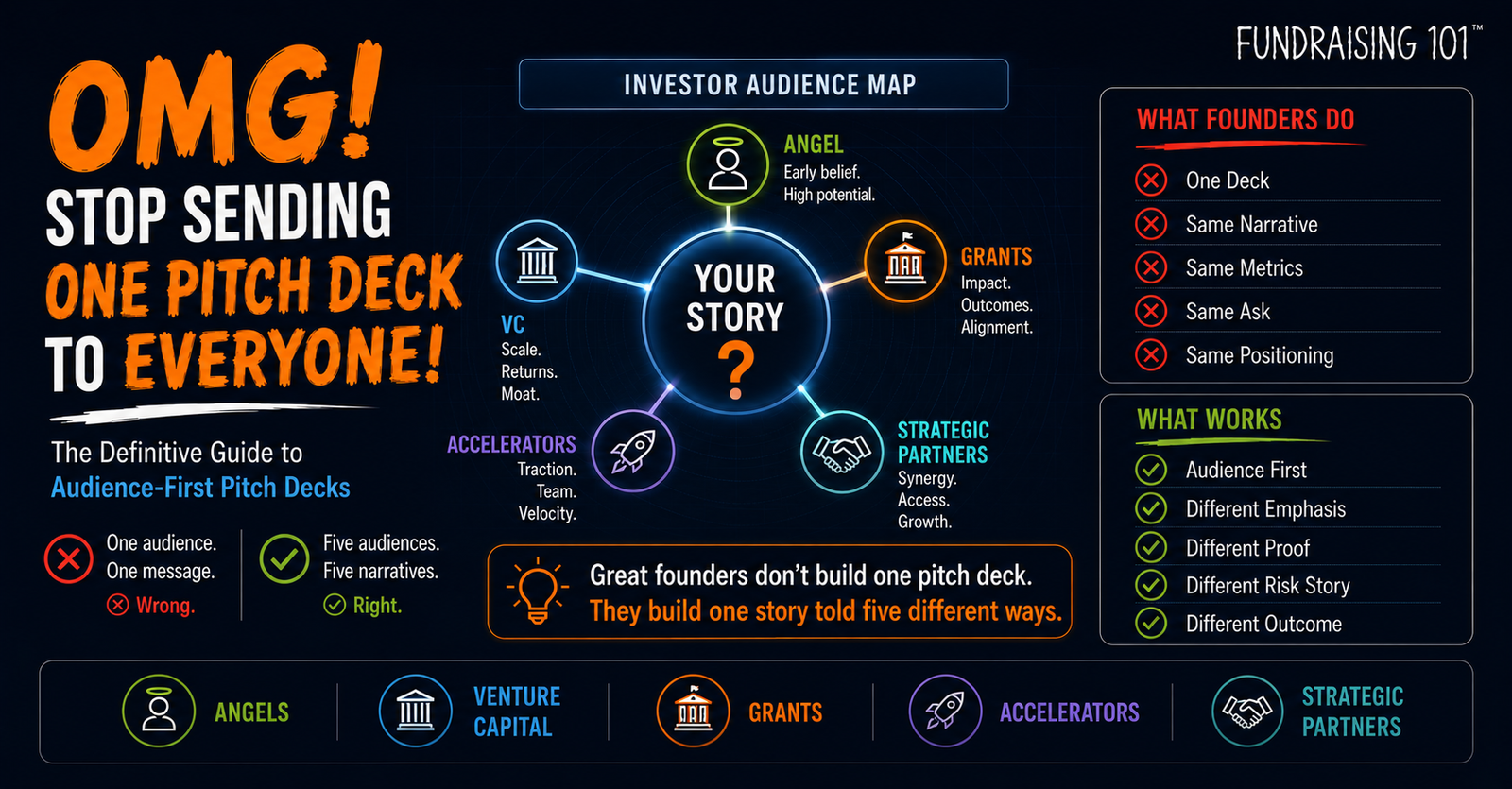
The Definitive Guide to Audience-First Pitch Decks

Written by
By Robert Hokin, Managing Partner, Fundraising101 Academy
First, a word on what not to do.
Did you know? Funds are now using AI to screen the tidal wave of inbound pitch decks landing in their inboxes every week. Founders scraping investor lists and blasting the same generic deck to hundreds of contacts, spray and pray, are not just wasting their own time. They are being filtered out automatically. I wrote about this in detail in The Fundraising Fatberg. Read this first.
But the answer is not more or fewer emails. It is about the right deck for the right investor profile.
There Is No Such Thing as a One-Size-Fits-All Deck
Different investors have completely different lenses and questions when they open your deck.
- A generalist VC wants market size and return trajectory.
- A sector specialist already knows your market and wants technical credibility.
- An angel wants to believe in you as a person.
- A grant body needs milestones and impact.
- A corporate strategic is thinking about bolt-on acquisitions.
Sending the wrong deck to the wrong audience gets you dismissed. Permanently.
The framework: build one master deck: your Source of Truth and then adapt it for each audience. The core facts never change. The emphasis, tone, and sequencing do.
The Six Deck Types Every Pre-Seed Founder Needs
- The Teaser Deck | 3 to 5 slides | Cold outreach, first touch
What it is: Not a pitch deck. An invitation to a conversation. Its only job is to get a reply.
What goes in it: one-sentence description of what you do, problem and solution simply stated, one proof point such as revenue, pilots, or letters of intent, your raise amount and stage, your email address. That’s it.
If it cannot be read on a phone in under 90 seconds, it is a pitch deck disguised as a teaser. No. Cut it down. - The Generalist Deck | 12 to 16 slides | SEIS/EIS funds, angel networks, regional VCs
What it is: Clear story. Plain language. No jargon. This audience has not specialised in your sector. They are making portfolio decisions across diverse industries. Or based on S/EIS.- Lead with the problem.
- Show market size built bottoms-up, not as a percentage of a vast TAM.
- Explain the business model simply.
- Make the ask concrete and milestone-driven.
- Write it for a smart person who has never heard of your industry.
- The Sector Specialist Deck | 12 to 16 slides | Cleantech, deeptech, sector VCs
This is where most founders make a catastrophic mistake: sending the Generalist Deck to a sector specialist.
They have seen 200 companies in your space. They know the problem. What they do not know is why you are technically superior to the other 12 they looked at this month. Lead with that.
Compress or cut the problem slides entirely. Lead with IP, technical differentiation, and sector-specific KPIs. Name the right validation partners and programmes. Show your technical advisors, not just your business advisors.
For a sector specialist, the competitor slide is your most important slide. Show them you know every company in your space and explain precisely why you win.
Quick pause here. If you are reading this and thinking: “I am not sure which version of the deck I actually have, or which version I need”, that is exactly the gap that The Fundraising 101 Raise-Ready Deck Review is designed to close. We review what you have, tell you what is missing, which investor types it is and is not suited for, and give you a 10-point action plan to fix it. Turnaround in five working days. Plus targeted funds to approach. No fluff. Email me or visit fundraising101.academy to find out more. - The Angel / HNWI Deck | 10 to 14 slides | Individual angels, angel syndicates
Angels back people, not portfolio theses. Their underlying question is not what is the return trajectory. It’s: do I believe in this person?
Lead with your origin story. Why are you doing this? What do you know about this problem that no one else does? Support it with early traction and recognisable social proof: advisors they know, customers they recognise, co-investors they respect.
Do not front-load an Angel Deck with five slides of market sizing. They want to believe in you first. The numbers support the person, not the other way around. - The Strategic / Corporate VC Deck | 12 to 16 slides | Corporate VCs, industry partners
Corporate VCs are making strategic bets, not pure financial ones. They want to know how you fit into their world: does this extend our product, reach a market segment we cannot reach ourselves, protect us from disruption, or make a good acquisition?
Open with the strategic alignment. Show the integration story. Reference their market positioning. Emphasise partnership potential alongside equity. If you can show that investing in you locks out a named competitor, you have turned a financial pitch into a strategic imperative. - The Grant / Programme Deck | Variable no. of slides | Innovate UK, Scottish EDGE, Converge, accelerators
Grant bodies are not investors. They are funders with mandates. Submitting your VC pitch deck to a Scottish EDGE application is a fast way to get rejected.
Replace the ROI narrative with an impact narrative: jobs, revenue, emissions, whatever aligns to the programme. Frame milestones as deliverables. Match the programme’s own language. Grant assessors are checking boxes. Make it easy for them to check yours.
Read the criteria. Then read them again. Then write to those criteria, not to your VC narrative.
One of the most common things we see in a Raise-Ready Deck Review is a founder who has built a solid Generalist Deck and is sending it everywhere, including to sector specialists and grant bodies where it simply will not land. A targeted review saves months of wasted outreach. Details at fundraising101.academy.
Build Once, Deploy Many
You do not need to build six decks from scratch. Build one master deck first.
It contains every slide you will ever need in its fullest form: the complete problem and solution narrative, full market sizing, product deep-dive, all revenue streams, complete traction data, IP and defensibility section, full team bios, three-year financials, impact slides, and a detailed use of funds.
From this, you select, reorder, and adapt for each audience. Core facts stay fixed. Emphasis, tone, and sequence change.
Quick Reference: the six decks at a glance
- Teaser | 3 to 5 slides | Lead with what you do and the ask | For cold outreach and first touch
- Generalist | 12 to 16 slides | Lead with the problem and market | For SEIS/EIS funds, angel networks, regional VCs
- Sector Specialist | 12 to 16 slides | Lead with technical differentiation | For cleantech, deeptech, sector funds
- Angel / HNWI | 10 to 14 slides | Lead with the founder story | For individual angels and syndicates
- Strategic / Corporate VC | 12 to 16 slides | Lead with strategic fit | For corporate VCs and industry partners
- Grant / Programme | Variable | Lead with innovation and impact | For Innovate UK, EDGE, Converge, accelerators
Six Rules That Apply to Every Deck
- One idea per slide. Investors scan, they do not read. If your slide is making two points, it is making zero.
- Data points over adjectives. Significant market opportunity means nothing. A 4.2 billion pound UK market growing at 18 percent CAGR means something. Specificity creates credibility.
- Your ask must be milestone-driven. We are raising 500k to complete clinical validation and extend runway to 18 months ahead of our Series A tells an investor everything. We are raising 500k tells them nothing.
- Team slide: relevant experience only. Nobody cares about the MBA from 2011. They care that your CTO built and sold a SaaS product, or that your CEO spent eight years at the company that will be your biggest customer.
- Build a reading version and a presenting version. A deck sent by email must stand alone. A deck presented live is a backdrop. These are different documents. Build both.
- Contact details on every deck, every time. A 2025 analysis of 17,500 pitch decks found 37 percent lacked an email address and 54% don’t list a website. That’s insane. Your name, email, and website on the cover slide and the last slide. No exceptions.
There is a difference between being investment-ready and being Raise-Ready. Investment-ready means you have a deck and a business plan. Raise-Ready means you have a fundraising process. Your deck, narrative, data room, and investor targeting are all calibrated for the specific investors you are approaching. And you can prove it.
The founders who raise at pre-seed are not necessarily the ones with the best product. They are the ones who did the work.
Six decks. One business. One raise. Get Raise-Ready.
Get Your Deck Reviewed — The Raise-Ready Deck Review
If this article raised questions about your own deck, consider contacting us for a Raise-Ready Deck Review. It’s not a coaching call or a general feedback session. It is a structured, forensic stress-test and review of your actual pitch deck, the one you are sending to investors right now.
Here is what you get. A full slide-by-slide RAG (red, amber, green) analysis identifying what is working, what is weak, and what is missing entirely. A gap analysis specific to the investor types you are targeting. A 10-point prioritised action plan. Guidance on raise structure and ask framing. A sift of more than 50 relevant funds and investors matched to your stage, sector, and geography.
Turnaround: five working days. Investment: £375. No VAT.
You will leave knowing exactly what your deck is saying to investors right now, and precisely what to change before you send it to another single fund.
To get started, email robert.hokin@fundraising101.academy with the subject line Deck Review, or visit fundraising101.academy. We’re here to help.
Robert Hokin is the Managing Partner of Fundraising101 Academy, Scotland’s pre-seed investment readiness coaching practice. He has coached over 500 ventures to raise millions in funding across 30 years of UK venture capital experience.
fundraising101.academy | robert.hokin@fundraising101.academy
Get Raise-Ready. Pre-seed tech founder in Scotland? There is a difference between deck-ready and Raise-Ready. We can help you get there. Fast. With No BS. Visit fundraising101.academy.