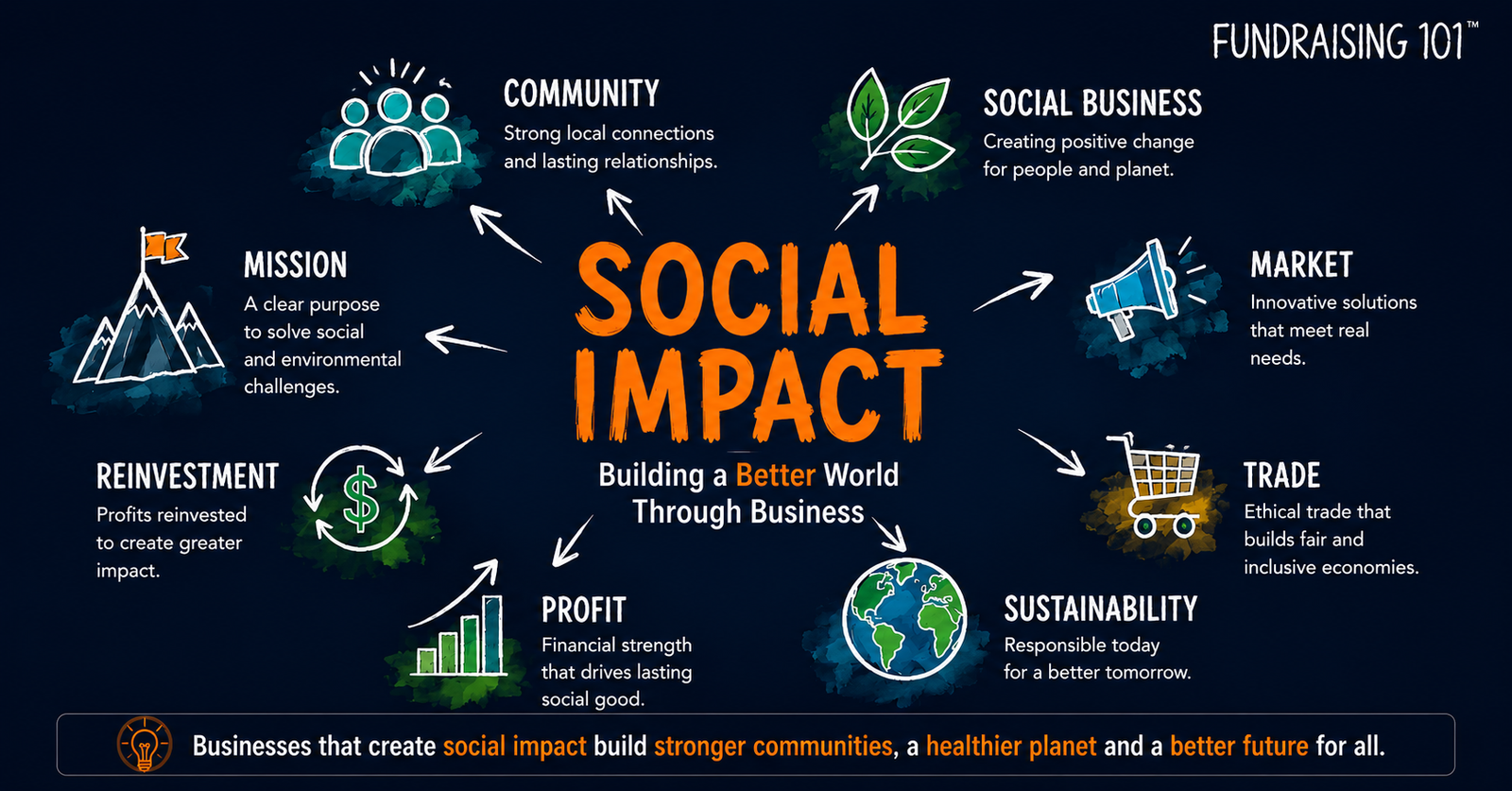

By Robert Hokin, Managing Partner, Fundraising101
First, Let’s Define What We’re Actually Talking About
If you’ve described your business as “purpose-driven,” “social impact,” “mission-led,” or “ESG-aligned”, you’re not alone. And you’re probably also aware that these terms mean different things to different people, including the investors you’re trying to reach.
This isn’t semantics. It has direct, material consequences for which capital you can access, which investors will take your call, and how your pitch lands in a room.
So before we cover the funding landscape, we need to address the terminology problem, because the industry itself hasn’t solved it, and that confusion will cost you time and credibility if you don’t navigate it deliberately.
The Terminology Stack … And Why It Matters
The investment world uses these terms, frequently interchangeably. They are not interchangeable.
Purpose-driven business
The broadest and loosest category. A company with an explicit mission or set of values that shapes how it operates. This covers everything from a B Corp-certified SaaS company to a community employment programme running as a social enterprise. The term implies intentionality but says nothing specific about what outcomes are being generated or how they’re measured. Most investors do not treat “purpose-driven” as a fundable category on its own. It is not an investment thesis. It is a disposition.
ESG (Environmental, Social & Governance)
A risk and disclosure framework originally designed for large listed companies. ESG measures how a business operates — environmental footprint, labour practices, supply chain ethics, board diversity, governance structures. Critically, ESG is about operational process, not product or service outcomes. A fossil fuel company can have excellent ESG scores while still extracting oil. As Morrison Foerster noted in their 2025 ESG analysis, the debate is “plagued by confusion over nomenclature” — with critics of ESG often conflating it with impact investing, claiming that it is, by definition, concessionary. It isn’t. But the conflation misleads founders who think a good ESG posture qualifies them for impact capital.
Impact investing
Capital deployed with the intention to generate measurable positive social or environmental outcomes alongside financial returns. Key word: measurable. The GIIN (Global Impact Investing Network), the global standards body, requires that impact claims be intentional, measured, and reported. Impact investing is a broader category than social impact investing and includes environmental outcomes: climate, biodiversity, clean energy…alongside social ones.
Social impact investing
A subset of impact investing with a direct, intentional focus on generating measurable benefits for people and communities: poverty alleviation, education access, healthcare, affordable housing, financial inclusion, economic participation for marginalised groups. This is the most tightly defined of the four categories, and the most directly relevant for founders building products or services that directly serve underserved people and communities.
Where Confusion Gets Costly
The lack of a universally accepted definition of impact is one of the main causes behind both greenwashing and impact washing. Mission-driven concepts of ESG, SRI, and impact investing are frequently lumped together despite having different goals and metrics. Every impact investment fund has its own proprietary process for defining and evaluating impact; and without a consistent standard, firms can cherry-pick what to report, or opt out of reporting altogether.
Which creates a two-directional risk for founders.
‘Impact washing’ really is a thing
Overstating or loosely claiming social impact without the measurement infrastructure to back it. Impact washing can be a deliberate misrepresentation, an embellishment, or simply a mistake caused by inadequate measurement. Experienced impact investors have seen every version. Vague claims without evidence do not attract capital. They damage credibility with the investors who matter most.
So is impact washing from investors
Not every fund that calls itself an “impact fund” has earned the label. Some are ESG rebrands. Some are standard commercial funds with a sustainability narrative attached. Pitching a genuinely social-impact business to one of these is a category mismatch — you will spend months in a process only to be told they “couldn’t make the numbers work.” Vetting investors for genuine impact rigour is as important as vetting your business model.
So: What Is a Social-Impact Tech Business?
For the purposes of this article — and for positioning your business to the right investors — a social-impact business is one where:
- The product or service itself generates a measurable positive outcome for identifiable beneficiaries: people, communities, or ecosystems.
- The impact is intrinsic, not incidental — removing it would change the core commercial proposition, not just the marketing copy.
- The scale of impact grows proportionally with the scale of the business — this is what separates a scalable social-impact business from a service organisation with a fixed capacity ceiling.
- Outcomes can be tracked, even if measurement frameworks are still being built.
This is materially different from a commercial business that operates ethically, donates a percentage of revenue, or has a good ESG score. Those things matter and they are not the same thing.
When you frame this correctly, you are not a social enterprise that needs to apologise for wanting commercial returns. You are a business with a structural commercial advantage. Your impact is your moat. Put simply, impact-washing is about looking good, while genuine impact criteria are about proving good.
The Capital Is There…if You’re in the Right Conversation
Globally, the GIIN’s State of the Market 2025 report, based on 429 institutions across 54 countries, recorded impact AUM growing at 21% CAGR over six years, with an 11% increase in the past year alone. Global impact investing AUM hit $1.6 trillion in 2025, with nearly half a trillion ($448bn) accounted for.
In the UK, social impact investment reached £11.2bn at end-2024, the most recent published figure, up 10% year-on-year, and a 13-fold increase since 2011. The 2025 data isn’t out yet, but the trajectory is clear. This is not a niche.
In Scotland specifically: since its launch in 2020, the Scottish National Investment Bank has committed £991 million, unlocking over £1.4 billion in additional funding. Social Investment Scotland’s total active loans and investments for the year to March 2025 topped £52.5 million among 216 ventures. The capital exists. The problem is mismatch — founders pitching the wrong type of capital, at the wrong stage, in the wrong structure, with impact framing that does not hold up under scrutiny. All of that is fixable.
The Mistake That Costs The Most: Equity Errors at Pre-Seed
Before we map the landscape, equity mistakes deserve to come first — because the damage is often irreversible.
Early Dilution
Giving away 30–40% at pre-seed for a small cheque is a structural error that haunts every subsequent round. Future investors look at the cap table before they look at the deck. If founders are already at 50% equity before Series A, institutional investors get uncomfortable about alignment and control — and they price the risk accordingly.
Rule of thumb: Keep founder dilution below 25% cumulatively at pre-seed. SEIS rounds should be 10–20% maximum. Every percentage given away cheaply at this stage costs five times as much at Series A.
Mispriced Rounds
Valuation at pre-seed is part art, part narrative. Common errors: accepting any offer without understanding what the post-money implies for future rounds; failing to model the full dilution waterfall before signing. If you don’t know what a fair pre-money valuation looks like for your stage, sector, and geography — find out before you walk into the room.
Shares Without Proper Terms
No shareholders’ agreement. No vesting schedule. No reserved matters clauses. This is a timebomb. Investors at later stages will reprice the risk — or walk away entirely. If you are raising equity, governance must be right from day one, not tidied up later.
Misaligned Investors — The Impact-Specific Risk
This is the most emotionally painful mistake in the social-impact space, and it deserves its own heading.
A commercially-oriented investor who does not genuinely understand or care about your impact thesis will apply constant, reasonable-sounding pressure to compromise social objectives in favour of revenue metrics. Each individual decision looks sensible. Cumulatively, they transform a social-impact business into a standard commercial one. This is mission drift in its most structurally embedded form — and it is very hard to reverse once a board seat has been granted.
The time to assess alignment is before you take the money. Ask every potential investor:
- What do you need to see in year three?
- How have you handled a portfolio company where mission and margin conflicted?
- What’s your exit thesis for a company like ours?
- Have you backed a social-impact business before — and what happened to the impact at exit?
Their answers — and how quickly they find them — tell you more than any term sheet.
When to Say No to Capital
This is undercoached. The ability to decline the wrong capital is as important as the ability to close the right round. Turn capital down when:
- The repayment timeline is shorter than your revenue ramp — this guarantees distorted decision-making under pressure.
- The investor’s exit horizon conflicts with your mission permanence goals (a VC needing a 5-year exit from a company built to last 50 years is a structural incompatibility, not a negotiation point).
- The equity price is so low it will cripple your cap table for future institutional rounds.
- Grant conditions require activity that diverts from your core commercial strategy.
- The investor does not understand social enterprise structures, CIC asset locks, or impact reporting requirements.
- You are taking capital because you are scared, not because it strategically moves the mission forward.
There is no rule that says you must take the first cheque offered. The founders who build the strongest social-impact companies are almost always the ones who are selective about who they allow onto their cap table.
The Full Funding Landscape
Here is every capital type available to Scottish social-impact founders — whether you are operating as a Ltd company or a social enterprise. The right capital depends on your legal structure, your stage, and how tightly your impact is embedded in the commercial model.
Grants
Available to both Ltd companies and social enterprises at early stage. Non-dilutive, slow, and restrictive — but critical at pre-revenue stage for de-risking your model before approaching equity investors. Key sources: Scottish Enterprise, Innovate UK, Scottish EDGE (up to £100k, open to social enterprises), Converge, Wellcome Trust, NatureScot, IBioIC (bioeconomy and circular economy tech).
Watch out: Grant dependency is a red flag for investors. If 60%+ of your income is grant-funded, institutional capital becomes very hard to access. Grants should enable commercial revenue, not substitute for it.
Concessionary Debt and Social Loans
Loans at below-market rates, specifically designed for mission-led organisations. Social Investment Scotland (SIS) lends £25k–£875k to social enterprises, charities, CICs, and mission-led businesses. 33% of their loans are under £50k — this is genuinely accessible early-stage capital for trading organisations often invisible to commercial lenders. Also relevant: NatWest Social Enterprise fund, CDFIs (Community Development Finance Institutions), Virgin Money Foundation.
Watch out: Debt requires repayment regardless of revenue trajectory. Not appropriate for pre-revenue businesses.
Angel Investment
The primary route for early-stage equity for Scottish founders. Primarily for Ltd companies, though CICs can access SEIS investment in some structures — verify with an accountant before pitching. Key networks: LINC Scotland (national angel trade body), Archangels (Scotland’s largest and oldest syndicate — tech and life sciences focus), Par Equity, Equity Gap (Edinburgh-based SEIS/EIS syndicate), Investing Women (female-led angels, female founder focus).
Watch out: Warm introductions are 10x more effective than cold outreach. The Scottish angel community is small, and back-channel reputational checks happen before any formal process begins.
Venture Capital
For Ltd companies with demonstrably scalable, high-growth models. The return expectation is 10x in 5–7 years. If your business is designed for permanence rather than exit, traditional VC is structurally misaligned — and that is a legitimate strategic choice, not a failure. Active Scottish and Northern England funds: Par Equity, Epidarex Capital (life sciences), Kelvin Capital, Techstart Ventures, Praetura Ventures, Seedcamp (UK-wide, early stage).
Watch out: Mission drift risk is highest with traditional VC. If your social impact is a genuine constraint on the commercial model, make that explicit in term sheet negotiations — not as a footnote.
Impact Investment
The most relevant capital category for social-impact founders — and, as covered above, the most confused. Impact investment spans a wide return spectrum, from concessionary (below-market returns accepted for mission primacy) to full market-rate funds where social outcomes are genuine co-benefits rather than marketing.
Know exactly where on this spectrum your target fund sits before you walk in:
- Concessionary / social-first — below-market returns (3–7%). Needs: social impact evidence, governance, repayment capacity.
- Impact-first VC — market-adjusted returns (8–12%+). Needs: scalable model, measurable outcomes, financial returns with impact co-benefit.
- ESG / impact-aligned — full commercial return. Impact reporting and SDG mapping are hygiene factors, not the primary thesis.
Key sources: Scottish National Investment Bank (£1m–£50m equity, debt and hybrid — TRL 8+ in most cases), Nesta Investments (health, education, economic inclusion), Bridges Fund Management (sustainable growth, growth stage), Resonance (community investment), Better Society Capital (wholesale funder — access via their intermediary networks, not directly to founders).
Revenue-Based Finance (RBF)
One of the most underutilised funding options for social-impact businesses generating recurring revenue. Repayments are tied to a percentage of monthly revenue — no fixed repayment schedule, no equity dilution, no personal guarantees. For mission-driven founders uncomfortable with dilution but generating consistent subscription or SaaS-type revenue, RBF is a genuinely powerful tool that most never explore.
How it works: you receive a capital advance, then repay a fixed percentage of monthly revenue until the agreed total is returned (typically 1.3–1.5x the advance). When revenue is high, you repay faster. When revenue dips, repayments slow accordingly. No investors on your cap table. No board seats. No exit pressure.
Watch out: RBF is growth capital, not survival capital. You need consistent, recurring revenue to qualify — typically £10k+ monthly recurring revenue at minimum. It is not appropriate for pre-revenue or highly variable revenue models. And the effective cost of capital (expressed as a flat fee rather than an interest rate) can be higher than it initially appears — compare carefully.
UK providers:
- Uncapped (London) — £100k–£10m; SaaS, subscription and e-commerce businesses; no equity, no personal guarantees; 3–5 day approval
- Outfund (London) — £10k–£2m; e-commerce and subscription businesses; revenue share repayment; fast approval
- Clearco (London / Toronto) — e-commerce and consumer app businesses; capital advances against marketing and inventory spend
- Pipe (London / New York) — subscription and SaaS businesses; integrates with billing systems; non-dilutive capital against recurring revenue
- Capchase (London / Madrid) — SaaS-focused; non-dilutive financing and revenue acceleration; trusted by 4,000+ companies
- YouLend (London) — SME-focused; flexible repayment tied to card and revenue streams; often accessed via banking and e-commerce platform partners
- Liberis (London) — embedded revenue-based finance; works via partner platforms; e-commerce and hospitality focus
- 365 Finance (London) — UK-based RBF and merchant cash advances for SMEs; £5k–£400k; fast, flexible, no fixed repayments
EU providers accessible to UK businesses:
- Re:cap (Berlin, Germany) — SaaS and subscription businesses across Europe including UK; non-dilutive; integrates with billing and accounting tools
- Viceversa (Milan / London) — digital businesses; revenue-based financing combined with marketing analytics; UK accessible
Concessionary Debt and Social Loans
Loans at below-market rates, specifically designed for mission-led organisations. Social Investment Scotland (SIS) lends £25k–£875k to social enterprises, charities, CICs, and mission-led businesses. 33% of their loans are under £50k — this is genuinely accessible early-stage capital for trading organisations often invisible to commercial lenders. Critically, concessionary lenders do not require commercial revenue multiples. They require a trading model and a credible repayment capacity assessment. That is a very different bar.
Watch out: Debt requires repayment regardless of revenue trajectory. Not appropriate for pre-revenue businesses. And multiple lenders mean multiple reporting requirements — manage the overhead carefully.
UK concessionary social lenders:
- Social Investment Scotland (SIS) (Edinburgh) — £25k–£875k; below-market rates; SocEnts, charities and CICs across all 32 Scottish local authorities
- Access — Foundation for Social Investment (London) — blended finance and concessionary loans; £20k–£500k; charities and SocEnts in England
- Big Issue Invest (London) — Engage Fund (£20k–£400k); Social Impact Debt Fund IV (£500k–£4m); 600+ organisations funded since 2005
- CAF Venturesome (London) — unsecured loans £50k–£1m at 5.5% for charities and SocEnts; 700+ investments since 2002
- Charity Bank (Tonbridge, Kent) — specialist savings and loans bank for charities and social enterprises; £50k–£2m
- Key Fund (Sheffield) — loans and quasi-equity for social enterprises in Northern England and Yorkshire; £10k–£500k
- Northstar Ventures / North East Social Investment Fund (Newcastle) — loans £50k–£400k for social enterprises across the North East
- NatWest Social & Community Capital (London) — loans £10k–£150k for charities and social enterprises in underserved communities
- Resonance (Bristol) — community investment, social housing and impact lending; £100k–£2m
- Social and Sustainable Capital (SASC) (London) — social investment fund manager; health, housing, employment; £500k–£5m
- Social Investment Business (SIB) (London) — manages multiple grant and loan programmes for charities and social enterprises across the UK
- Unity Trust Bank (Birmingham) — ethical commercial loans for social enterprises, charities, unions and co-operatives
- ART Business Loans (Birmingham) — finance for social enterprises and businesses in underserved areas of the West Midlands
- Bristol & Bath Regional Capital (Bristol) — regional social investment for the South West; concessionary terms for mission-led organisations
EU providers accessible to UK social enterprises:
- Triodos Bank UK (Bristol — UK branch of Netherlands bank) — mission-aligned loans and bonds for established trading organisations; £500k+; one of very few ethical banks lending in the UK
- LGT Venture Philanthropy (Zurich, Switzerland / London) — capacity-building grants and patient capital for high-impact social enterprises; UK office; £50k–£500k
- European Investment Fund (EIF) / InvestEU (Luxembourg) — provides guarantees and equity products to UK intermediaries via qualifying UK lenders; access through SIS, Charity Bank and other UK social lenders
- Innpact (Luxembourg) — social finance platform and blended finance structurer; manages vehicles accessible to UK social enterprises via intermediary arrangements
“The options beyond VC and grants are quite rich. Most founders don’t know they exist because nobody tells them.”
Crowdfunding
Works well for community-rooted, B2C products and services where the crowd is also the customer or beneficiary base. Requires significant marketing effort, and a failed public campaign is highly visible. Platforms to consider: Crowdfunder (rewards and donations), Ethex (ethical equity and bonds — accessible for both Ltd and social enterprise), Abundance Investment (project and green bonds), Triodos Bank (ethical bonds and loans for established trading organisations).
Watch out: A community crowd is not a lead investor. Use crowdfunding to complement an institutional round — not as a substitute for one.
Blended Finance
Grants layered with concessionary loans, designed for organisations straddling the grant/commercial divide. Often the right solution for social-impact businesses at early growth stage that cannot yet access commercial capital at scale. Key facilitators: Access — Foundation for Social Investment, SIS, Power to Change, UnLtd (social entrepreneur awards at very early stage).
Watch out: Multiple funders means multiple reporting timelines, multiple impact frameworks, and significant management overhead. Powerful tool; genuinely demanding in practice.
Ltd vs. Social Enterprise: Structure Follows Strategy
The right legal structure depends on which capital you need and when — not on how you feel about the company. Here is the practical breakdown:
- Equity investors: Ltd — standard angels, VC, EIS/SEIS. Social enterprise — very limited; asset lock restricts equity returns.
- SEIS/EIS access: Ltd — yes, most tech sectors. CICs can qualify for SEIS; verify with HMRC.
- Grant access: Ltd — possible but harder, seen as commercial. Social enterprise — often preferred by grant funders.
- Debt finance: Ltd — standard commercial terms. Social enterprise — SIS specialises here; concessionary rates available.
- Mission protection: Ltd — relies on founder control and board governance. Social enterprise — asset lock and articles of association legally protect mission.
- Exit options: Ltd — trade sale, MBO, IPO. Social enterprise — limited; asset lock constrains exit proceeds.
- Impact measurement: Ltd — voluntary. Social enterprise — often required by funders (SROI, ToC, IRIS+).
The conversion question: Can you move from CIC to Ltd if you want equity? Yes — but it takes 3–6 months, requires CIC regulator approval, carries legal costs of £5k–£15k, and you lose grant-access advantages. Model the capital implications before you incorporate, not after.
Capital by Stage: What Works When
- Pre-MVP, no revenue: Right — grants, EDGE, Converge, founder capital. Wrong — VC, bank debt, equity angels.
- MVP / Early Traction (£0–£100k ARR): Right — SEIS angels, grant co-investment, impact seed funds. Wrong — institutional VC, large debt.
- Growth / PMF (£100k–£1m ARR): Right — EIS Series A angels, impact VCs, revenue-based financing. Wrong — pure grant dependency.
- Scaling (£1m+ ARR): Right — VC, SNIB, institutional impact funds, growth debt. Wrong — crowdfunding, grants.
- Mature Social Enterprise (established trading): Right — SIS loans, social bonds, patient capital, Triodos. Wrong — traditional VC.
What Investors Won’t Tell You
After 30 years in UK venture capital, here is the version you don’t usually hear on stage.
The first meeting is about you, not the deck.
Investors make a preliminary decision in the first ten minutes. The deck justifies what they have already decided. Energy, clarity, conviction, and intellectual honesty matter more than slide design.
“No” usually means “not yet.”
Most pass responses are really “not at this stage” or “come back with more traction.” Investors rarely say this directly because they don’t want to create an obligation. Ask them directly: is this a permanent pass or a timing issue?
They’re talking to your references before they call them.
The Scottish investment community is small. Back-channel calls happen before the formal process begins. Your reputation in the ecosystem precedes every pitch.
The cap table is reviewed before the financials.
A messy cap table — early advisors at 5%, departed co-founders at 15%, no vesting — is a deal-killer at diligence stage.
Impact measurement is now table stakes, not a differentiator.
“We have social impact” means nothing to a serious investor. They want a Theory of Change, measurable outcomes, and evidence of impact achieved — not just intended. IRIS+ metrics, SROI, SDG mapping. Qualitative stories matter but they do not replace data.
The co-investment model is how Scotland works.
SNIB, Scottish Enterprise, HIE, and SIS all primarily co-invest alongside private capital. Having a private lead investor — even a modest one — dramatically increases your chances of unlocking public co-investment. Come with a lead committed, not a blank ask.
The best social-impact investments don’t need the label to be commercial.
The strongest portfolio companies are the ones where the social or environmental outcome is the commercial moat — not a marketing layer applied to a standard business model. If you need to explain why your impact makes commercial sense, you may not yet have the model right.
Common Mistakes: The Full List
Grant dependency
Grants are powerful at the right stage and genuinely dangerous when they replace commercial revenue rather than enable it. Investors — including impact investors — are wary of businesses where grant income dominates. Not scalable, not bankable, and exit becomes nearly impossible.
Mission drift
It rarely happens in one decision. Twelve small pivots, each individually reasonable, collectively transform a social-impact business into a standard commercial one. Warning signs: impact measurement is the first thing cut in a down round; grant funders start withdrawing because “the mission has changed.”
Conflating your impact narrative with your commercial narrative
These are related but distinct. Your investment pitch needs a credible financial return thesis. Your impact case supports it — it does not substitute for it. Investors who are confused about which type of return you are offering will not invest.
Choosing structure based on sentiment rather than strategy
Some founders set up as a CIC because it feels right without modelling the capital implications. Others stay as Ltd and miss the grant access and concessionary finance available to social enterprises. Structure is a strategic tool, not an identity statement.
Raising too little — or too much
Too little: you run out before hitting the milestones that justify the next round. Too much: unnecessary dilution and a valuation problem for the following round. The raise amount should be milestone-defined — enough to reach the specific inflection point that de-risks the next cheque.
Being deck-ready instead of Raise-Ready
A polished deck is not the same as being ready to raise. Raise-readiness means: knowing your numbers cold, having a clear use-of-funds narrative, understanding your valuation, having a due diligence data room ready, knowing your right-to-approach investor list, and being able to answer hard questions without flinching.
Resources
Scottish Funding Bodies
- Converge (Edinburgh) — University spin-out focused; cash prizes and support
- Highlands & Islands Enterprise (HIE) (Inverness) — Grants, loans, account management for the H&I region
- IBioIC (Glasgow) — Bioeconomy and circular economy funding and matchmaking
- Postcode Innovation Trust (Edinburgh) — Subsidised loans for asset-locked social enterprises in Great Britain via People’s Postcode Lottery
- Scottish EDGE (Glasgow) — Grant + loan competition; up to £100k; open to social enterprises
- Scottish Enterprise (Glasgow) — Smart grants, R&D co-investment, innovation support
- Scottish National Investment Bank (SNIB) (Edinburgh) — Equity, debt, hybrid; £1m–£50m; net zero, place and wellbeing missions
- Social Investment Scotland (SIS) (Edinburgh) — Loans £25k–£875k; concessionary terms; all 32 Scottish local authorities
- Techscaler (Glasgow) — National scale-up programme, no equity taken
UK-Wide Impact Capital & Specialist Funds
- Abundance Investment (London) — Green bonds, project bonds and clean energy investment; retail-accessible impact bonds
- Access — Foundation for Social Investment (London) — Blended finance for charities and SocEnts; £20k–£500k; £87.5m dormant assets allocation confirmed 2025
- Arkbound Foundation (Bristol) — Social justice publishing and creative economy investment; grants and social investment for mission-led creative businesses
- ART Business Loans (Birmingham) — Finance for businesses and social enterprises in underserved areas of the West Midlands
- Ascension Ventures (London) — SEIS/EIS seed fund; impact focus including Fair by Design; £250k–£1m
- Barrow Cadbury Trust (Birmingham) — Social investment aligned with social justice aims; criminal, gender, racial and economic justice
- Better Society Capital (London) — UK social impact wholesaler deploying via intermediary funds; 2026–30 strategy targets £20–30bn mobilised
- Bridges Fund Management (London) — Sustainable growth, social property, impact venture; growth stage; £2m–£15m
- Bristol & Bath Regional Capital (Bristol) — Regional impact investment; channels capital to increase social, economic and environmental benefit
- British Business Bank (Sheffield) — Government-backed; funds via intermediaries including social enterprise lenders; also ENABLE guarantees
- CAF Venturesome (London) — 700+ investments since 2002; unsecured loans £50k–£1m at 5.5% for charities and SocEnts across UK
- Charity Bank (Tonbridge, Kent) — Specialist savings and loans bank for charities and social enterprises; £50k–£2m
- Clean Growth Fund (London) — Early-stage cleantech; UK government-backed; £500k–£2m for seed and Series A clean technology companies
- Esmée Fairbairn Foundation (London) — £45m social investment fund; nature, fairer future, creative communities; impact-first loans and equity
- Ethex (Oxford) — Ethical equity and bond crowdfunding; accessible for both Ltd and social enterprise
- Finance Earth (London) — Environmental and nature impact investment; manages Big Nature Impact Fund (£90m)
- Figurative (Arts & Culture Finance) (London) — Specialist loans for arts, culture and heritage organisations; £150k–£1m
- Fredericks Foundation (London) — Flexible finance for social enterprises and charities with potential for scalable impact and financial sustainability
- Generation Investment Management (London / Washington DC) — Long-only sustainable equity and growth equity; co-founded by Al Gore; global mandate; £14bn+ AUM
- Impetus (London) — Private equity-style approach to charities supporting young people into education and employment
- Joseph Rowntree Foundation (York) — Mission investment alongside grantmaking; poverty in the UK; patient capital and programme-related investment
- Key Fund (Sheffield) — Social investment specialist for Northern England and Yorkshire; £10k–£500k loans and quasi-equity
- Lloyds Bank Foundation (London) — Grants and development support for small/medium charities tackling disadvantage across England and Wales
- National Wealth Fund (London) — New UK government vehicle; green industrial transition; blended finance for major infrastructure and climate investment
- NatWest Social & Community Capital (London) — Loans to charities and social enterprises in underserved communities; £10k–£150k
- Nesta Investments (London) — Health, education, economic inclusion; seed to Series A; £250k–£2m
- Northstar Ventures (Newcastle) — North East Social Investment Fund; loans to social enterprises; £50k–£400k
- Outward VC (London) — Impact-led VC (formerly Investec INVC); diverse founders; seed to Series A
- Palatine Private Equity (Manchester) — ESG-integrated UK mid-market PE; impact reporting and sustainability-focused portfolio management
- Power to Change (London) — Community business funder; grants and loans for businesses owned and run by communities
- Resonance (Bristol) — Community investment funds, National Homelessness Property Fund; £100k–£2m
- Schroders BSC Social Impact Trust (London) — Listed investment trust investing in UK social impact funds; FTSE-listed access to the social impact market
- Social and Sustainable Capital (SASC) (London) — Social investment fund manager; health, housing, employment; £500k–£5m
- Social Finance UK (London) — Designs and manages social impact bonds and outcomes-based contracts; key ecosystem player
- Social Investment Business (SIB) (London) — Grant and loan programmes for charities and social enterprises; manages multiple specialist UK-wide funds
- Triodos Bank UK (Bristol) — Mission-aligned loans and bonds; established trading organisations; £500k+
- Trust for London (London) — Social investment £50k–£1m; flexible, low-cost loans; poverty and inequality focus in London
- UnLtd (London) — Social entrepreneur awards and early-stage support; very early-stage non-dilutive
- Unity Trust Bank (Birmingham) — Ethical bank for social enterprise, charities, unions and co-operatives; commercial and social enterprise loans
- Wellcome Trust (London) — £433m deployed in 15 fundraisings; health and life sciences innovation; awards, equity and grants
- Zouk Capital (London) — Leading sustainability-focused PE; cleantech and resource efficiency; £606m invested across 19 companies
Big Issue Invest — Family of Funds
Since 2005, Big Issue Invest (London) has invested over £100m in 600+ social-impact organisations across the UK, deploying £9.4m in 2024/25 alone. Their family of funds spans multiple stages and sectors:
- Engage Fund (London) — Loans £20k–£400k for social-impact organisations in England at earlier stage
- Growth Impact Fund (London) — Equity and loan finance for diverse-led organisations tackling inequality; in partnership with UnLtd
- North East Social Investment Fund (Newcastle) — Loans £50k–£400k for socially trading organisations in the North East
- Outcomes Investment Fund (London) — £10m fund investing in Social Outcomes Contracts; charities and SocEnts delivering government-commissioned services
- Power Up London (London) — Accelerator and grant programme for early-stage organisations supporting underrepresented communities in Greater London
- Social Impact Debt Fund IV (London) — £500k–£4m secured loans; health and social care, affordable housing, community infrastructure; established trading organisations
Angel Networks (Scotland)
- Archangels (Edinburgh) — Scotland’s largest and oldest angel syndicate; tech and life sciences focus
- Equity Gap (Edinburgh) — Edinburgh-based SEIS/EIS angel syndicate
- Investing Women (Edinburgh) — Female-led angels and female founder focus
- LINC Scotland (Glasgow) — National angel network trade body; links to syndicate groups across Scotland
- Par Equity (Edinburgh) — Scottish VC with angel co-investment; tech and life sciences focus
- TechScaler Angel Network (Glasgow) — Angel connections for Techscaler portfolio companies
EU Funds & Institutions (Investing in UK)
Post-Brexit, EU structural funds no longer flow directly into UK businesses. However, the following European institutions and fund managers actively invest in UK social-impact organisations, or deploy via UK-based intermediaries that accept their capital:
- Ananda Impact Ventures (Munich / Amsterdam) — Impact VC for social entrepreneurship; seed to Series A; active in UK through European impact networks
- Bamboo Capital Partners (Geneva, Switzerland) — Global impact investing platform; blended finance specialist; healthcare, financial inclusion, clean energy; UK and European mandate
- BlueOrchard Finance (Zurich, Switzerland / London) — Impact investment manager; $10bn AUM; microfinance, financial inclusion and climate; London office with UK activity
- Eurazeo Impact (Paris, France) — ESG-integrated private markets; impact investment mandate across European growth companies including UK
- European Investment Fund (EIF) / InvestEU (Luxembourg) — Provides guarantees and equity products to intermediaries financing UK and EU social enterprises; access via qualifying UK lenders and fund managers
- Finance in Motion (Frankfurt, Germany) — Development finance specialist; manages impact funds across Europe with environmental and social mandates
- Goodwell Investments (Amsterdam, Netherlands) — Social impact VC for inclusive economies; some UK and European social enterprise investment
- Impact Europe (formerly EVPA) (Brussels, Belgium) — European network for venture philanthropy and impact investing; connects UK social investors with European capital and knowledge
- Innpact (Luxembourg) — Social finance platform; manages blended finance vehicles for European and UK social enterprise; impact bond structuring
- LGT Venture Philanthropy (Zurich, Switzerland / London) — Capacity building and patient capital for high-impact social enterprises; UK office; £50k–£500k range
- Phenix Capital Group (Amsterdam, Netherlands) — Impact fund advisory and intermediary; manages Impact Summit Europe series; connects European institutional investors with fund managers deploying in UK
- Quadia (Geneva, Switzerland) — Sustainable and impact investment management; European mandate; access via intermediaries for UK opportunities
- Top Tier Impact (TTI) (Global / London chapter) — 600+ active members and 25,000+ subscribers across 50+ countries and 30+ city chapters including London. Operates TTI Investing ($800m+ facilitated), TTI Advisory and a private member network. Members include Permira, Octopus Ventures and NY State Common Retirement Fund. Annual UK events: TTI Nature & Biodiversity Investing Summit and TTI at London Climate Action Week
- Triodos Investment Management (Zeist, Netherlands) — €5.5bn AUM across energy transition, food systems, financial inclusion and impact equities; 750+ direct investments globally including UK
North America (Global Mandate — UK-Accessible)
The following North American funds and foundations either actively invest in UK social-impact businesses, deploy capital globally through UK-accessible vehicles, or are ecosystem leaders whose capital and standards shape global impact investing. UK founders should know these names.
- Acumen (New York, NY) — Non-profit impact fund; patient capital in businesses tackling poverty; Africa, Asia, Latin America and Europe; fellows programme with UK participation
- Bain Capital Double Impact (Boston, MA) — Private equity with social and environmental co-value; portfolio includes UK-accessible European investments
- Calvert Impact (Bethesda, MD) — Community Investment Notes providing retail access to impact capital; intermediary model deploying to social enterprises including UK entities via wholesale partners
- Capricorn Investment Group (Palo Alto, CA) — Founded 2000; manages approximately $9bn for Jeff Skoll, the Skoll Foundation and others; Technology Impact Fund, Growth Fund and Sustainable Investors Fund; invests across public equity, private equity and real assets globally including UK climate and impact companies
- Chan Zuckerberg Initiative (Palo Alto, CA) — LLC structure enabling grants and investments; science, education, housing and criminal justice; global reach including UK research and social innovation
- Emerson Collective (Palo Alto, CA) — Laurene Powell Jobs’ LLC; education, immigration, environment, health; for-profit and non-profit investments globally
- Ford Foundation (New York, NY) — Mission-aligned investing; $1bn+ in mission investment since 2017; equality and inclusive economies; UK civil society and social enterprise investments
- KKR Global Impact Fund (New York, NY) — $1.3bn fund targeting climate, sustainable living, lifelong learning, inclusive growth; global PE with UK portfolio companies
- MacArthur Foundation (Chicago, IL) — “Just Imperative” impact investment strategy; criminal justice, housing, climate; some UK investments via global programme
- New Profit (Boston, MA) — Venture philanthropy; invests in social entrepreneurs addressing systemic barriers; US-anchored but global knowledge exchange
- Omidyar Network (Redwood City, CA) — Hybrid foundation and LLC; dual checkbook for grants and impact investments; focus on equitable technology; UK investments via global portfolio; ∼$100m annual social investment
- Rockefeller Foundation (New York, NY) — Major programme-related investments and impact investments globally; zero carbon, food systems, health equity; UK and global mandate
- RSF Social Finance (San Francisco, CA) — Transformational finance for regenerative food, climate and equity; US-anchored but global connections and knowledge sharing
- Skoll Foundation (Palo Alto, CA) — Jeff Skoll’s foundation; ∼$1.5bn endowment managed by Capricorn; awards to social entrepreneurs; UK and global grantmaking; Skoll World Forum held annually in Oxford
- TPG Rise Fund (Fort Worth, TX) — World’s largest institutional impact platform; growth equity and climate strategies; UK portfolio companies include Koru Kids; global mandate; rigorous impact methodology via Y Analytics
Impact Measurement Frameworks
- B Impact Assessment — B Corp certification pathway and free diagnostic tool
- Good Finance — Grant and loan finder specifically for social enterprises and charities
- IRIS+ (GIIN) — Global standard for impact measurement metrics
- SDG Compass — Mapping business activities to the Sustainable Development Goals
- Social Investment Business Access Point Directory — Comprehensive UK fund and funder directory updated regularly
- Social Value UK / SROI — Social Return on Investment methodology and guidance
- Theory of Change — Free templates and facilitation guidance
Key Reports
- Better Society Capital: 2024 UK Social Impact Market Sizing
- GIIN: Sizing the Impact Investing Market 2024
- GIIN: State of the Market 2025 — Trends, Performance and Allocations
- Impact Investing Institute: UK Market Size Report 2024
- SIS Impact Report 2024/25
- SNIB Investment Strategy 2025–2026
- Social Enterprise UK: State of Social Enterprise 2025
Events
- Impact Investor Global Summit 2026 19–20 May 2026 — The Brewery, London.
- TTI Nature & Biodiversity Investing Summit Annual — June, London, during London Tech Week. Next edition: June 2026.
- Social Enterprise Summit Scotland 2026 17 June 2026 — Apex Hotel, Dundee.
- TTI at London Climate Action Week 2026 Annual — late June/early July, London. Next edition: June/July 2026.
- Oxford Sustainable Finance Summit 2026 29 June 2026 — Rhodes House, Oxford.
- Impact Investing World Forum 2026 (ESG-IIWF) Date TBC, 2026 — London.
- Impact Seminar Series 2026 — UK Edition Date TBC, 2026 — London.
- SOCAP26 12–14 October 2026 — Convene Willis Tower, Chicago, USA.
- GIIN Impact Forum 2026 27–29 October 2026 — Amsterdam, Netherlands.
- Impact Summit Europe 2026 Already held: 14–15 April 2026, Amsterdam. Pre-register now for the 2027 edition.
- Skoll World Forum Already held in 2026: 21–24 April 2026, Oxford. Next edition: 6–9 April 2027, Saïd Business School, Oxford.
Purpose-driven founder in Scotland? There’s a difference between deck-ready and Raise-Ready. We can help you get there. Fast. With No BS. Visit fundraising101.academy.
Get Raise-Ready.