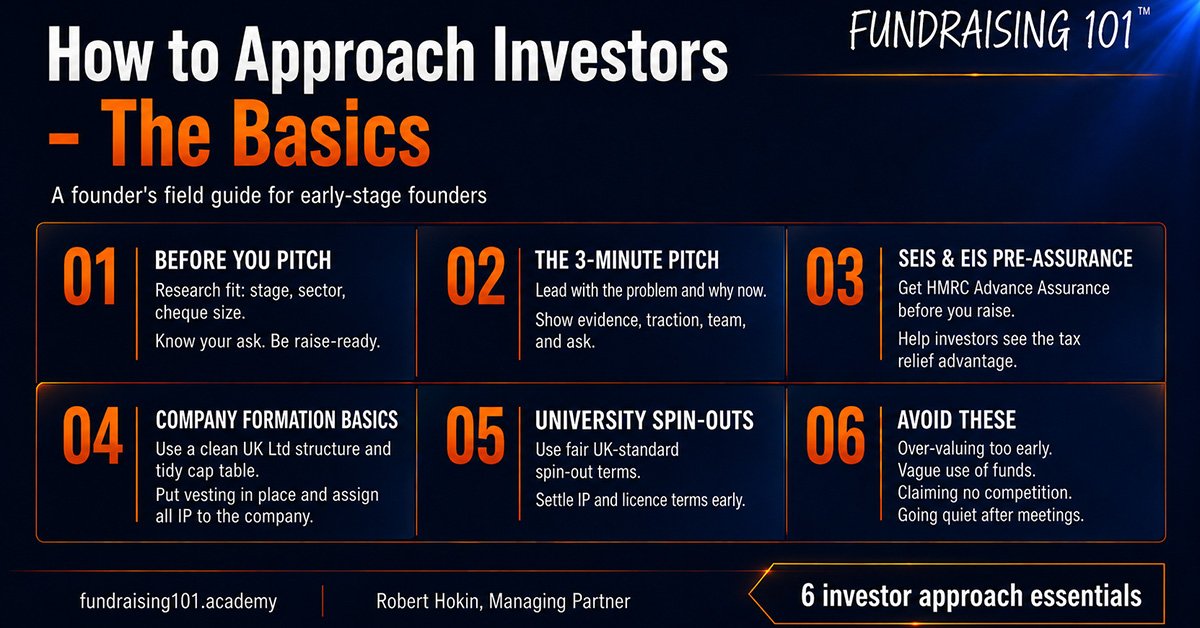
A founder’s field guide

By Robert Hokin, Managing Partner, Fundraising101
Why this matters
Founders can lose the room in the first minute. Not because the idea is weak, but because they pitch the technology instead of the problem, and ask for money before they’ve earned the right to. This is the short version of what I’ve learned over thirty years of watching it happen: the marks investors actually score against, and the housekeeping that has to be right before anyone writes a cheque.
It’s not a script, it’s a checklist for your back pocket. Some for your three minutes on the podium; the rest, SEIS, company formation, clean cap table, is the unglamorous groundwork that decides if a “yes” or “tell me more” survives due diligence. Investment-ready (is the business investable) and raise-ready (can you actually run the raise) are not the same thing. Get both right and the conversation gets easier. Read this before pitching; then after to work out what to fix.
1. BEFORE YOU PITCH
- Investors back people first, then market, then product, so be someone they’d bet on.
- Research each investor: stage, sector, cheque size and portfolio; don’t knock the wrong door.
- Be raise-ready, not just deck-ready; evidence and a credible plan beat polish.
- Know your ask: how much, for which milestones, and what it buys them.
- Lead with the problem and “why now”, not the technology.
2. THE 3-MINUTE PITCH
- Cover only: problem, solution, market, traction, team, ask.
- Show evidence, not adjectives: users, pilots, revenue, letters of intent.
- One clear sentence on what you do and why you’ll win.
- Name your risks first; investors trust founders who do.
- Close with a specific ask and a clear next step.
3. SEIS & EIS PRE-ASSURANCE
- SEIS gives your angels 50% income tax relief, a big reason UK investors say yes.
- Get HMRC Advance Assurance before you raise; it de-risks the cheque.
- SEIS: up to £250k lifetime; under 3 yrs trading, <25 staff, <£350k gross assets.
- Investor cap £200k/yr; shares held 3 years; then EIS (30% relief) for bigger rounds.
- Apply with your deck, plan, and details of investors you’re talking to.
4. COMPANY FORMATION BASICS
- Incorporate a UK Ltd with a clean, simple share structure of ordinary founder shares.
- Put founder vesting and a shareholders’ agreement in place early.
- Keep the cap table tidy; messy or over-diluted tables kill deals.
- Assign all IP into the company so you own what you’re selling.
- Use proper legal infrastructure (e.g. FounderCatalyst); don’t DIY the paperwork.
5. UNIVERSITY SPIN-OUTS
- Follow the USIT Guide (TenU), the UK standard for fair, fast spin-out deals.
- Software spin-outs: founders keep 90-95%; the university takes a small minority.
- Push for an exclusive licence and a clean, quick deal; avoid heavy royalties.
- Settle IP and licence terms before you fundraise; unresolved ownership stalls rounds.
- Work with the tech-transfer office, but negotiate; ask “is this within normal boundaries?”
6. AVOID THESE
- Over-valuing too early, or asking too much for too little.
- Vague use of funds and no clear milestones.
- Claiming you have no competition.
- Pitching features instead of outcomes.
- Going quiet after the meeting; follow up within 48 hours.
Free Mini Deck Review
Send us your pitch deck for a no-cost, Raise-Ready scan. Honest, actionable feedback from F101.