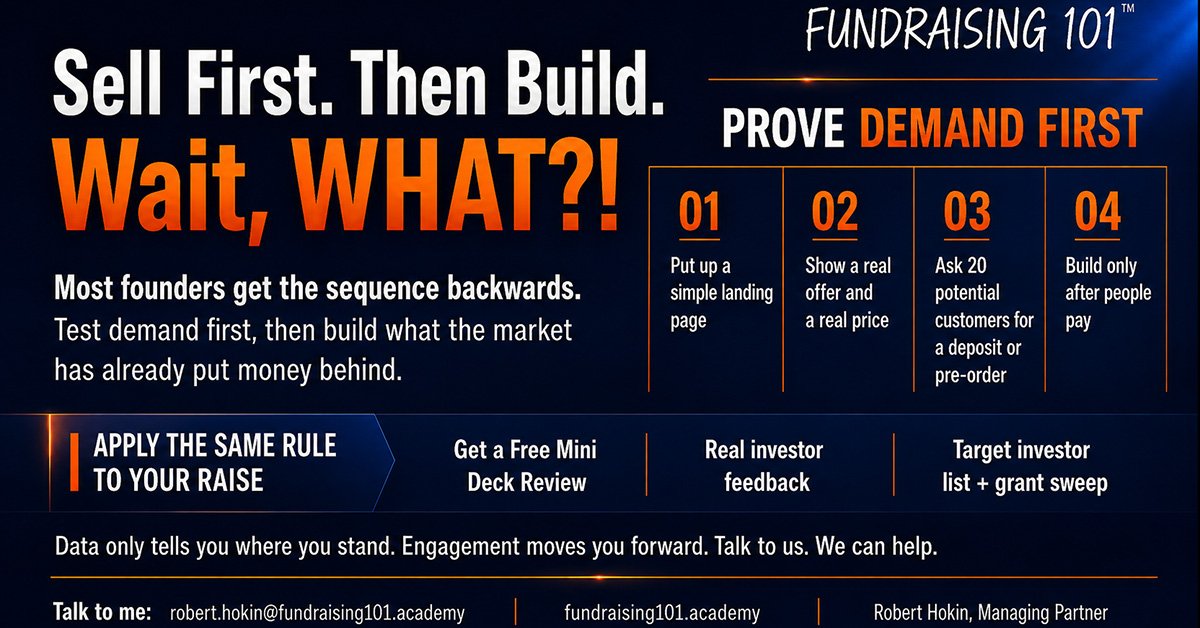
You heard me. Most founders get the sequence backwards. They build the product, then go looking for someone to sell it to. Wrong. Flip it.

By Robert Hokin, Managing Partner, Fundraising101
Why? So you don’t pour six months into a “perfect” product and reach the end only to find nobody will pay for it. Ask the harder question on day one: what’s the cheapest test that proves a real person wants this?
Not “would you use it?” Not a waitlist five thousand names long, that proves nothing, because signing up costs nothing. Only one question counts: will someone actually pay?
So run the experiment.
Put up a simple landing page. Show what it does. Attach a real price. Have conversations with 20 potential customers. Then ask for a deposit, or a pre-order. Then watch what happens.
Nobody buys? Okay. Good. You’ve just spent a few hundred pounds for what would otherwise have cost you six months and a hundred grand. Change something: the offer, the market, or the problem itself. Then test again.
People paying before the product is even finished? Now you’ve got something real.
Stop being precious about your idea and get ruthless about testing it. The founders who win aren’t the ones who call the market right from the start. They’re the ones who find their wrong turns sooner, and cheaper, than everyone else.
Get the demand signal first. Then build what the market has already put money behind.
Apply the same rule to your raise. Most founders perfect their deck in isolation, then fire it cold at their best investor contacts and burn those introductions finding out what was wrong. That’s you building first and selling later, all over again.
That’s the Fundraising 101 Mini Deck Review. I read your actual deck and send back an initial scan: a real investor telling you, plainly, what they think and where it’s losing them. No charge, no scorecard, no algorithm.
Because plenty of programmes will hand you data: a readiness score, a template, a red-amber-green dashboard. Data tells you where you stand. But it doesn’t move you an inch. What moves you is ENGAGEMENT. A person who has sat on the other side of the table, reading your deck and giving it to you straight.
If the scan shows there’s something worth building on, we go deeper. The forensic review is the paid step: a line-by-line teardown, a targeted investor list matched to your stage and sector, and a grant sweep to surface the non-dilutive money most founders leave on the table. Scoped to what you actually need, and then we talk it through.
Remember. Sell first, then build. Then test the deck for nothing with us, then decide how far to take it.
Talk to me: robert.hokin@fundraising101.academy | fundraising101.academy