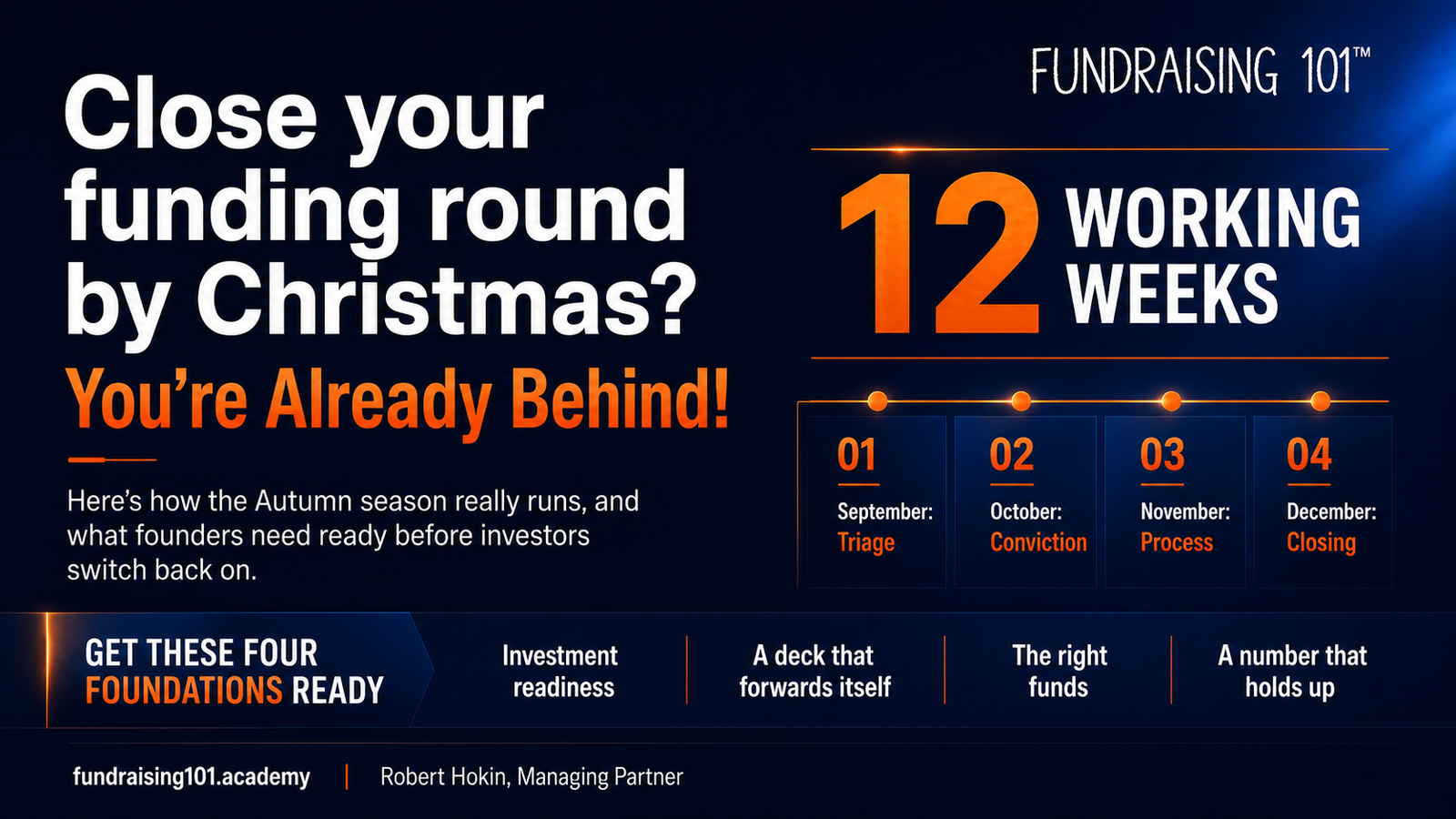
The autumn raise is twelve dedicated working weeks at the least. Here’s how the season actually runs, and what you need in your hands before investors switch back on.

By Robert Hokin, Managing Partner, Fundraising101
There’s a document being written this week that decides your entire autumn, but you’ll never see it.
Not a term sheet, but a handful of company names sitting in a fund partner’s notes app while they’re still on August holiday, but deciding who’s worth proper attention when they’re back at their desk. Nothing formal. Nothing you can influence once it’s written. But it’s the most important list in your fundraise, because it splits September into the founders who get real engagement and the ones who get politely managed until the door quietly closes.
To a founder, autumn is the starting line. To an investor, it’s the back half of a shortlist they began drawing up before July.
I’ve spent more than thirty years on the investor side of the table, and raised as a founder before that. Of course there are exceptions, but here’s a pattern I’ve watched hold, year after year: the rounds that close in December almost never came in cold in the autumn. The relationship started earlier. Usually, a LOT earlier.
Not four months. Twelve weeks.
There are pretty much only two windows in the year when money moves: September to early December, and January to June. The rest of the year is housekeeping.
The autumn window has a shape, and it isn’t spread evenly across the four months.
September is triage. Partners come back to a full pipeline and an empty diary, so a meeting costs them nothing and they’ll take plenty. Hardly anyone gets a term sheet this month. What’s really happening is that each partner is drawing up a watchlist.
October is conviction. Second meetings, partner discussions, the quiet reference calls you’ll never hear about. By the end of the month, most partners have privately settled on the one or two deals they’re prepared to fight for internally.
November is process. Diligence, committee, terms, lawyers. Nobody’s still looking in November; they’re building the case for a choice they already made in October.
December is closing. The signed deals go over the line in the first week, then the whole industry goes dark until mid-January, which restarts everything with a clean slate and no memory of the email you sent in November.
Two mistakes I see every single autumn
Letting the bank balance start the raise instead of the calendar. Most founders begin when their cash position starts to frighten them, which is the worst possible trigger, because fear is visible and investors price it. The calendar should set your start date, and your runway should have been stretched to meet it. If you need money in the bank by December, that decision had to be made 10 months prior.
Quitting six weeks in, right before it works. DocSend found failed raises were abandoned after about 6.7 weeks on average; the successful ones ran twelve or more. Six weeks from a September start is mid-October, which is precisely when conviction is forming on the other side of the table, and precisely when silence feels most like a no. The founders who get through that fortnight are the ones who started with the route mapped and treated the silence as expected, not as an answer.
So, honestly, where are you?
Four questions. Answer them straight, not generously.
- Could you write down the actual partners you’re targeting, by name, not just the firms, right now?
- Has anyone credible put your name in front of an investor in the last month or two?
- If a partner asked for your data room this afternoon, could you send the link before dinner?
- Do you know exactly what you’re raising, at what price, and why that price holds up in their model?
Four or more ‘yes-es’ and September is genuinely yours; go and enjoy it. One or two and you’ve got a fortnight to fix the rest. None, and this autumn is your preparation season and January is your raise. That’s not a failure. It’s the single most valuable decision on the table this month, and it’s worth more than another week spent nudging boxes around your deck.
The four questions the season really turns on
Underneath all of it sit four questions, and founders usually answer them the expensive way, by burning real meetings to find out.
1. Are you fundable at the round you’re going for? This is investment readiness: do the signals match the stage. Investors rarely pass on a single weak metric; they pass because the overall shape doesn’t fit the stage, and that resolves to “not yet” in a partner’s head. Starting a raise six months early is the costliest mistake in this game, and in a twelve-week window it’s fatal.
2. Will your deck survive the first thirty seconds and travel without you? A partner spends three or four minutes on a deck and forwards two or three slides internally. Those slides are the real product, not the deck. If nothing in yours is forwardable, your deal can’t move through the firm without you in the room, and a deal that can’t travel can’t reach a committee.
3. Are you targeting funds that can actually say yes? Stage, sector, cheque size, geography: four gates, all invisible from the outside, all absolute. Sit outside a fund’s band and the conversation was over before it began, and nobody will tell you. They’ll just be slow. Sixty-six well-chosen names close a round. Sixty-six hopeful ones start you again in January.
4. Is your number one that survives their model? “What are you raising at?” turns up in every second meeting. Most founders guess, or anchor high and hope confidence carries it. Investors aren’t guessing: they work backwards from an exit value to the ownership they need, then price your round to produce it. If you don’t understand that maths, you’re negotiating blind in the exact month the decision is being taken.
Get those four right and you’ve done the season: fundable at the stage, a deck that forwards itself, the right funds in your sights, and a number that holds up. Questions one is investment readiness. Two, three and four are raise readiness: actually running the campaign. Both have to be true.
Free offer: plenty of people will sell you data. We’ll give you engagement.
That’s the Fundraising 101 Mini Deck Review. I read your actual deck and send back an initial scan: a real investor telling you, plainly, what they think and where it’s losing them. No charge, no scorecard, no algorithm.
Because plenty of programmes will hand you data: a readiness score, a template, a red-amber-green dashboard. Data tells you where you stand. But it doesn’t move you an inch. What moves you is ENGAGEMENT. A person who has sat on the other side of the table, reading your deck and giving it to you straight.
If the scan shows there’s something worth building on, we can go deeper. The forensic review is the paid step: a slide-by-slide teardown, a targeted investor list matched to your stage and sector, and a grant sweep to surface the non-dilutive money most founders leave on the table. Scoped to what you actually need, then we’ll talk it through. Engagement.
Talk to me: robert.hokin@fundraising101.academy | fundraising101.academy