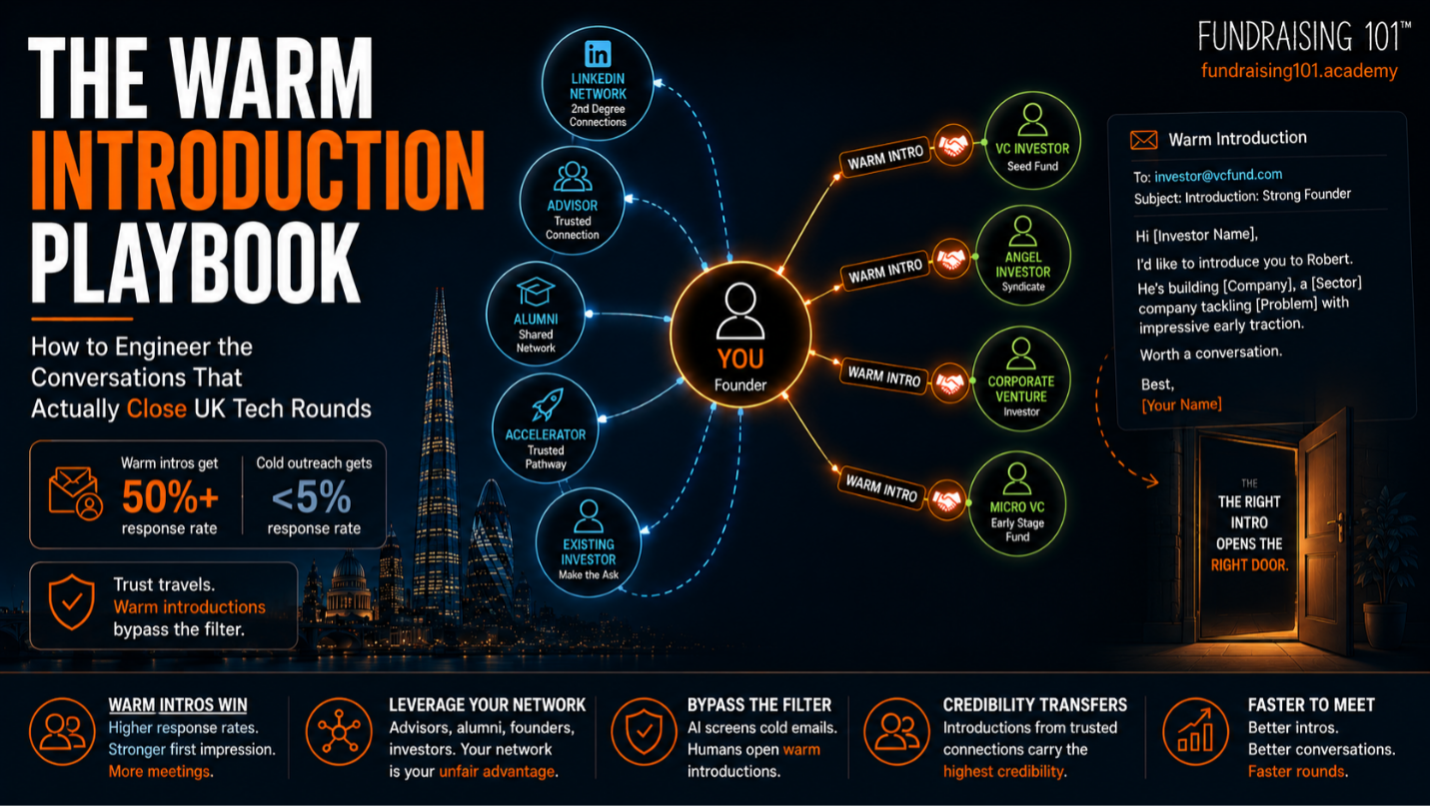
Engineer the Conversations That Actually Close UK Tech Rounds

By Robert Hokin, Managing Partner, Fundraising101
Why This Matters
The founders who raise most quickly are almost never the ones who sent the most emails. They are the ones who engineered the right conversations through the right people. Warm introductions. Systematic, deliberate, prepared.
Venture capital is a people business. It always has been. Most investment decisions at pre-seed stage are made on the basis of trust, and trust starts with a credible introduction from someone the investor already respects. Cold outreach to UK VC funds generates response rates below 5%. Warm introductions generate response rates above 50%. That arithmetic is decisive.
But here is what most founder guides miss: the warm introduction is not just a tactics question. It is an architecture question. Building the introduction infrastructure that powers a successful raise takes months, not weeks. Founders who start mapping their introduction pathways on the day they decide to raise have already made a significant strategic error.
The AI Fatberg Has Made Warm Introductions Non-Optional
Something structural has changed in the past eighteen months. The flood of AI-generated cold pitches now overwhelming fund inboxes has fundamentally altered the economics of cold outreach.
Fund managers and analysts at UK seed and pre-seed funds are now reporting volumes of inbound they simply cannot process. The response to that has been predictable: automation. Funds are deploying AI screening tools to filter cold submissions at scale. The human who might have opened your cold email in 2022 is now seeing a small fraction of inbound. The rest is being screened, sorted, and in most cases discarded before anyone with a cheque book sees it.
I call this the AI Fatberg. A dense, immovable blockage of AI-generated content choking the fund inboxes that founders used to be able to reach. It is not clearing. It is growing.
The warm introduction bypasses the fatberg entirely. It does not arrive in the cold inbound channel. It arrives via a trusted person the investor knows, often directly to their calendar. It carries something no AI-generated pitch can replicate: the social capital of a human being the investor actually trusts.
The warm introduction is not just a better way to reach an investor. In 2025 and beyond, for most founders, it is the only reliable way through the front door.
This raises the stakes considerably. It means that building your introduction network is not a nice-to-have activity alongside your fundraising process. It is the fundraising process. Everything else — deck quality, financial model, pitch preparation — is contingent on getting the conversation started. And in the current environment, the conversation only reliably starts with a warm introduction.
What a Good Warm Introduction Looks Like From the Other Side of the Table
I spent over thirty years evaluating investments and sitting in the rooms where introduction decisions are made. Let me tell you what actually happens when a warm introduction lands.
The investor receives the introduction email. Before they read a word of your pitch, they look at one thing: who sent it. They are asking a single question — do I trust this person’s judgement? If the answer is yes, they read on with positive intent. If the answer is uncertain, they read on with scrutiny. If the introducer is someone they barely know, the introduction carries little more weight than a well-targeted cold email.
The next thing they notice is whether the introducer actually knows you, or is just forwarding something on. The language of the introduction reveals this immediately. “I’m forwarding this as [founder] asked me to” is not an endorsement. “I’ve worked with [founder] for the past year and the progress they’ve made in six months is genuinely impressive” is an endorsement. The difference is legible in seconds.
What investors do not want from a warm introduction:
- A mass introduction to six founders at once, diluting the signal of each
- An introduction where it’s clear the introducer barely knows the company
- A pitch deck attached to the first message before any interest has been expressed
- A long pitch narrative in the introduction email itself — the introduction is not the pitch
- An introduction that requires the investor to do significant work to understand why they’re being approached
What investors do want:
- A short, credible endorsement from someone whose judgement they respect
- A clear one-line description of what the company does
- An obvious reason why this specific investor is relevant — stage, sector, thesis alignment
- A simple ask: a 20-minute call, not a commitment, not a meeting, not a ‘chance to explore a partnership’
- An easy out — the best introducers say ‘happy to take no for an answer and it won’t be awkward’ because it preserves the relationship whatever the outcome
The introductions that convert to meetings fastest are the ones that do the least work for the investor. Short, specific, easy to act on, easy to decline.
The Introducer Hierarchy: Not All Introductions Are Equal
Before you start mapping your introduction pathways, apply a quality filter. An introduction from a founder in the investor’s own portfolio is worth approximately ten introductions from LinkedIn contacts. The hierarchy matters. Here it is, ranked.
| Tier | Introducer type | Why it carries weight | Watch out for |
|---|---|---|---|
| 1 | Portfolio founder | The investor has already backed them. Their judgement is validated by the investment relationship. The highest-trust signal available. | Portfolio founders are protective of their relationships. Earn it before you ask for it. |
| 2 | Co-investor or LP | These are the investor’s own partners in deals or fund backers. The professional relationship is deep and the trust transfer is strong. | Requires you to have existing investors or access to LP networks. |
| 3 | Respected operator or executive | Senior figures the investor has worked with or watched build something. Carries real weight if the relationship is active. | Operational seniority alone doesn’t create investor trust — the relationship has to be genuine. |
| 4 | Accelerator / programme director | Programme directors at Techscaler, Converge, EDGE, Entrepreneur First have built sustained investor relationships. Their introductions carry institutional credibility. | Only if the relationship is current and active. A historical connection two programmes ago carries less weight. |
| 5 | Fellow founder (peer cohort) | Founders who have been through the same accelerator or programme have peer credibility. Less powerful than a portfolio founder but still meaningfully above zero. | Peer introductions work best when the fellow founder has real conviction, not just goodwill. |
| 6 | University / research connection | Particularly relevant for deeptech and spinout founders. University TTO and commercialisation contacts often have established investor relationships. | Variable quality. Some TTOs have strong investor networks; others have surface-level contact lists. |
| 7 | Professional intermediary | Brokers, advisers, and consultants who introduce as their primary value proposition. Investors know they are doing it for everyone and discount accordingly. | High volume, lower signal. Use only when higher-tier options have been exhausted. |
| 8 | LinkedIn second-degree contact | Technically warm, functionally cold in most cases. The investor may not actively trust the shared connection. | Can be upgraded if you cultivate the shared connection into a genuine relationship first. |
The practical implication: spend 80% of your introduction-building effort on Tiers 1–4 and treat Tiers 5–8 as secondary channels, not primary ones.
The Double Opt-In: The Step Most Founders Skip
The double opt-in is the professional standard for a quality introduction — and most founders have never heard of it.
Here is how it works. Before the introducer connects you to the investor, they first check with the investor that they are willing to receive the introduction. They send a brief message: ‘I’m working with a founder in [sector] who is raising [round size] and I think you’d find the conversation interesting. Happy to make the introduction if you’d like me to.’ Only if the investor says yes does the introduction happen.
Why does this matter?
- It protects the introducer’s relationship with the investor. A cold introduction — even a warm one — can feel presumptuous if the investor wasn’t expecting it.
- It creates an investment of attention from the investor before they’ve even heard from you. They have already said yes to the conversation.
- The response rate from a double opt-in introduction is materially higher than a standard warm introduction, because the investor has already signalled interest.
- It is a mark of professionalism that experienced introducers and investors notice.
When you ask someone to introduce you, ask them to use the double opt-in. Give them the language to make it easy. Something like: ‘Would it be okay to suggest a brief check-in with [investor] before making the formal introduction? I want to make sure it’s a conversation they’re genuinely interested in having.’
The rule: Never push for an immediate introduction if the double opt-in route is available. The two extra days it takes to confirm interest are worth months of follow-up chasing a cold introduction that never converted.
Building Introduction Infrastructure From Zero
This is the section most guides leave out. Because most guides assume you already have a network.
If you are a first-time founder outside London — in Glasgow, in Edinburgh, in Newcastle, in Leeds — without existing investors, without accelerator alumni connections, without a portfolio of former colleagues who have gone into VC, the warm introduction problem feels circular. You need introductions to get meetings. You need meetings to build relationships. You need relationships to get introductions.
Here is how you break the circle.
Step 1: Enter a Programme With Investor Infrastructure
The single highest-leverage action a founder without a network can take is to enter a programme that already has investor relationships built in. In Scotland, Techscaler, Converge, and Scottish EDGE are not just funding mechanisms — they are introduction infrastructure. Programme directors at each of these organisations have sustained, active relationships with the Scottish and UK investor community. Their endorsement carries Tier 4 weight.
If you are not programme-eligible, the Fundraising101 Raise-Ready Bootcamp, delivered through Scottish Enterprise and partner organisations, serves the same function for investment readiness. Being known to the ecosystem matters.
Step 2: Become a Giver Before You Become an Asker
The fastest way to build introduction infrastructure from zero is to make yourself useful to your target network before you need anything from them. Introduce two founders to each other. Share a useful article with a comment. Offer feedback on someone’s deck publicly. Volunteer to speak on a panel. Write something thoughtful and tag the people whose opinion you want.
Relationships built around genuine contribution are qualitatively different from relationships built around an ask. Investors and introducers can tell the difference in the first thirty seconds. Build the former.
Step 3: Use the Scottish Ecosystem Infrastructure Deliberately
Scotland has unusually strong founder support infrastructure relative to its size. Techscaler has a cohort community. Scottish EDGE has an alumni network of hundreds of funded companies. Converge has university spinout alumni across every Scottish institution. IBioIC has life sciences and biotech connections. The Informatics Ventures network connects tech founders to investors.
These are not just resources. They are warm introduction networks if you use them actively. The founders in these networks are your Tier 5 introductions. The programme directors are your Tier 4. Invest the time to be known in these communities and the introduction infrastructure builds itself over 12 to 18 months.
Step 4: Use Events Strategically, Not Socially
Most founders attend events. Few attend them strategically. There is a significant difference.
Attending an event socially means going, meeting whoever you meet, collecting business cards, and following up with a generic LinkedIn connection request. Attending strategically means identifying three specific people you want to build a relationship with before you arrive, engineering a natural introduction through the event format, having a specific and memorable conversation, and following up with something of value within 48 hours.
The events worth prioritising for Scottish pre-seed founders:
- Techscaler Demo Days and Investor Evenings — direct investor access in a context where your presence signals ecosystem standing
- Scottish EDGE Finals — investor audience, peer network, and visible credibility signal
- Converge Challenge Finals — university spinout and deeptech investor audience
- London Tech Week and Web Summit — higher volume but lower relationship density; best for secondary relationship building
- BVCA Summit — institutional LP and fund manager audience; not for pitching, for relationship infrastructure
- SETsquared Investor Showcase — regional university spinout network with investor relationships
One well-prepared conversation at a targeted event is worth more than twenty business cards and fifty LinkedIn connections.
Step 5: Build in Public
Founders who build in public — sharing progress, lessons, decisions, and setbacks — generate inbound relationship interest that cold outreach cannot manufacture. A LinkedIn post about a significant customer win, a milestone reached, or a lesson learned from a failed approach generates direct messages from investors who are watching. Those conversations are already warm.
You do not need a large following for this to work. You need a relevant following. 500 engaged connections in the UK tech ecosystem are worth more than 5,000 generic ones.
Mapping Your Introduction Pathways
Before any outreach, build the map. This is not a mental exercise — it is a spreadsheet exercise.
List your 20 to 30 target investors. For each one, run a structured second-degree search: LinkedIn mutual connections, accelerator alumni overlaps, shared investors in other companies, university connections, previous employer networks, conference attendee lists where both you and the investor appear.
For each investor, populate three columns:
- Who in my network is connected to this investor?
- What is the quality of that connection — Tier 1–8 on the hierarchy?
- What is the pathway to activating that introduction?
Your current investors are your most underused asset in this exercise. Ask them explicitly to make specific introductions to their co-investor network. Most will, if you make the ask specific, give them the context, and prepare the ammunition. A general ask — ‘could you introduce me around a bit?’ — produces nothing. A specific ask — ‘I’m targeting [fund], I know you co-invested with them in [company], would you be comfortable making an introduction?’ — produces results.
Your accelerator alumni network is also systematically underused. Most accelerator communities have active group channels. Most alumni are willing to make introductions for strong peers. Ask directly, in the channel, with context: ‘Does anyone in this network have a relationship with [fund] or [investor]? I’m preparing a raise and would value a warm route in.’ The response rate from a peer network is much higher than you expect.
How to Make the Ask Without Making It Awkward
The worst way to ask: “Could you introduce me to [investor]?” No context, no preparation, no explanation of fit. The introducer has to do all the work. Most won’t.
The right way to ask: send a brief email that contains everything the introducer needs to say yes in under five minutes. Here is the structure:
- Why you are coming to them specifically — name the connection you are aware of
- A one-paragraph description of your company, written for a non-technical audience
- Why this specific investor is a relevant match — stage, sector, geography, thesis
- The explicit ask: a double opt-in check first, then an introduction if they’re willing
- A forwardable email they can use verbatim
The Forwardable Email: What It Should Look Like
This is the tool most guides mention and none provide. Here is a working template.
FORWARDABLE EMAIL TEMPLATE
Subject: Introduction — [Founder name], [Company] ([Sector], [Round])
Hi [Investor name],
I’m introducing [Founder name], founder of [Company]. I’ve worked with [him/her/them] for [time period] and have been impressed by [specific observation — growth rate, customer quality, founder tenacity, domain expertise].
[Company] does [one sentence: what it does, who for, and the core value proposition]. They are currently raising [amount] at [pre-seed/seed] stage, [SEIS/EIS eligible], and are [specific traction signal: e.g. at £X ARR with Y paying customers / pre-revenue but with LOIs from Z].
I thought of you specifically because [reason: sector thesis match / stage focus / portfolio company synergy / geography]. I think a 20-minute conversation would be worth your time.
Happy to take a no — it won’t be awkward. But if you’re open to it, I’ll cc [Founder] and let you two take it from there.
Three things to note about this template. First: the introducer is doing the endorsement work in the second paragraph — the specific observation is the credibility signal. Generic praise is worthless. Second: the traction line in paragraph three is the founder’s job to write, not the introducer’s — make it specific and honest. Third: the ‘happy to take a no’ line protects the introducer’s relationship with the investor. It matters.
One introduction per ask. Do not send someone a list of ten investors and ask them to work through it. Pick the one that matters most from their network, make that specific ask, and return for others separately.
Managing the Introduction to First Meeting
When the introduction arrives — by email or LinkedIn — respond within a few hours. A slow response to a warm introduction tells the investor exactly how you manage time-sensitive situations in the business. It is your first data point. Make it a good one.
Your first response should be short, warm, and action-oriented. Three elements:
- Acknowledge the introduction warmly but briefly — one sentence
- Two sentences on what you are building and why this investor is relevant
- Two or three specific times for a call in the next five to seven days
Do not send your deck unsolicited in the first message. Let the investor express interest in receiving materials before you push them. This signals that you respect their time and manage your process deliberately.
If there is no response within a week, a single follow-up is appropriate. Keep it short: ‘Following up on [introducer]’s introduction — happy to find a time that works for you.’ If there is still no response, do not chase further. Return to your introducer and ask for a gentle nudge if the relationship warrants it.
Track every introduction: the source, the date, the status, the next step. A fundraising process with 30 to 50 active conversations is unmanageable without a simple CRM. A spreadsheet with investor, introducer, last contact, status, and next action is the minimum viable system.
The Raise-Ready Warm Introduction Checklist
Work through this before your next investor conversation. Be honest about the gaps.
Network Mapping
- Have you listed your 20–30 target investors and mapped second-degree connections for each?
- Have you assessed each potential introducer against the Tier 1–8 hierarchy?
- Have you asked your existing investors for specific introductions — not a general ask?
- Have you reviewed your accelerator alumni network for introduction pathways?
- Have you identified programme directors (Techscaler, Converge, EDGE) who can make Tier 4 introductions?
Building the Network (If Starting From Zero)
- Have you entered a programme with active investor introduction infrastructure?
- Have you invested time in the Scottish ecosystem communities before asking for introductions?
- Are you building in public — creating content that makes investors aware of your progress?
- Are you attending events with a specific relationship target, not a general networking goal?
- Have you made introductions for others before asking for introductions yourself?
Making the Ask
- Have you prepared a forwardable introduction email for each target investor?
- Does the forwardable email include: specific endorsement, company description, investor fit rationale, and traction signal?
- Have you asked the introducer to use the double opt-in process?
- Are you making one specific ask per introducer, not a bulk request?
- Have you briefed each introducer with enough context to make a credible endorsement?
After the Introduction
- Are you responding to new introductions within a few hours?
- Is your first response short, warm, and proposing specific times?
- Are you withholding the deck until interest is expressed?
- Are you following up once if no response within one week?
- Are you tracking every introduction in a CRM or equivalent?
Key Takeaways
- Cold email to UK VC has a sub-5% response rate. Warm introductions have a 50%+ rate. The AI Fatberg has widened that gap and will continue to do so. Build your introduction infrastructure before your raise begins.
- The introducer hierarchy is real and rankable. A portfolio founder’s introduction carries ten times the weight of a LinkedIn contact’s. Invest your relationship-building effort at Tiers 1–4.
- Use the double opt-in. It protects your introducer, signals your professionalism, and increases conversion from introduction to meeting. Most founders have never heard of it. Now you have.
- Write the forwardable email yourself. Make it so easy to introduce you that the act takes five minutes on the introducer’s side. Specific traction, specific investor fit rationale, easy out for the investor.
- If you don’t have a network yet, build one deliberately. Programmes, ecosystem communities, strategic events, building in public. The introduction infrastructure takes 12–18 months to build properly. Start now.
- Respond to warm introductions within hours. The speed of your response is the first data point the investor has about how you operate under time pressure.
- Your current investors are your most underused asset. Ask them explicitly, with specific targets, and give them the ammunition to make the introduction quickly.
Resources for Scottish and UK Pre-Seed Founders
Scottish Ecosystem Introduction Networks
- Techscaler: techscaler.co.uk — Scottish tech community, investor events, and peer founder introduction network
- Scottish EDGE Alumni: scottishedge.com — Active alumni network across hundreds of funded Scottish ventures
- Converge Challenge: convergechallenge.com — University spinout network with active investor introduction infrastructure
- IBioIC: ibioic.com — Industrial biotech and life sciences investor and industry connections
- Informatics Ventures: informatics-ventures.com — Scottish tech investor network, demo days and investor evenings
UK Angel and Fund Networks
- UKBAA Angel Network Directory: ukbaa.org.uk/find-an-angel-network — Structured introduction pathways into angel networks
- SETsquared: setsquared.co.uk — University spinout investor network across UK regions
- Beauhurst: beauhurst.com — UK equity deal database — use it to identify which investors are active in your sector and stage
Legal Infrastructure for UK Rounds
- FounderCatalyst: foundercatalyst.com — Fixed-price (£1,495 excl. VAT) UK funding round legal documents. SEIS/EIS advance assurance included. Secure data room. Trusted by hundreds of UK founders. F101’s recommended legal partner.
Investment Readiness
- Fundraising101 Academy — Raise-Ready Deck Review: fundraising101.academy — 70-point deck review against a 50+ fund sift. £375. No VAT. 5 working days. Know where you stand before you send a single introduction request.
Get Raise-Ready.
Pre-seed tech founder in Scotland? There’s a difference between deck-ready and Raise-Ready. We can help you get there. Fast. With No BS. Visit fundraising101.academy.