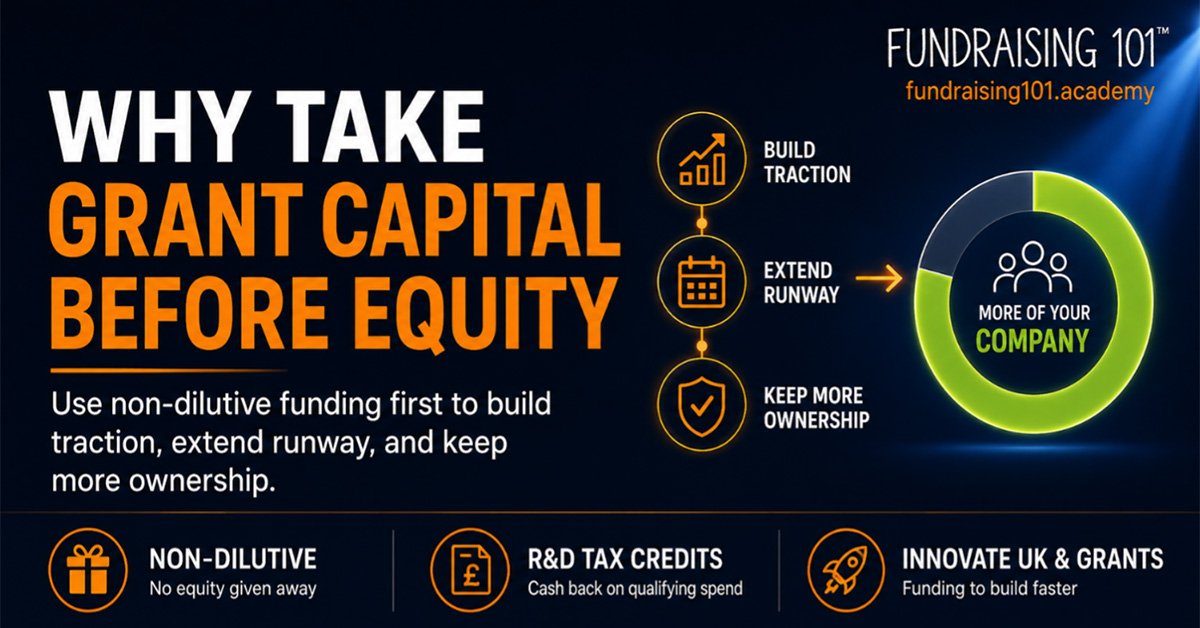
Grant Money + R&D Tax Credits + Innovate UK + Competitions = Less Dilution Later

By Robert Hokin, Managing Partner, Fundraising101
“Non-dilutive funding is capital provided to a company that does not require the issuance of equity or any reduction in existing shareholders’ ownership stakes. It includes grants, government incentives, R&D tax credits, and prize awards.”
Standard financial definition — applied across HMRC, Innovate UK, and British Business Bank guidance
The Equation
In my investing years, companies that had stacked non-dilutive funding before raising equity were almost always better investments. More runway. More milestones proven. Lower ask. Stronger negotiating position.
The formula is straightforward:
R&D Tax Credits + Grant Money + Innovate UK + Competitions = Less Dilution Later
Each of the four pillars is independent. They stack. They are not mutually exclusive. The founders who understand and use all four arrive at their equity raise better capitalised, with more credibility, at a higher valuation.
Every pound of non-dilutive capital you raise is a pound of equity you do not give away. The UK and Scottish non-dilutive landscape is substantial and consistently underused. Innovate UK distributed over £900 million in grants in 2024–25. The merged R&D tax credit scheme returns real cash to qualifying technology companies every year — yet fewer than 40% of eligible UK SMEs claim. Scottish EDGE has funded over 560 Scottish businesses. The founders who don’t use this landscape give away equity to solve problems the government would have paid to help with.
The grant wasn’t charity. It was evidence of commercial competence. They’d used every available tool before giving equity away.
How Investors Actually View Non-Dilutive Funding
Before building your non-dilutive strategy, understand how the investors you are about to approach will read it. This section is missing from almost every guide on grants.
What investors see as positive
- A SMART grant win signals independent competitive assessment. Innovate UK reviewers evaluate market opportunity, technical credibility, and commercial potential. An award is third-party validation that experienced investors notice.
- Grants covering specific R&D milestones mean your equity round is funding commercial scale, not technology risk. That is a meaningfully better story.
- Evidence that you understand the full funding landscape signals operational sophistication. A founder who has navigated HMRC, Innovate UK, and Scottish Enterprise before raising equity has demonstrated programme management, financial literacy, and resourcefulness.
- A lower equity ask. Every pound of non-dilutive capital raised reduces what you need from investors and improves your negotiating position on valuation and terms.
What investors are cautious about
- Grant dependency. A company whose roadmap is structured entirely around grant timelines rather than commercial milestones raises questions about whether the business can operate without subsidy.
- Distracted founders. A three-month grant application is a significant time investment. If managing grant programmes is consuming the CEO’s attention during a critical commercial window, experienced investors notice.
- Milestone misalignment. Grant milestones and investor milestones are not always the same thing. Make sure your grant pathway serves your commercial story, not just the funding criteria.
The framing rule: In investor conversations, lead with the commercial outcome, not the grant. ‘We won an Innovate UK SMART grant covering our proof-of-concept development’ is correct. ‘We are funded by Innovate UK’ positions you as a grant-dependent business.
Pillar 1: R&D Tax Credits — The No-Competition Capital
R&D tax credits require no competition, no pitch, and no external validation. If you are spending money on qualifying R&D activities, you are entitled to claim. Fewer than 40% of eligible UK SMEs do.
The Merged R&D Scheme (from April 2024)
HMRC consolidated the previous SME scheme and RDEC into a single merged scheme from April 2024. The headline rate is a 20% tax credit on qualifying expenditure — paid as a cash repayment to loss-making companies. For most pre-seed UK tech companies, this means direct cash from HMRC. Not a reduction in a future tax bill. Actual cash.
ERIS: The Higher Rate Most Founders Miss
The Enhanced R&D Intensive Support (ERIS) scheme applies to loss-making SMEs where R&D expenditure represents 30% or more of total company expenditure. The rate is 27% — materially higher than the standard 20%.
Check this first: If your R&D spend is 30%+ of total costs — typical for pre-seed deeptech, biotech, or hardware companies — you likely qualify for ERIS. On £300K of R&D spend, the difference between 20% and 27% is £21,000 in additional cash.
What a Typical Pre-Seed Claim Returns
| Annual R&D spend | Standard merged rate (20%) | ERIS rate (27%, if qualifying) |
|---|---|---|
| £100,000 | £20,000 cash | £27,000 cash |
| £200,000 | £40,000 cash | £54,000 cash |
| £300,000 | £60,000 cash | £81,000 cash |
| £500,000 | £100,000 cash | £135,000 cash |
What Qualifies
- Staff costs: salaries, employer NICs, pension contributions for employees directly engaged in R&D
- Subcontracted R&D: payments to third parties carrying out R&D on your behalf (65% of cost under merged scheme)
- Consumables: materials consumed or transformed in the R&D process
- Software: licences and cloud computing costs directly attributable to qualifying R&D
What Does Not Qualify
- Capital expenditure — equipment purchases (though capital allowances apply separately)
- Routine or non-experimental work — must advance overall knowledge or capability in science or technology
- Marketing, sales, and business development activities
- R&D carried out wholly overseas (with limited exceptions)
Specialist vs DIY
Use a specialist R&D tax advisor for your first claim. The documentation discipline they impose in year one is worth more than the fee recovery. After a well-documented first claim, many founders manage subsequent claims with less specialist input.
Official HMRC guidance: gov.uk/guidance/corporation-tax-research-and-development-rd-relief
Pillar 2: Grant Money — Scottish and UK Programme Grants
Scottish Enterprise
Scottish Enterprise (scottish-enterprise.com) is Scotland’s main economic development agency. Relevant mechanisms for pre-seed tech founders include R&D grants for specific development projects, business development grants for market development activities, and the Scottish Enterprise Co-investment Fund, which invests alongside qualifying angel investors. Engaging early — before you need funding — gives you an assigned account manager who can navigate the landscape and flag relevant programmes as they open.
Scottish EDGE: The Four Awards
Scottish EDGE (scottishedge.com) is Scotland’s biggest business funding competition. There are four distinct award categories for 2026:
| Award | Eligibility | Maximum funding |
|---|---|---|
| Main EDGE | Early-stage companies, social enterprises, all sectors | £150,000 (30% grant / 70% loan) |
| Young EDGE | All directors under 30, Scottish company | £15,000 grant |
| Wild Card EDGE | Pre-trading companies, sole traders, partnerships | £15,000 grant |
| Social Enterprise EDGE | Social enterprises demonstrating community impact | £75,000 (70% grant / 30% loan) |
Round 27 ran February–March 2026. Next round details expected June 2026. EDGE is not just money — winning it is a credentialling event. I have seen EDGE credentials genuinely shift investor conversations for Scottish companies raising from UK-wide funds. Enter as early as you qualify.
Converge Challenge
Converge Challenge (convergechallenge.com) is open to staff, students, and recent graduates from Scottish universities and research institutions. Applications for 2026 opened January 29 and closed April 2, with finals and awards scheduled for Autumn 2026. Prize fund over £400,000. The programme includes world-class entrepreneurial training alongside competition. For spinout founders, Converge is one of the strongest credentialling programmes in the Scottish ecosystem. University connection is required for eligibility.
IBioIC
The Industrial Biotechnology Innovation Centre (ibioic.com) supports life science, biotechnology, and bio-based industrial companies. For founders in these sectors, IBioIC provides direct routes into collaborative innovation funding, Scottish and UK industrial partner connections, and support for Innovate UK collaborative R&D applications.
Interface
Interface (interface-online.org.uk) connects Scottish businesses with university expertise and R&D capability. For pre-seed founders with a technology challenge addressable through academic collaboration, Interface is a direct route into co-funded collaborative R&D with Scottish universities — often the foundation for a subsequent Innovate UK or Scottish Enterprise collaborative grant application.
Highlands and Islands Enterprise
For founders in the Highlands, Islands, and parts of Argyll and Stirling, Highlands and Islands Enterprise (hie.co.uk) provides the equivalent range of business support, development grants, and investment facilitation to Scottish Enterprise.
RSE Unlocking Ambition
The Royal Society of Edinburgh Unlocking Ambition programme (rse.org.uk/awards/unlocking-ambition) provides fellowships for early-career Scottish entrepreneurs. The RSE network and endorsement carries real weight with institutional investors for founder-researchers.
Pillar 3: Innovate UK Programmes
Innovate UK distributes over £900 million annually across a portfolio of programmes, competitions, and support services. All current funding competitions are listed at apply-for-innovation-funding.service.gov.uk. Checking this page monthly is a minimum discipline for any founder pursuing non-dilutive capital.
SMART Grants
SMART grants fund innovation in science and technology for UK businesses. The most accessible tiers for pre-seed founders:
| Tier | Details |
|---|---|
| Feasibility studies | Up to £100K — 6–18 months, testing technical and commercial viability |
| Industrial research | Up to £500K — 18–36 months, advancing knowledge toward a specific commercial application |
| Experimental development | Up to £500K — prototype to production scale |
Success rate is approximately 10–15%. Well-prepared applications from companies with genuine innovation stories perform significantly better than the average submission. The most common failure reasons: weak commercial case, unclear innovation claim, unrealistic projections, vague project plan, or misalignment with the specific competition scope.
Applications take three to four months from submission to decision. Start before you think you urgently need the money.
Innovate UK Growth Catalyst — Investor Partnerships
This programme provides matched Innovate UK funding alongside qualifying private investment. Round 2 ran December 2025–February 2026 with over £100M allocated. If you have secured angel investment or are close to closing an angel round, watch for the next round — this programme can add Innovate UK capital on top without requiring additional equity.
Innovate UK Edge
Innovate UK Edge (iuk-edge.ktn-uk.org) provides free business support, market intelligence, and investor introductions for high-growth innovative businesses. Register before your raise begins. The support includes access to global market opportunities, IP strategy, and the Innovate UK investor network.
Knowledge Transfer Partnerships
KTPs (ktp.ac.uk) are three-way partnerships between a business, a university, and a recently qualified graduate, funded approximately two-thirds by Innovate UK. A KTP can fund a highly qualified technical hire at a fraction of the real cost while giving you access to a university’s facilities and IP commercialisation infrastructure. KTPs run for 12 to 36 months and produce IP that belongs to the company. One of the most valuable and least-used tools for technical pre-seed companies.
The Catapult Network
The Catapult network provides access to world-class facilities at subsidised rates, and Catapult involvement strengthens Innovate UK collaborative grant applications significantly.
- High Value Manufacturing Catapult (hvm.catapult.org.uk) — manufacturing process and scale-up
- Digital Catapult (digitalcatapult.org.uk) — AI, data, and digital innovation
- Energy Systems Catapult (es.catapult.org.uk) — energy transition and net zero
- Medicines Discovery Catapult (mdc.ac.uk) — drug discovery and development
- Compound Semiconductor Applications Catapult (csacat.co.uk) — semiconductor and photonics technology
Women in Innovation
The Innovate UK Women in Innovation programme (iuk.ktn-uk.org/programmes/women-in-innovation) awards grants of up to £50K alongside structured mentoring for female-led innovative businesses. The programme runs annually. Given the documented gap in VC funding for female founders, this provides both non-dilutive capital and a credible credential for investor conversations.
Pillar 4: Competitions — The UK Tech Competition Calendar
Prize competitions occupy a unique position in the non-dilutive landscape. The capital is typically smaller than grants, but the credibility return is disproportionate. A credible competition win is a third-party endorsement that costs nothing except the application and the pitch.
Important note on dates: competitions run annually and dates shift year to year. Where 2026 dates are confirmed they are shown. For others, the application window shown is the typical annual pattern. Always verify current dates on the programme’s own website. Check websites from September onwards for the following year’s competitions.
The table below covers competitions in order of typical application window. The ‘Type’ column distinguishes cash prizes, investment prizes, and in-kind/support awards.
| Competition | 2026 window / dates | Prize / award | Type | Sector | One-line description |
|---|---|---|---|---|---|
| Scottish EDGE Round 27 | Apps: 25 Feb – 25 Mar 2026. Next round: from Jun 2026 | Up to £150K | Grant + loan | All sectors (Scotland) | Scotland’s largest growth business competition. scottishedge.com |
| Converge Challenge | Apps: 29 Jan – 2 Apr 2026. Finals: Autumn 2026 | Up to £50K + support | Cash prize | All sectors (Scottish uni connection) | Scotland’s premier university spinout competition. £400K+ prize fund with world-class entrepreneurial training. convergechallenge.com |
| Tech Nation Rising Stars | Apps: Jan–Mar (annual). Finals: London Tech Week, Jun | Up to £1M investment | Investment | B2B tech, all UK regions | UK’s largest prize pitch competition for early-stage B2B tech startups, £3M on offer across regional and national levels. technation.io |
| Hello Tomorrow Global Challenge | Apps: Sep–Jan (closes ~Jan). Finals: Jun 2026, Amsterdam | €100K Grand Prize | Cash + network | Deep tech, 15 tracks | World’s longest-running deep tech competition. 800 Deep Tech Pioneers gain investor access at the Summit. hello-tomorrow.org |
| Innovate UK Women in Innovation | Annual — typically Spring. Check website | Up to £50K + mentoring | Grant | All sectors (female-led) | Annual Innovate UK award combining grant funding with structured mentoring for female founders. iuk.ktn-uk.org |
| NatWest Accelerator Pitch | Rolling rounds. Current final: 18 Jun 2026, Oxford | £100K per round | Cash prize | All sectors, UK | NatWest’s flagship pitch competition, £1M total prize pot across multiple rounds throughout 2025–26. natwest.com |
| EIC Accelerator | Multiple batching dates throughout 2026. Rolling short applications | Up to €2.5M grant + €10M equity | Grant + equity | Breakthrough innovation, all sectors | European Innovation Council’s flagship programme for market-creating innovations. UK companies eligible. The largest single non-dilutive prize in this list. eic.ec.europa.eu |
| Santander X UK Awards | Annual — apps typically Spring. Finals: Autumn | Up to £25K equity-free | Cash prize | All sectors, UK | Santander’s flagship entrepreneurship competition. Over £1.2M awarded to UK founders since 2011. Global finals in Barcelona. santanderx.com |
| RAEng Enterprise Hub | Rolling programmes. Scotland hub active year-round | Fellowship + support | In-kind + cash | Engineering-led ventures | Royal Academy of Engineering fellowship and support programme for engineering-led ventures. Scotland hub specifically relevant. enterprisehub.raeng.org.uk |
| UKRI Future Leaders Fellowships | Spring and Autumn rounds annually | Up to £1.5M | Grant | Research-led, all sectors | UKRI fellowships for early-career researcher-entrepreneurs with commercial ambition. Up to £1.5M. ukri.org |
| CivTech Scotland | Annual — typically Autumn challenge launch | Contract + support | Contract (not prize) | Public sector innovation (Scotland) | Scottish Government innovation challenge. Winning provides a live public sector contract, not just a prize. civtech.scot |
| Slush 100 Startup Competition | Apps: Summer. Event: Nov 2026, Helsinki | €1M investment | Investment | All tech sectors | Europe’s leading startup-investor event. High-profile competition with strong deeptech and B2B representation. slush.org |
| Web Summit ALPHA / BETA | Apps: Spring–Summer. Event: Oct/Nov, Lisbon | Pitch stage access + visibility | In-kind / visibility | All tech sectors | Startup programme for Europe’s largest tech conference. Pitch stage access and investor visibility. websummit.com/startups |
On EIC Accelerator: The European Innovation Council Accelerator is one of the most significant non-dilutive funding sources available to UK deep tech founders and is almost entirely absent from UK founder conversations. UK companies remain eligible post-Brexit via Horizon Europe association. Grant up to €2.5M. Equity up to €10M. Application bar is high but the capital scale is transformative. If your technology is genuinely breakthrough, this deserves serious assessment.
The Stacking Strategy: A 24-Month Non-Dilutive Roadmap
The goal is to arrive at your equity raise with non-dilutive capital already deployed or confirmed, milestones already funded, and credibility already established. Here is what a well-constructed 24-month roadmap looks like for a Scottish pre-seed tech company. Numbers are illustrative.
| Month | Action | Programme | Likely outcome | Investor impact |
|---|---|---|---|---|
| 1–3 | Document all R&D activities. Engage specialist advisor. | R&D Tax Credits (merged / ERIS) | £20K–£80K cash per year | Immediate runway extension |
| 1–6 | Apply to Scottish EDGE (correct tier) | Scottish EDGE | Up to £150K (grant/loan) | Credentialling + runway |
| 3–6 | Register with Innovate UK Edge and Scottish Enterprise | Innovate UK Edge + ScotEnt | Free support, account manager | Ecosystem standing |
| 1–4 | Apply to Converge (if Scottish uni connection) | Converge Challenge | Up to £50K + training | University spinout credibility |
| 4–8 | Submit Innovate UK SMART feasibility application | SMART Grant | Up to £100K — 3–4 months to decision | Third-party technical validation |
| 6–13 | Explore KTP if technical hiring is a constraint | KTP | £60K–£120K value over 24 months | University collaboration signal |
| 6–12 | Enter relevant competitions (Hello Tomorrow, Tech Nation, EIC short app) | Competition calendar | Variable — credibility + cash | Third-party endorsement |
| 9–15 | Structure angel round to qualify for Innovate UK Investor Partnerships | Investor Partnerships | Matched Innovate UK capital | Reduces pure equity requirement |
| 12–18 | Raise SEIS/EIS equity round | Equity raise | Full round, stronger terms | Non-dilutive capital has reduced risk profile |
| 18–24 | File year 2 R&D claim. Apply for SMART industrial research. | R&D + SMART | Increasing annual return | Ongoing credibility |
Total non-dilutive capital available through this roadmap, executed well: £250K–£500K before a single share is issued. That changes the equity round conversation entirely.
The timing rule: Grant applications take three to four months from submission to decision. The time to apply is before you need the money, not when runway is running out. Build your grant calendar 12 months in advance.
When Not to Pursue Grants
A balanced guide acknowledges the limits. Non-dilutive capital is not always the right priority at every moment.
- When a commercial customer is available and grant-writing would consume the time required to close them. A paying customer is worth more than a grant in almost every scenario.
- When your equity round is imminent and a grant application timeline would not resolve before the round closes.
- When the grant criteria require you to pursue a technical direction that does not serve your commercial roadmap.
- When the application cost — management time, specialist fees, and opportunity cost — exceeds the realistic expected value. A 12% success rate on a £100K award is an expected value of £12K. If it takes 40 hours of CEO time, the calculation may not be attractive.
- When speed to market matters more than runway extension. Grants are slow. Equity is faster. Know which constraint is binding.
The honest test: Before committing to a grant application, ask: if I spent this time on commercial development instead, what would I have? If the answer is a paying customer or a signed LOI, do that first.
The Raise-Ready Non-Dilutive Funding Checklist
Pillar 1: R&D Tax Credits
- Are you keeping records of all staff time spent on qualifying R&D activities?
- Have you documented the scientific or technological uncertainty your R&D is addressing?
- Have you calculated whether your R&D spend exceeds 30% of total expenditure (ERIS eligibility)?
- Have you engaged a specialist R&D tax advisor to review eligibility and establish documentation methodology?
- Is your accounting structured to clearly separate R&D expenditure from other costs?
Pillar 2: Grant Money
- Have you registered with Scottish Enterprise and have an assigned account manager?
- Have you identified the correct Scottish EDGE award tier for your company?
- If you have a Scottish university connection, have you assessed Converge Challenge eligibility?
- If you are in life sciences or biotech, are you connected with IBioIC?
- Have you explored Interface if a university R&D collaboration would strengthen your innovation case?
- Have you explored the Scottish Enterprise Co-investment Fund as part of your angel raise?
Pillar 3: Innovate UK
- Are you checking the UKRI funding competition finder monthly?
- Does your project fit the SMART grant criteria?
- Have you checked the Investor Partnerships programme if you have existing angel investment?
- Are you registered with Innovate UK Edge?
- Have you explored KTPs if technical hiring is a constraint?
- Have you engaged with the most relevant Catapult for your sector?
- If you are a female-led business, have you assessed Women in Innovation?
Pillar 4: Competitions
- Have you mapped your competition calendar for the next 12 months using the table above?
- Have you entered or planned to enter Scottish EDGE at the earliest opportunity?
- Have you assessed EIC Accelerator eligibility if your technology is genuinely breakthrough?
- Are you tracking Tech Nation Rising Stars and Hello Tomorrow application windows?
The Stacking Strategy
- Have you mapped your grant application calendar 12 months in advance?
- Are your grant milestones aligned with your commercial and investor roadmap?
- Have you calculated the total non-dilutive capital available before your equity round?
- Can you describe your non-dilutive funding history clearly and positively in investor conversations?
Key Takeaways
- R&D Tax Credits require no competition. Check ERIS eligibility first — if your R&D is 30%+ of total expenditure, your rate is 27% not 20%. Start documenting qualifying activities now.
- Grant money is layered, not singular. Scottish Enterprise, EDGE, Converge, and IBioIC are not alternatives — they are complementary pillars. Use all that apply.
- Innovate UK is a campaign, not a one-off application. SMART grants, KTPs, Edge support, and Investor Partnerships work together across a 12–24 month horizon.
- Competitions deliver credibility as much as cash. A SMART grant win, an EDGE award, or a Tech Nation Rising Stars finalist placing shifts investor conversations for Scottish companies raising from UK-wide funds.
- The EIC Accelerator is almost unknown in UK founder circles. Up to €2.5M grant plus equity investment. UK eligible. If your technology is genuinely breakthrough, assess it seriously.
- Stack, don’t choose. The four pillars are not mutually exclusive. Build a 24-month non-dilutive roadmap and execute it systematically.
- In investor conversations, lead with the commercial outcome. ‘We won an Innovate UK SMART grant covering our proof-of-concept’ is the right framing. Grant dependency is the wrong story.
Resources
Pillar 1: R&D Tax Credits
- HMRC R&D Tax Relief (gov.uk/guidance/corporation-tax-research-and-development-rd-relief) — Official HMRC guidance on the merged R&D scheme and ERIS
Pillar 2: Scottish and UK Grant Programmes
- Scottish Enterprise (scottish-enterprise.com) — Grants, co-investment, and business support
- Scottish EDGE (scottishedge.com) — Main EDGE up to £150K, Young EDGE £15K, Wild Card £15K, Social Enterprise £75K
- Converge Challenge (convergechallenge.com) — Scottish university spinout competition, £400K+ prize fund
- IBioIC (ibioic.com) — Life science, biotech, and bio-based industrial support
- Interface (interface-online.org.uk) — Connecting Scottish businesses with university R&D expertise
- Highlands and Islands Enterprise (hie.co.uk) — Development agency for the Highlands and Islands
- RSE Unlocking Ambition (rse.org.uk/awards/unlocking-ambition) — Fellowships for early-career Scottish entrepreneurs
Pillar 3: Innovate UK
- UKRI Funding Finder (apply-for-innovation-funding.service.gov.uk) — All current Innovate UK funding competitions
- Innovate UK Edge (iuk-edge.ktn-uk.org) — Free business support, market intelligence, investor introductions
- Knowledge Transfer Partnerships (ktp.ac.uk) — KTP programme overview and application guidance
- Catapult Network (catapult.org.uk) — Directory of all UK Catapult centres
- Women in Innovation (iuk.ktn-uk.org/programmes/women-in-innovation) — Up to £50K grant plus mentoring for female-led businesses
Pillar 4: Competitions
- Scottish EDGE (scottishedge.com)
- Converge Challenge (convergechallenge.com)
- Tech Nation Rising Stars (technation.io)
- Hello Tomorrow Global Challenge (hello-tomorrow.org)
- EIC Accelerator (eic.ec.europa.eu)
- NatWest Accelerator Pitch (natwest.com)
- Santander X UK Awards (santanderx.com)
- RAEng Enterprise Hub Scotland (enterprisehub.raeng.org.uk)
- UKRI Future Leaders Fellowships (ukri.org)
- CivTech Scotland (civtech.scot)
- Slush 100 (slush.org)
- Web Summit ALPHA/BETA (websummit.com/startups)
Legal Infrastructure
- FounderCatalyst (foundercatalyst.com) — Fixed-price UK funding round legal documents (£1,495 excl. VAT). SEIS/EIS advance assurance included. F101’s recommended legal partner.
Investment Readiness
- Fundraising101 Academy — Raise-Ready Deck Review (fundraising101.academy) — 70-point deck review with 50+ fund sift and tailored investor target list. £375. No VAT. 5 working days.
Get Raise-Ready.
Pre-seed tech founder in Scotland? There’s a difference between deck-ready and Raise-Ready. We can help you get there. Fast. With No BS. Visit fundraising101.academy.