How It Works and How to Defend It
The Number Investors Test You On and Most UK Tech Founders Get Wrong

By Robert Hokin, Managing Partner, Fundraising101
noun – “The process of estimating the financial worth of something; a calculated or estimated value assigned after consideration of relevant factors including comparable transactions, market conditions, and the assessed risk profile of the asset.” Oxford English Dictionary, Third Edition
Why This Matters
Valuation is the number that determines how much of your company you give away in this round. At pre-seed there is rarely a defensible objective methodology behind it: no revenue, no validated customer base, sometimes no product. Yet I watch founders walk into investor conversations and quote a number as if it’s a fact of nature. Experienced investors know within seconds whether the work has been done or whether a number has been picked that felt ambitious.
Getting this wrong in either direction costs you. Overvalue and experienced investors walk without telling you why. Undervalue and you set a precedent that complicates every subsequent round and may trigger anti-dilution provisions you didn’t anticipate. Mishandle the conversation itself and you signal to an investor that you either haven’t done your homework or can’t handle commercial pressure, and neither of which helps you close.
The UK market has also reset materially since 2021. Pre-revenue companies that were routinely raising at £5M to £10M pre-money two to three years ago are now being asked to justify much more modest valuations. Founders who are still anchoring to peak-era comparables are walking into harder conversations than they need to. This article covers the methods investors use, what the current UK market looks like, and how to have this conversation with confidence.
The Honest Truth About Pre-Seed Valuation
Pre-seed valuation is a negotiation between what the founder needs to give away and what the investor needs to receive for the risk they are taking. Methodology provides a framework for that negotiation: it does not produce an objective number. The founders who understand this and approach the conversation accordingly consistently do better than those who present their valuation as a calculation already completed.
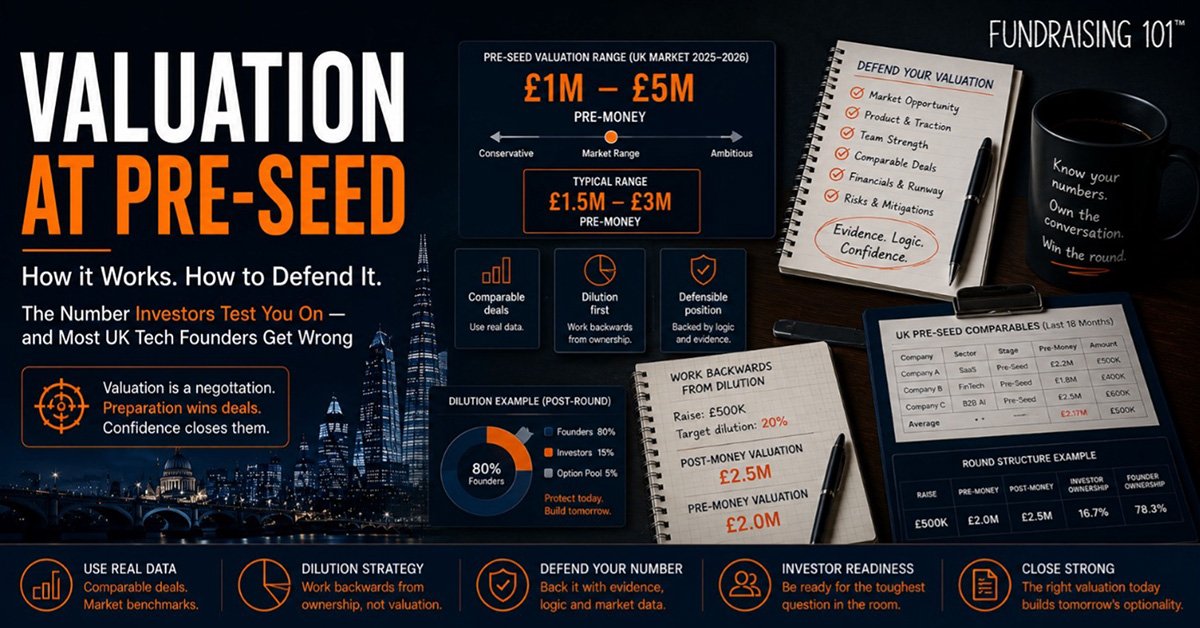
There is one useful discipline here: work backwards from dilution. Decide the maximum percentage of your company you’re willing to sell in this round (typically 15% to 25% at pre-seed). Then the valuation follows from the raise amount. Raising £500K and willing to sell 20%? Post-money valuation is £2.5M. Pre-money is £2M. That’s your anchor. Now you need to defend it.
Main Valuation Methods for UK Pre-Seed
The Berkus Method
The Berkus method assigns value to five risk categories: sound idea, working prototype, quality management team, strategic relationships, and initial sales. Each category is worth up to £250K in the original formulation, giving a theoretical maximum pre-money of £1.25M. It’s blunt and needs adjusting for current market conditions, but it’s a useful floor-check and most UK angel investors are familiar with it.
The Scorecard Method
The scorecard method compares your company to a baseline pre-seed valuation for your region and sector, then adjusts based on team strength, market size, product stage, competitive landscape, and route to market. A strong technical team in a large market with a working prototype and one paying customer might score 25–30% above the regional baseline. A solo non-technical founder with a concept and a deck might score 30–40% below.
Comparable Transactions
Comparable transactions are the most powerful method if you have access to deal data. Beauhurst covers UK deals comprehensively. The British Business Bank’s annual Small Business Finance Markets report includes regional benchmarks. If you can point to three comparable pre-seed raises in your sector in the last 18 months (similar stage, similar team profile, similar market) and your valuation is consistent with that data, you have a defensible position. If you can’t, you’re negotiating without data.
A Note on DCF: Discounted Cash Flow
You may have encountered discounted cash flow analysis in a finance course or corporate context and wondered why it doesn’t feature in pre-seed valuation conversations. The short answer is that it can’t. Not credibly.
DCF works by projecting a company’s future free cash flows over a defined period (typically five to ten years) and discounting them back to a present value using a rate that reflects the risk of the investment. The logic is sound: a pound received in five years is worth less than a pound today, and riskier cash flows deserve a higher discount rate.
The problem at pre-seed is the inputs. DCF requires credible revenue projections, margin assumptions, and a terminal value. None of which exist at this stage in any form an experienced investor will take seriously. Pre-seed founders routinely produce five-year financial models, but investors read them as an indicator of financial literacy, not as a reliable basis for valuation. A DCF built on a pre-revenue company’s assumptions is, in practice, a spreadsheet that can justify almost any number the founder wants it to justify.
DCF becomes genuinely useful later in the funding journey. At Series A and beyond, companies typically have 12 to 24 months of revenue data, observable churn rates, and a clearer cost structure. Institutional investors at growth stage will run their own DCF models as part of due diligence. At seed stage, a well-constructed DCF can be a supporting input, particularly for companies with early recurring revenue or contracted pipeline. At pre-seed, it is context, not evidence.
If an investor asks whether you’ve done a DCF, the honest and credible answer is: “We’ve modelled our financials out to Year 3 and I’m happy to walk through the assumptions, but at this stage we’re anchoring our valuation to comparable transactions and team credentials rather than a DCF, because we think that reflects the actual basis on which pre-seed deals get done.” That answer demonstrates financial literacy without pretending the model is more predictive than it is.
What the UK Market Looks Like in 2025–2026
In the current UK market, pre-seed valuations for technology companies with working prototypes typically range from £1M to £5M pre-money, with the majority clustering between £1.5M and £3M. This is a correction from the 2021–2022 peak and it’s real. Investors who were writing £500K cheques at £8M pre-money three years ago are now more likely doing the same cheque at £3M pre-money.
Scottish pre-seed valuations have historically sat 15–25% below London equivalents, reflecting investor density and the thinner exit comparables available. This gap has narrowed as Scottish deal flow quality has improved, and the presence of Scottish Enterprise Co-investment Fund and EDGE credentials has made Scottish deals more attractive to UK-wide investors. A Scottish tech company with SEIS advance assurance, a working prototype, and two paying or committed customers can credibly support a £2M to £3M pre-money in most sectors.
How to Have the Valuation Conversation
Don’t anchor with a specific number before you understand the investor’s framework. Ask how they approach valuation at pre-seed before you reveal yours. Most investors will describe their methodology, which helps you to position your response.
Use a range, not a single number. “We’re targeting a pre-money valuation of £2M to £3M depending on the investor and what they bring beyond capital.” This leaves room to negotiate upward for a strategic investor while anchoring in a credible range. Be prepared to justify every element. “We think we’re worth £4M” is not a position. Three comparable deals in your sector from the past 18 months, your team credentials, your product stage, and your market evidence is a position.
Know your numbers cold. Pre-money, post-money, fully diluted ownership post-investment including option pool, and what 10x on your valuation means for the investor in cash terms. Fumbling any of these in the meeting does more damage than any individual valuation assumption.
Checklist
Work through this before your next investor conversation. Be honest about the gaps. If you can’t answer any of these confidently, that’s a signal. Fix the gap before the investor finds it.
Methodology
- Have you applied at least two valuation methods and sense-checked the results?
- Have you researched three to five comparable pre-seed raises in your sector in the last 18 months?
- Can you state your pre-money valuation, post-money valuation, and founder dilution in one sentence?
- Have you calculated your fully diluted ownership post-investment including the option pool?
- Does your valuation imply a dilution percentage you are comfortable with?
Investor Readiness
- Can you justify your valuation without a spreadsheet in a live conversation?
- Do you know what 10x on your current valuation means for an investor in cash terms?
- Have you prepared an evidence-based response to “that seems high”?
- Have you thought about how your current valuation sets up your Series A?
UK Context
- Are you aware of current median pre-seed valuations in your sector and region?
- Have you accounted for the post-2021 valuation correction in your benchmark data?
- Is your EIS/SEIS advance assurance in place. This supports your valuation narrative with UK investors?
- If raising in Scotland, have you adjusted your benchmark to reflect regional comparables?
Takeaways
- Pre-seed valuation is a negotiation, not a calculation. Methodology gives you a defensible position. The number comes from understanding what the investor needs to earn for the risk they’re taking.
- The UK market has reset since 2021. Founders anchoring to peak-era valuations are having harder conversations than they need to. Use current comparables.
- Work backwards from dilution. Decide what you’re willing to sell, then set the valuation. Not the other way around.
- Use a range, not a fixed number. It signals confidence, leaves room for strategic premium, and avoids anchoring too low for sophisticated investors.
- Know your post-money and fully diluted numbers cold. Investors will ask in the meeting. Not knowing them signals you haven’t done the work.
- EIS/SEIS eligibility effectively supports a higher pre-money. The tax relief reduces investor downside, which justifies a more aggressive valuation for a qualifying company.
Additional Resources
Crunchbase: crunchbase.com: International deal database for cross-referencing UK comparables against global benchmarks
Beauhurst: beauhurst.com: UK deal database for pre-seed comparable transaction data
British Business Bank: british-business-bank.co.uk/research: Annual Small Business Finance Markets report with UK valuation benchmarks by region and sector
Seedcamp Valuation Content: seedcamp.com/views: Carlos Espinal’s writing on pre-seed valuation frameworks for European founders
Get Raise-Ready.
Pre-seed tech founder in Scotland? There’s a difference between deck-ready and Raise-Ready. We can help you get there. Fast. With No BS. Visit fundraising101.academy.