The Most Powerful Investor Incentive in the UK…and How to Use It

By Robert Hokin, Managing Partner, Fundraising101
“The Enterprise Investment Scheme (EIS) is designed to help smaller higher-risk trading companies to raise finance by offering a range of tax reliefs to investors who purchase new shares in those companies.” HM Revenue and Customs, EIS Introduction Guidance
This Matters…a lot!
I’ve seen deals close on SEIS & EIS eligibility alone that certainly would have struggled without it. I’ve also watched founders walk into meetings with UK angels and mention alleged eligibility for S/EIS as a footnote on their legal slide. Those are two very different conversations with very different outcomes.
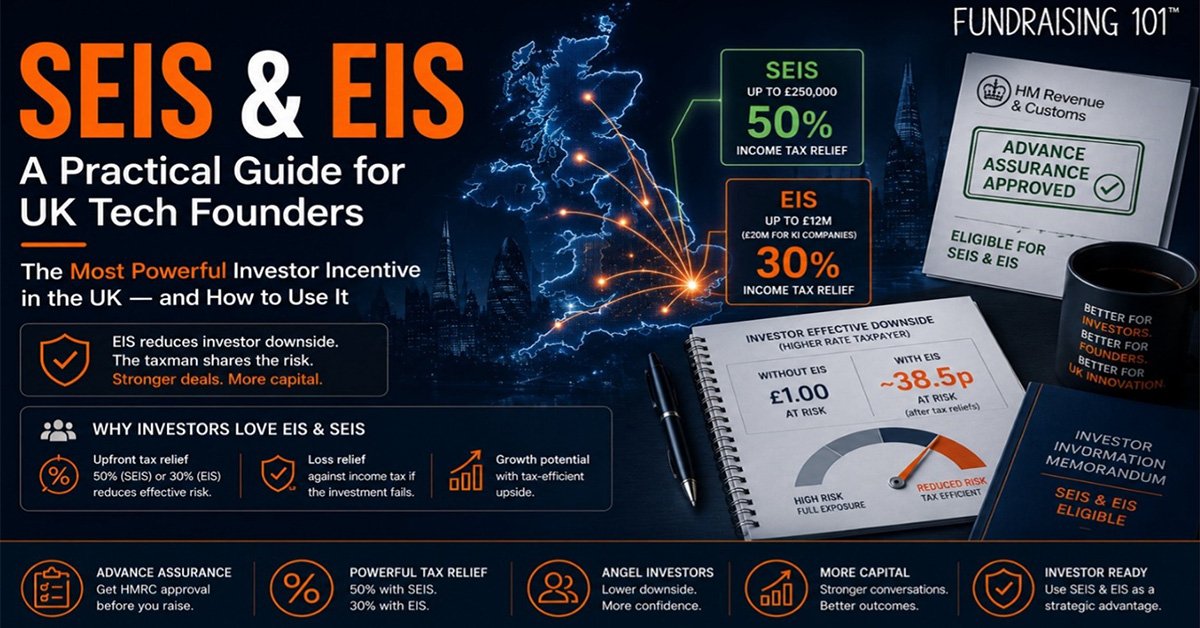
The UK has two of the most generous investor tax incentive schemes in the world. SEIS gives investors 50% income tax relief on their investment. EIS gives 30% for bigger sums. For a UK angel paying higher rate income tax, the effective downside on an EIS-qualifying investment, taking into account income tax relief and loss relief if the investment fails, is approximately 38.5p in the pound. That changes the risk calculus completely. An angel who might otherwise pass on your deal because the risk feels too high may well invest if S/EIS means the taxman is sharing a significant portion of that risk.
Most UK tech founders know S/EIS exists. Far fewer understand how it works, what can disqualify their company, and, most importantly, how to use it actively as a selling tool rather than a compliance checkbox. We cover it all here, with a helpful checklist at the end…but read the artcile first, don’t just skip through to the check-list!
EIS vs SEIS: The Key Differences
SEIS is designed for the earliest-stage companies. Maximum lifetime investment raised under SEIS is £250,000. Your company must have fewer than 25 employees at the time of the investment and gross assets of no more than £350,000 before the investment. Income tax relief for investors is 50%. SEIS is more generous but more restrictive, it’s designed for the very early bet.
EIS covers later-stage companies. Up to £12M raised under EIS over a company’s lifetime, £20M for knowledge-intensive companies. Maximum gross assets of £15M before investment. Fewer than 250 employees. Income tax relief is 30%. Most UK tech companies begin with SEIS and transition to EIS as they grow. A company can qualify for both simultaneously if structured correctly, with SEIS investors coming in first, this is called a blended round and it’s common practice for UK pre-seed raises.
The practical point: if you’re raising your first round and your company is below the SEIS thresholds, start with SEIS. The relief is more generous, the investor’s effective downside is lower, and it’s a stronger selling argument for UK angels taking a first bet on your company.
Advance Assurance: Get This Before You Start Raising
Advance assurance is an application to HMRC confirming that your company is likely to qualify for EIS or SEIS before you raise. It is not a guarantee, HMRC confirms the position as it stands at the point of application, but it gives investors the confidence they need to commit.
Almost every UK angel investor and all VCs investing under EIS mandates require advance assurance before committing. This is non-negotiable in practice. Apply before you begin your raise. The process takes four to eight weeks and requires details of your corporate structure, your trading activities, your planned use of funds, and your share structure. Do not start approaching investors until this is in hand. I’ve seen founders lose warm conversations because they started raising before advance assurance was confirmed and an investor wouldn’t wait.
What Qualifies and What Disqualifies
To qualify, your company must carry on a qualifying trade. Most UK technology businesses qualify straightforwardly. The excluded activities list includes property development, financial services, banking, insurance, leasing, farming, and hotels. The complication arises with mixed activities, a SaaS platform that also has a consultancy revenue stream, for example. The non-qualifying element must remain below 20% of total activity. If you’re unsure, get advice before submitting the advance assurance application.
The conditions most commonly missed by UK tech founders: the company must be unquoted at the time of investment; the shares must be newly issued ordinary shares with no preferential rights; the company must be carrying on, preparing to carry on, or researching a qualifying trade.
The connected persons rule catches more founders than any other disqualifier. Investors who are connected to the company, directors, employees, or close family members, cannot claim EIS or SEIS relief on shares they hold. This catches founders who have invested their own money into the company they’re running, and family members who have contributed early capital. If you have these investors, get specific advice before applying for advance assurance.
Use EIS and SEIS as a Selling Tool, Not a Footnote
I’ve sat in pitch meetings where EIS was mentioned once, in passing, on a legal slide near the end of the deck. That’s the wrong place and the wrong approach entirely.
EIS and SEIS eligibility should be in your investment highlights, front and centre, alongside your funding ask. The specific language that moves UK angels: “We hold HMRC advance assurance for SEIS up to £250,000, transitioning to EIS thereafter. For a higher rate taxpayer, the effective downside before any return on the business is approximately 38.5p in the pound.” That’s a closing statement. Not a footnote. Write it that way. Put it that way in your deck. Say it that way in your pitch.
When I was on the investment side, EIS eligibility was one of the first things I confirmed for any UK deal. If it was already confirmed and clearly articulated by the founder, that was a mark in their favour, not because EIS was the investment rationale, but because it showed they understood who they were pitching and what mattered to those investors.
Checklist
Work through this before your next investor conversation. Be honest about the gaps. If you can’t answer any of these confidently, that’s a signal. Fix the gap before the investor finds it.
Eligibility
- Have you confirmed your primary trading activity is not on the HMRC excluded activities list?
- Is your company unquoted on any recognised investment exchange?
- Are the shares you plan to issue ordinary shares with no preferential rights?
- Does your company have fewer than 25 employees (SEIS) or 250 employees (EIS)?
- If you have mixed trading activities, is the non-qualifying element below 20% of total activity?
Advance Assurance
- Have you applied for HMRC advance assurance before beginning your raise?
- Does the assurance cover the full amount and share type you plan to issue?
- Have you confirmed your planned use of funds matches your assurance application?
- Have you identified any connected persons investors who cannot claim EIS/SEIS relief?
Investor Communication
- Is EIS/SEIS eligibility in your investment highlights, not buried in a legal slide?
- Can you state the effective downside for a higher rate UK taxpayer in one sentence?
- Do you have a process for issuing EIS3/SEIS3 compliance certificates after investment completes?
- Have you confirmed your share structure is compatible with EIS/SEIS throughout the round?
Takeaways
- Apply for HMRC advance assurance before you start raising. Not after. Most UK angels will not commit without it and the process takes four to eight weeks.
- EIS and SEIS are not compliance footnotes. They are front-page commercial facts. Put them in your investment highlights and state the effective downside explicitly.
- SEIS first, EIS second. If you’re below the SEIS thresholds, start there, the 50% relief is more powerful than the 30% EIS rate for early investors.
- The connected persons rule is the most commonly missed disqualifier. Check every planned investor before raising.
- Ordinary shares are required. Preference shares are not EIS-qualifying. If institutional investors want preference shares, get legal advice on structuring the round so EIS-eligible angels aren’t affected.
- Using EIS funds correctly is as important as qualifying for them. Document your use of funds and ensure it matches your advance assurance application throughout.
Additional Resources
- HMRC EIS Guidance: gov.uk/guidance/enterprise-investment-scheme-introduction — Official HMRC guidance on EIS for companies
- HMRC SEIS Guidance: gov.uk/guidance/seed-enterprise-investment-scheme-background — Official HMRC guidance on SEIS for companies
- HMRC Advance Assurance: gov.uk/guidance/venture-capital-schemes-apply-for-advance-assurance — How to apply before raising
- FounderCatalyst: foundercatalyst.com. Don’t DIY your HMRC application. FounderCatalyst is a fixed-price funding legal platform at £1,495 (excl. VAT) — all legal paperwork, SEIS/EIS advance assurance included at no extra cost. There success rate is amazing, that’s why we recommend them.
- UKBAA: ukbaa.org.uk — UK Business Angels Association — EIS-qualifying angel investment standards
Get Raise-Ready.
Pre-seed tech founder in Scotland? There’s a difference between deck-ready and Raise-Ready. We can help you get there. Fast. With No BS. Visit fundraising101.academy.