
Written by
Robert Hokin
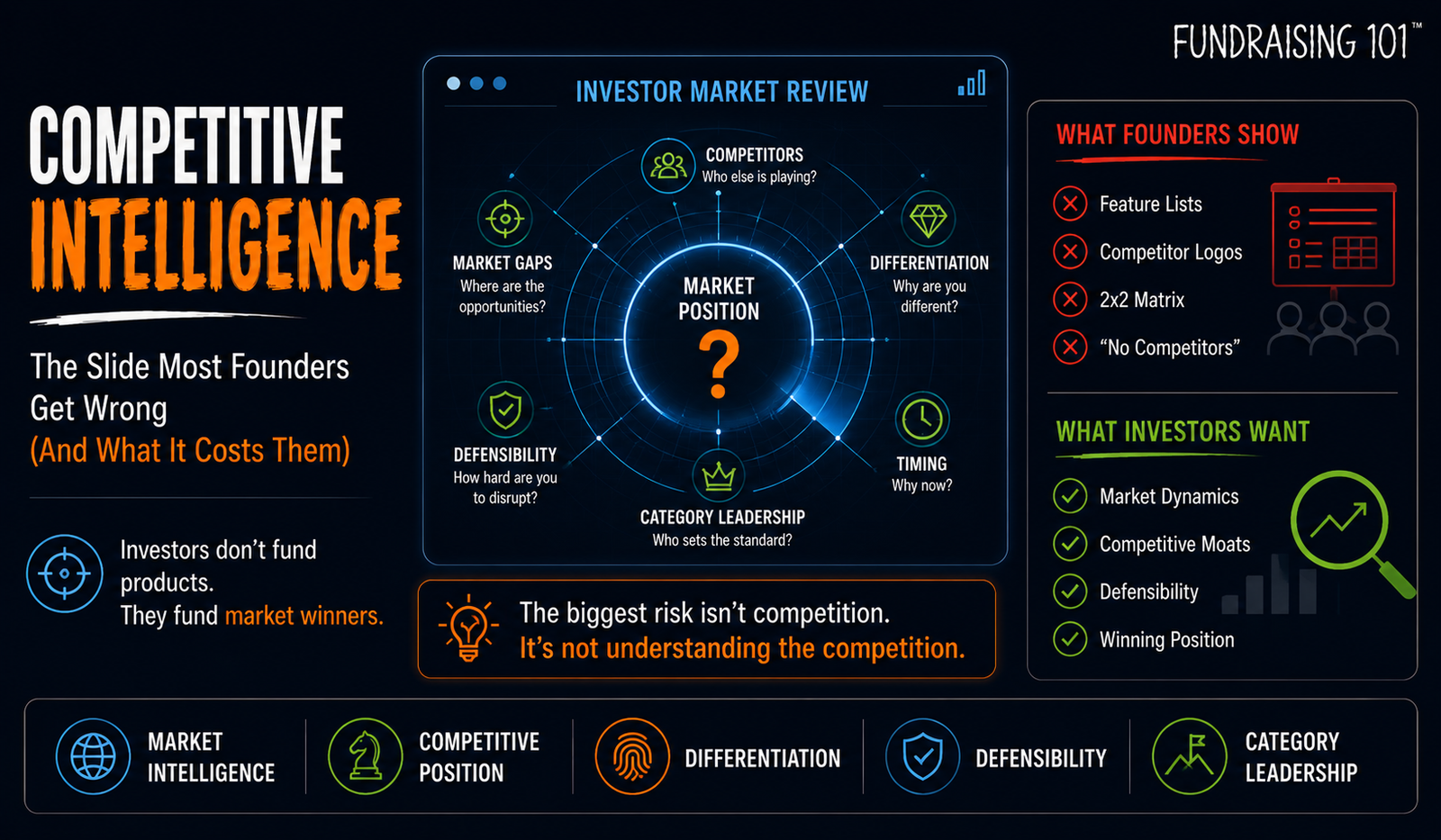
After reviewing 300+ investment pitch decks, I can tell you this: roughly 60% either skip the competitive analysis entirely or deliver something so weak it would have been better left out.
That’s not hyperbole. This is what I see week after week from pre-seed founders.
And here’s the kicker – investors notice. Because when you don’t address competition properly, you’re sending one of three signals:
1. You don’t know your market (ignorance)
2. You know but hope they won’t notice (dishonesty)
3. You genuinely believe you have no competition (delusion)
None of these get you funded.
Why Investors Care About Your Competitive Intelligence
Let’s cut through the noise. Investors aren’t asking about competition because they want to see a fancy 2×2 matrix with you in the top-right corner. They’re asking because:
They need to understand your market position. If you can’t articulate who you’re up against and why you’re different, you don’t understand your own business well enough to scale it.
They’re testing your self-awareness. Every founder thinks their baby is beautiful. Investors want to know if you can see the warts.
They’re evaluating your strategic thinking. How you position against competitors tells them whether you understand go-to-market strategy, defensibility, and where the real value is in your solution.
They want to know what keeps you up at night. Because it should. If you’re not worried about competition, you’re not paying attention.
What “Missing” Competitive Intelligence Actually Looks Like
From the decks I’ve analysed, the failures fall into clear patterns:
1. The “We Have No Competitors” Claim – Usually followed by “we’re unique” or “we’re first to market.” Investors hear this and immediately think: “This founder hasn’t done their homework.”
2. The Generic Comparison Table – A grid showing checkmarks for you and X’s for everyone else. Conveniently, you win on every single dimension. This is pantomime, not analysis.
3. The Irrelevant Competitors – Listing companies that aren’t actually fighting for the same customers or solving the same problem. This shows you don’t understand your own positioning.
4. The Outdated Intelligence – Referencing competitor capabilities from two years ago when they’ve since pivoted, raised £10M, or been acquired.
Best Practices: How to Actually Do Competitive Analysis
Here’s what works, based on what I’ve seen get funded:
1. Acknowledge direct AND indirect competition Don’t just list the startups in your space. Include:
• The manual process you’re replacing
• The spreadsheet or workaround people currently use
• The larger platforms that could add your feature tomorrow
• The “do nothing” option
2. Use a positioning map that means something Skip the generic “price vs. features” axes. Choose dimensions that actually matter to YOUR customers. For a climate tech solution, that might be “carbon reduction vs. implementation complexity.” For a SaaS tool, perhaps “automation level vs. learning curve.”
Put yourself honestly on that map. If you’re mid-market on both axes, own it and explain why that’s the white space.
3. Be specific about your defensibility Don’t say “better technology.” Say: “Our proprietary dataset of 5M+ transactions gives us 23% higher accuracy than rule-based systems.”
Don’t say “strong team.” Say: “Our CTO built the fraud detection system at [Company X] that processed £2B annually.”
4. Show you’re monitoring the landscape Reference recent moves: “Competitor X raised their Series A in October 2024 and will likely expand to our segment within 18 months. Here’s our response strategy…”
This tells investors you’re watching the chessboard, not just your own pieces.
5. Explain why you’ll win the next 12-24 months Not forever. Not theoretically. Right now, with the resources you have, against the competitors as they exist today – why will you capture market share?
6. Include your competitive response strategy What happens when your largest competitor copies your core feature? What happens when someone undercuts you on price? These aren’t hypotheticals – they’re inevitabilities. Show you’ve thought about it.
The Format That Actually Works
In your deck, this typically means:
Slide 1: Market Landscape
• Who are the players (direct and indirect)
• How is the market currently segmented
• Where are you positioning
Slide 2: Competitive Positioning
• Visual map with meaningful axes
• Honest placement of you and 4-6 key alternatives
• Brief explanation of your differentiation
Optional Slide 3: Competitive Deep-Dive
• For investors who want details, include in appendix
• Feature comparison that’s honest
• Customer overlap analysis
• Defensibility breakdown
The Bottom Line
Competitive intelligence isn’t about showing you’re better than everyone else. It’s about showing you understand the battlefield, have a clear strategy, and can execute against real opposition.
Investors fund founders who see reality clearly, not founders who paint everything in the best possible light.
If 60% of decks get this wrong, that’s your opportunity. Get it right, and you’re immediately in the top 40% before you’ve even finished your pitch.
Robert Hokin is the Founder in Chief of Fundraising101™ Academy, where he teaches pre-seed Scottish tech startups the DIY fundamentals of effective investment-raising. With 25+ years of UK technology investment experience and 500+ ventures guided through fundraising, he’s seen what works – and what doesn’t.