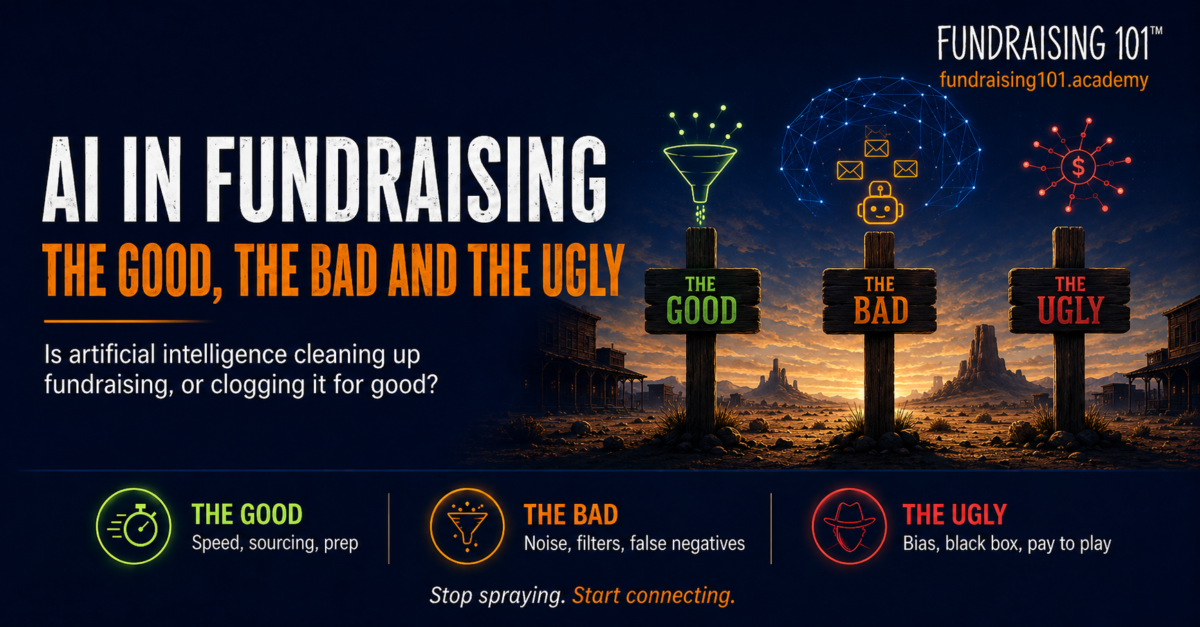
Is artificial intelligence cleaning up fundraising, or clogging it for good?

By Robert Hokin, Managing Partner, Fundraising101
30 years in venture capital. 80+ companies invested in. 500+ ventures coached in fundraising. And the single biggest change I’ve watched in the last year isn’t a new fund, a new sector, or a new stage. It’s a machine sitting between every founder and every cheque.
Let me start where I always start: by holding my hand up. I’ve generated investor lists and posted them on LinkedIn. Not using AI, but plenty of advisors on that platform have. It’s fast, it’s cheap, and it looks useful. A year ago, I wrote a piece called The Fundraising Fatberg about what happens next. It touched a nerve. So let me revisit it, and this time give the machines a fair hearing, because the argument has two sides.
Quick reminder of the thesis. Advisor produces an AI generated investor list. Founder fires the same deck at hundreds of funds, no research, no qualification, no relationship. Pure spray and pray. Multiply that by thousands of founders doing the same thing and you get a phenomenon quietly strangling the fundraising ecosystem. The funds, now drowning, deploy AI to screen the flood back out again.
AI created the flood. AI is now building the dam.
I called it a ‘fatberg’ on purpose. A fatberg is what forms in a sewer when people flush things that don’t belong there: a solid, toxic mass that blocks the whole system. That’s what’s forming in investor inboxes, and founders treating fundraising like a marketing funnel are clogging the pipe for everyone.
The noise is real, and the numbers are brutal
This isn’t nostalgia for the good old days. The congestion is measurable. One fund I spoke with invested in 20 portfolio companies but took 3,500 inbound enquiries in a single year, and used AI to screen out over 80 percent before a human saw a single slide.
It gets worse. Only around 1 in 400 startups that seek venture money secure it. Analysts now call the modern pitch deck a filtering machine, built for an investor who has to reject ninety eight percent of what crosses the desk. AI increasingly sits at the top of the funnel, where as little as 5-7 seven percent of submissions reach partner level attention. The rest are sorted by software.
Think about what that means for a real person. A founder spends six months on a deck, finds the courage to approach investors, and gets eliminated by an algorithm in seconds. No human contact. No feedback. Just gone. They don’t even know which filter killed them, or why.
A Startup Boston panel this year put it plainly: spray and pray is finished, because every inbox is overwhelmed and every generic message is easier to ignore than ever. Relevance is the only currency left. I’ve been saying that for a year. It’s nice to have company. But is it?
Now the other side of the table
But honestly (because a 1-way argument is propaganda with footnoted) the case for AI is genuinely strong.
Start with speed. One firm cut its due diligence time by 60 percent with AI tooling. That’s not a gimmick. It’s leverage that lets a small team review more deals properly, instead of letting good companies rot in a maybe pile for months. If you’ve ever been stuck in that pile, you know why it matters.
Then sourcing. Tools like Harmonic, now valued at over one and a half billion dollars, index more than 30 million companies and hunt for signals, a key hire, a domain registration, a founder leaving a big job, long before a raise begins. Rex Salisbury at Cambrian Ventures paused hiring associates because his AI first workflow made them unnecessary. QuantumLight, the 250 million dollar fund co-founded by Revolut’s chief executive, reportedly runs without analysts at all.
The best investors are no longer waiting for your email. They’re already looking for you.
And here’s the argument I find hardest to dismiss. AI can be less biased than the people it replaces. Venture has a long habit of backing founders who look like the founders it backed last time, and anonymous, structured screening can strip some of that out. I predict that the first fund to mainstream blind-screening will see limited partner (LP) money flow into it, simply because it widens the net. For a founder in Glasgow, or anywhere outside London, an algorithm that doesn’t care where you went to school isn’t the enemy. It might be the best friend you’ve ever had.
So why am I still worried? Because the machine can’t see you yet
Here’s my problem. Every model in this game is trained on what got funded before. Feed it history and it hands you back history with a confidence score attached. The same systems sold as anti-bias are, by construction, pattern matchers, and the pattern they’ve learned is the past. That isn’t neutrality. That’s bias with a user interface.
And the part that should worry every early-stage founder is the false negative. AI is decent at flagging risk, but dreadful at spotting conviction. It can’t read team dynamics, raw resilience, or the particular madness of someone who will run through walls for ten years. As one analysis put it, in the messy middle between promise and proof, founders look like noise, not signal. That middle is exactly where pre seed lives. It’s where every company I’ve ever loved started, and precisely the zone the filters read worst.
So we’ve built one machine to flood the system and a second to screen the flood, then asked the screener to spot genius in a ten slide PDF it skims in milliseconds. That isn’t a funnel, it’s an arms race, and arms races have no winners, only escalating costs. Founders buy better AI to write decks, funds buy better AI to reject them faster, and somewhere in the middle a brilliant company gets quietly deleted.
We’ve automated the rejection. We haven’t automated the judgement.
Where this goes next, and I’ll be blunt
Let me speculate, I like to be contentious.
First, the realistic one. Within a couple of years the cold pitch is dead. Not declining, dead. Your AI will pitch the fund’s AI: founders running agents that research, target and draft outreach, funds running agents that ingest, score and reply. The logical endpoint is machines talking to machines, with humans pulled in only at the end to rubber-stamp a decision two algorithms already made. Think your inbox is noisy now, wait until both sides are automated.
Second, the hopeful one. The warm introduction doesn’t die in that world. It becomes the single most valuable asset a founder owns. When everything written can be generated, the only signal a machine can’t fake is a trusted human vouching for you. A word from a portfolio founder. A nod from a co investor. An introduction from an ecosystem partner who knows both sides. The scarcer authenticity becomes, the more it’s worth. The fatberg makes the warm intro precious, not obsolete.
Which is why a tool like Boardy is so revealing. Boardy is an AI superconnector: you talk to it by phone, it learns what you’re building and who you need, and it brokers warm, double opt-in introductions across its network. It’s no gimmick, it famously raised its own seed round by charming investors before the founders ever spoke, I’m a user myself. The pros are real. It targets exactly the cold-inbox problem its founder describes, a fund-returning deal going cold because two people never crossed paths, and one UK fundraising firm reported every introduction it got was genuinely worthwhile, not the usual LinkedIn noise. So are the cons. It only connects you to other sign-ups, so it’s a walled garden, the network skews heavily American and Silicon Valley, intros are capped, and plenty of users report matches that never pan out. And here’s the irony at the heart of this piece: if a warm intro is precious because a trusted human stakes their name on it, what is an intro made by a bot? A warmer cold email, or a real vouch? How much will an investor trusts the machine.
Even the cleverest networking AI is only as good as the human relationships it can borrow against.
Third, the contentious one. Reputation layers are coming. Expect verified founder track records, portable diligence, and signal scores that follow you between funds whether you consented or not. Useful, yes. Also a quiet new gatekeeper, with all the bias of the current system, just harder to see and harder to argue with. Be careful what you cheer for.
The Good, the Bad and the Ugly
If you take nothing else from this, take the rundown.
The Good
Used well, AI is the best thing to happen to an under resourced founder in a decade.
- It finds you. Sourcing tools hunt for promising founders before you’ve drafted an email. The gatekeeper comes to you.
- It’s fast. Diligence that took weeks takes days, so good companies spend less time in the maybe pile.
- It widens the net. Anonymous screening can strip out some of the old who-you-know bias, helping founders outside London and the Bay Area.
- It levels the prep. Research, targeting and deck craft that once needed a paid advisor are now within reach of a solo founder at midnight.
The Bad
Used badly, which is most of the time, AI turns a clogged pipe into a sewer.
- The noise. Every founder has the same tools, so funds drown, then automate the rejection. The fatberg, as predicted.
- The false negative. Software flags risk well and conviction badly, and pre seed lives in the messy middle it reads worst.
- The rear view mirror. Models trained on what got funded before hand you back the past with a confidence score, then call it objectivity.
- The silent delete. Founders filtered out by a black box, with no feedback, no reason and no appeal.
The Ugly
My call. The part nobody puts on a conference slide.
- Baked-in gender and ethnic bias. This isn’t a hunch, it’s measurable, and the UK numbers are stark. All-female founder teams still take only around two percent of UK equity investment, a share that hasn’t moved in a decade, and more than eighty percent of UK venture deals are done with no women on the founding team. For Black female founders it’s starker still: across one recent decade, just ten received venture funding, about 0.02 percent of the total. Train a model on who got funded before and you teach it that winners look like the winners always have. A biased human is one person’s prejudice. A biased model is that prejudice automated, scaled and applied to every founder at once, then sold back as objectivity.
- The permanent record. Reputation and signal layers are coming that follow a founder between funds whether they consented or not. A credit score for ambition, with the old bias baked in.
- Pay to play, quietly. Founders who can afford the best tooling get surfaced. The ones who can’t get buried. AI widening the very gap it claims to close.
- The hollowing out. Funds optimising for throughput over judgement, and founders learning to game machines instead of building conviction. That’s the day venture stops being a people business. And that’s the day it breaks.
Where I land: AI isn’t the villain and it isn’t the saviour. It’s an accelerant. It makes a good process faster and a bad process catastrophic. Used well, it finds you, frees up the humans who matter, and widens a network that was too narrow. Used badly, it floods the pipe, filters the flood, and buries the founders the system claims to want.
My position hasn’t moved in thirty years, and the machines haven’t changed it. Venture capital is a people business. It always has been. The founders who cut through won’t have the longest investor lists or the slickest AI generated decks. They’ll be the ones who did the work, qualified properly, and found a route in through someone the investor already trusts.
Stop spraying. Start connecting.
The machines are getting smarter. Be the founder who remembers that, on the other side of every filter, there’s still a person deciding whether to believe in you. Give them a reason a machine never could.
Get Raise-Ready.
Pre-seed tech founder in Scotland? There’s a difference between deck-ready and Raise-Ready. We can help you get there. Fast. With No BS. Visit fundraising101.academy.
Robert Hokin is Managing Partner of Fundraising101 Academy, host of the First Money In podcast and author of the Dry Powder newsletter.