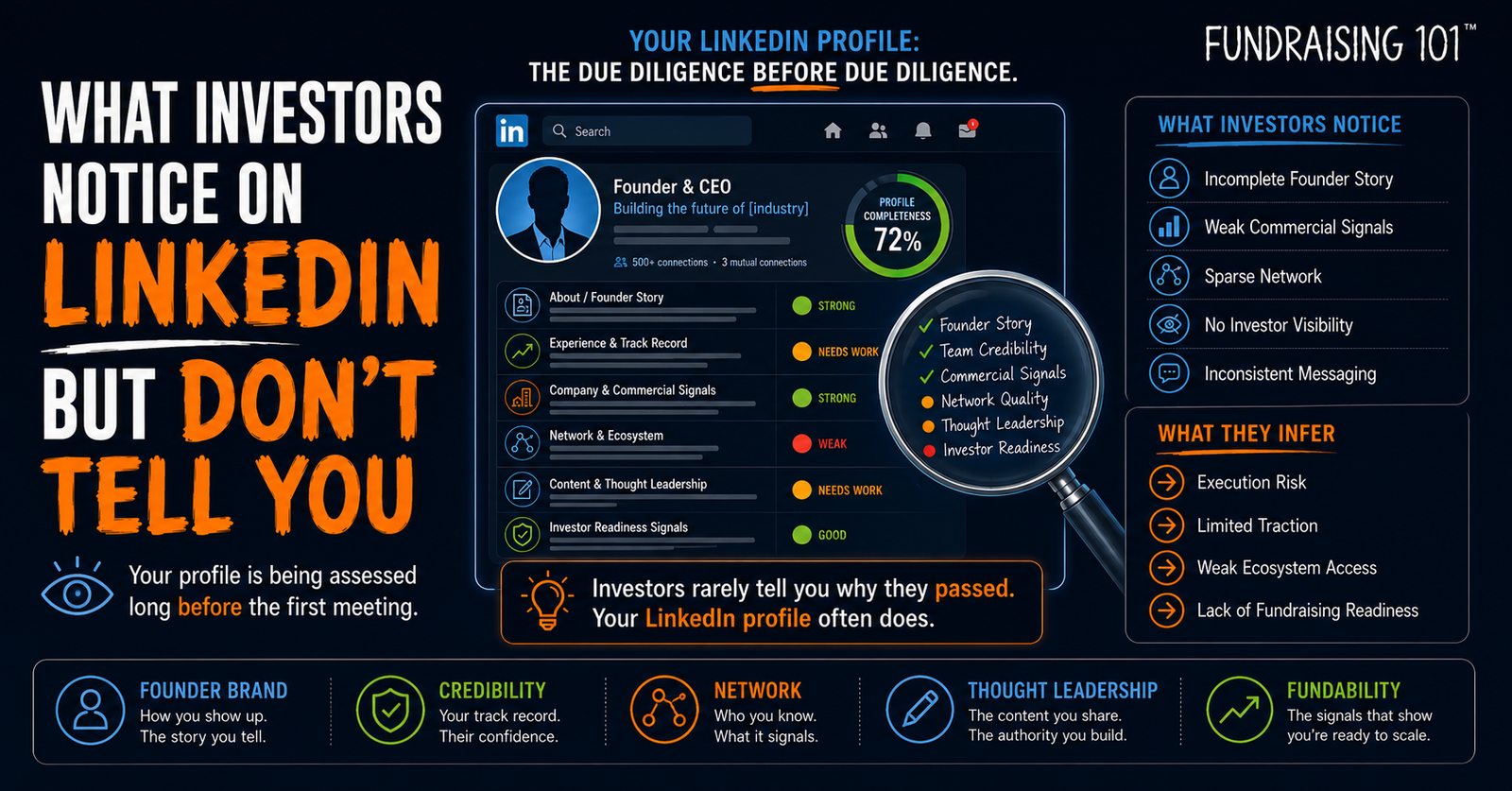
An investor reads your LinkedIn profile. Then they click your co-founder. Or your Head of Sales. And the profile looks like it belongs to a completely different company. That inconsistency is a yellow flag and most founding teams don’t even know it’s there. It starts with your own profile. Here’s the 7-section audit…
Fix These 7 Sections in 20 Minutes, Before the Next Investor looks at it
Here’s what happens before every warm intro, every VC meeting, every angel coffee chat: They Google you. Then they click on your LinkedIn.
Your profile has roughly 8 seconds to tell them: “This founder knows what they’re doing.”
Most founder profiles fail that test, not because the founder isn’t credible, but because the profile doesn’t communicate it. You’ve probably spent hours crafting your pitch deck. But when was the last time you dusted off your LinkedIn profile? If you’re like many, probably 90 seconds when you first signed up and hasn’t been touched since.
That’s the gap. And it’s costing you.
Your pitch deck is seen by a handful of investors. Your LinkedIn profile is visible to every investor, journalist, potential hire, and customer who ever searches your name. It works around the clock, long after your last post has disappeared from the feed.
Here’s the 7-section audit. Set a 20-minute timer. Then let’s go.
01: Headline (2 mins)
Your headline is the most-read line on your entire profile. It shows up in search results, in DM previews, in comment threads — everywhere. Most founders default to their job title: “Co-Founder & CEO at [Startup].” That tells people who you are, not why they should care.
The fix: Replace it with a value statement. Use this formula:
“I help [specific audience] achieve [specific outcome] — without [main pain point].”
My own Example: “I coach Scottish technology founders in how to close pre-Seed investment, faster, without advisors and wasting time on the wrong investors.”
If you’re pre-revenue or still validating, lead with the problem you’re solving and who you’re solving it for. Your headline should also include 2-3 keywords investors or customers might search: seed stage,” “SaaS founder,” “climate tech” because LinkedIn’s algorithm surfaces profiles based on keyword matches, and your headline carries the most weight.
Pro tip: Turn on Creator Mode in your settings. It swaps the “Connect” button for “Follow,” puts your featured content front and centre, and signals to LinkedIn’s algorithm that you’re an active voice. Profiles with Creator Mode enabled get meaningfully more organic reach.
02: Banner Image (3 mins)
Your banner is the first visual anyone sees when they land on your profile — it loads before they read a single word. Most founders leave it as a company logo or LinkedIn’s default gradient. Both are wasted space.
The fix: Your banner should communicate transformation. What changes for someone when they work with you, invest in you, or join your team? It should answer that question before anyone reads your headline.
Example: “Helping B2B founders generate inbound leads – without cold outreach or paid ads.”
You can build a clean, professional banner in 10 minutes using Canva (free). Use your brand colours, a clear one-line value statement, and your website URL. Keep it simple. The goal isn’t to be beautiful – it’s to be clear.
Investors and customers form an impression in under 50 milliseconds. A strong banner makes the next 8 seconds work harder.
03: About Section (4 mins)
This is your best opportunity to tell your story. Most founders waste it by opening with their own background: “I’ve spent 10 years in enterprise software…” Your reader doesn’t care…yet. They’re wondering whether you understand their world.
The fix: Open with your ideal customer’s (or investor’s) problem, so they feel seen before you’ve said anything about yourself. Then introduce yourself in the context of how you solve it. Close with exactly one clear CTA.
A strong structure looks like this:
- Hook: their problem, in their language. (2-3 sentences.)
- Your credibility: why you, why now. Include real numbers where you have them.
- What you’re building or working on right now.
- One CTA: a calendar link, a newsletter signup, your website. One. Not three.
Write in first person. “I am a founder” not “Robert is a founder who…” This is a social network. People want to hear from you, not read your CV.
LinkedIn’s algorithm also scans your About section for keywords. Weave in 4-6 relevant terms naturally i.e., “early-stage,” “seed round,” your industry vertical, your target customer type. Don’t stuff it. Just be specific.
04: Featured Section (3 mins)
Most founders either leave this empty or fill it with their most popular content. Both miss the point. Your Featured section isn’t a highlight reel. It’s proof.
The fix: Pin the things that prove you can solve the problem your ideal reader arrived with. Think: investor evidence, customer results, frameworks that demonstrate expertise.
The best Featured sections for fundraising founders include:
- A post or case study showing a specific result you’ve driven (“How we grew from 0 to 1,000 users in 60 days with zero paid spend”)
- A link to your company website or product
- A newsletter or resource that shows your thinking
- A media mention, podcast appearance, or press piece if you have one
The Featured section sits directly below your headline. It’s often the first thing people scroll to. Use it like a proof point, not a portfolio.
05: Experience Section (3 mins)
Rewriting your CV with different words doesn’t cut it. Investors aren’t looking for responsibilities – they’re looking for evidence that you can execute.
The fix: Rewrite every entry around outcomes. What moved as a result of your work?
Before: “Managed a sales team of 6 across EMEA.” After: “Built and led a 6-person EMEA sales team. Grew ARR from £400k to £1.6M in 18 months.”
If you’re an early-stage founder with limited operating history, use your current role to show traction: users acquired, revenue milestones, partnerships closed, rounds raised. Even pre-revenue, you can show velocity — interviews conducted, validation experiments run, advisors brought on board.
If you have earlier experience at recognisable companies or with notable exits, surface those prominently. Social proof from past roles compounds with your current story.
06: Skills & Recommendations (2 mins)
This section is almost universally ignored by founders. Which means it’s easy to stand out.
The fix: Add 5-8 skills that match the keywords investors and customers actually search. LinkedIn uses skills for ranking in search results – being endorsed for “Fundraising,” “SaaS,” or “Product Strategy” improves your discoverability.
More importantly: ask for recommendations. A short, specific recommendation from an investor, customer, or co-founder saying what you actually accomplished is worth more than anything you write about yourself.
Even one or two strong recommendations builds the kind of trust that makes a cold viewer become a warm one. Ask someone specific. Make it easy for them – draft a suggestion of what to say.
07: Contact & Call to Action (2 mins)
This is probably the most ignored section on every founder profile – which makes it the highest-leverage fix.
The fix: Add a calendar link directly to your About section. If you’re in fundraising mode, make booking a call as frictionless as possible. Use Calendly, Cal.com, or whatever your team uses.
Also check your contact settings. Many founders accidentally have DMs turned off, or only allow connections to message them. Go to Settings > Communications and make sure anyone can send you a message. You don’t know which investors are trying to reach you right now.
Remove every friction point between “someone being interested” and “someone taking action.”
Your 20-Minute Audit Checklist
- Does your Headline state a specific outcome for a specific audience, with keywords?
- Does your Banner visually communicate transformation or your core value proposition?
- Does your About section open with their problem (not your background)?
- Is your About section written in first person with a single clear CTA?
- Does your Featured section prove you can solve the problem, not just that you post?
- Does every Experience entry show results, not just responsibilities?
- Do you have 5+ relevant Skills listed, and at least one Recommendation?
- Is there a calendar link or direct contact method that’s impossible to miss?
- Have you turned on Creator Mode?
Nine checks. Twenty minutes. Your profile will be doing more work than most founders’ entire content strategy.
Next Steps – The problem most founders don’t notice until it’s too late.
An investor reads your polished profile. Now they’re impressed. Then they click through to your co-founder. Or your Head of Sales. Or your first engineering hire.
And the profile looks like it belongs to a completely different company.
No consistent messaging. No clear signal of what the team is building. One person says “we help SMEs with finance automation.” Another says “passionate about fintech disruption.” A third hasn’t updated their headline since their last job.
To an investor, that inconsistency is a yellow flag. It suggests a team that isn’t aligned on its own story. which makes them wonder WHAT ELSE isn’t aligned.
Your LinkedIn profile doesn’t exist in isolation. It’s part of a team brand. And right now, most startup teams have no brand consistency at all on LinkedIn.
The fix is simple, and it takes one team meeting:
- Agree on a shared company description (2 sentences max) that everyone uses in their About section
- Align on the problem you’re solving and the audience you’re solving it for — so every headline points in the same direction
- Ask each team member to run this same 7-section audit on their own profile
- Set a shared banner template (same Canva file, personalised per person) so there’s visual consistency across the team
You don’t need everyone to sound identical. You need everyone to sound like they’re working on the same thing.
Send this article to your team. Block 30 minutes in the calendar. Do it together.
The investors who look you up will notice — even if they never say so.
Want more resources like this? Find more resources here for founder playbooks, templates, and practical guides — and sign up for our newsletter for free, actionable startup insights delivered straight to your inbox.