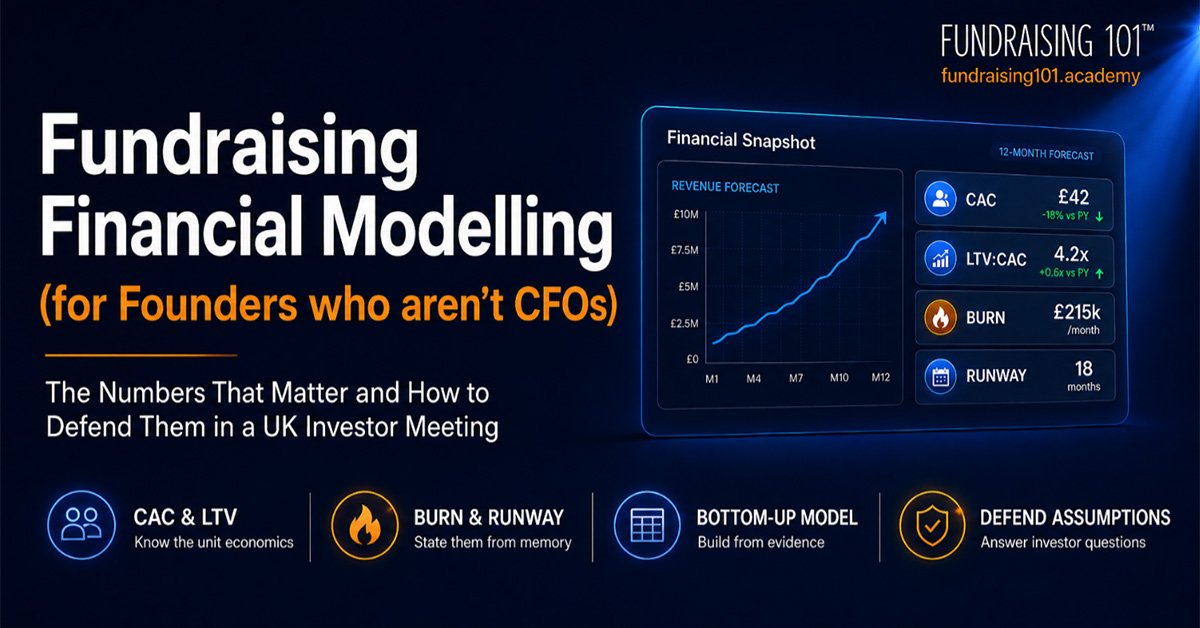
The Numbers That Matter and How to Defend Them in a UK Investor Meeting

By Robert Hokin, Managing Partner, Fundraising101
“A financial model is a quantitative representation of a company’s operations and financial performance, used to forecast future revenues, costs, cash flows, and financial position under a defined set of assumptions.”
Standard accounting and corporate finance definition, aligned with ICAEW guidance
Why This Matters
I have sat in hundreds of pitch meetings over 30 years. The founders who fumble their own financial projections, who have to look at their deck to answer a question about their own burn rate, or who can’t explain what causes the revenue inflection in year three of their model, do more damage in that moment than any individual bad assumption in the model. It’s not the number that’s the problem. It’s that not knowing it signals you don’t understand your own business as a business.
UK tech investors don’t expect pre-seed founders to have CFO-grade financial models. They do expect financial coherence, that you understand the economic logic of what you’re building, can state the numbers that matter from memory, and can defend your assumptions with evidence rather than optimism. This article covers what UK investors actually look for, the numbers every founder must know before walking into a meeting, how to build assumptions that survive questioning, how the capital-efficiency lens has sharpened since 2024, and the most expensive modelling mistakes in a pitch deck. It closes with what three parts of the UK ecosystem actually say, and a comprehensive Raise-Ready checklist.
What UK Investors Actually Want to See
At pre-seed, investors are not expecting detailed bottom-up revenue models with granular customer acquisition funnels. They are looking for evidence that you understand the financial logic of your business. Specifically: how does the business make money; what does it cost to acquire and serve one customer; how do those economics scale with volume; what does this round achieve in terms of concrete milestones; and what does the business look like at the end of the runway period.
A well-constructed one-page financial summary that answers these questions clearly is more impressive than a 50-tab Excel model with undefendable assumptions. Investors read your model to see how you think, not to predict your exact revenue. They know the numbers will move. What they are testing is whether you understand the drivers behind them. The model is not the point. The understanding behind it is.
There are two ways to build the numbers. A bottom-up model starts from your own units: customers, conversion rates, pricing, and the cost to acquire and serve each one. A top-down model starts from a big market and assumes you capture a slice of it. UK investors trust bottom-up and are wary of top-down, because top-down is where founders reverse-engineer a number they want to reach. Use top-down only as a sanity check on a bottom-up model, never as the model itself. The same applies to market sizing: a credible total addressable market is built from the ground up, not asserted as a share of the whole planet.
The Numbers Every Founder Must Know
Customer Acquisition Cost (CAC): how much it costs on average to acquire one customer, including all sales and marketing spend. This number must come from evidence: a pilot, a cohort, or a controlled experiment, not a benchmark from an American SaaS report.
Customer Lifetime Value (LTV): the total net revenue expected from one customer over the full period of their relationship with the business. For subscription businesses: average monthly revenue divided by monthly churn rate. Your LTV:CAC ratio should ideally be above 3:1 and trending upward. A ratio below 1:1 means you are spending more to acquire customers than they are worth over their lifetime, which is structurally fatal at scale. Alongside the ratio, know your payback period: how many months of revenue it takes to recover the cost of acquiring a customer. Investors increasingly ask for it.
Gross margin and contribution margin: gross margin is revenue minus the direct cost of delivering your product. Contribution margin per customer strips that down to what one customer actually contributes after the variable costs of serving them. Both tell an investor whether the unit economics work before any overhead.
Monthly burn rate: how much cash the company spends each month. Know this precisely. Not approximately. Precisely. Runway: how many months of cash the company has at current burn. Both numbers will be tested in every serious UK investor conversation. Not knowing either from memory is a significant credibility cost.
Build Assumptions That Survive Questioning
The most important word in financial modelling is not forecast. It is assumption. Every projection is only as credible as the assumptions underlying it. Good assumptions are anchored in evidence: historical performance if you have it, customer conversations and letters of intent, comparable businesses in the UK market, and sector-specific industry data from sources like Beauhurst or UK Private Capital (formerly the BVCA).
For every key assumption in your model, be able to answer two questions: what evidence supports this number? And what would have to be true for this assumption to be wrong? If you can’t answer both, the assumption isn’t defensible. Document the source behind each one, group similar assumptions together, and keep your inputs separate from your outputs so a reviewer can follow the logic. Focus your effort on the handful of assumptions that actually move the model, rather than polishing every line. Build the evidence first, then build the model around it.
Two practices separate a credible model from a hopeful one. First, present ranges, not just point estimates. Instead of arguing whether conversion will be two percent or five, show the range and what each end does to the outcome. Second, build scenarios: a base case, an optimistic case, and a conservative case, each with explicit assumptions. Then run a sensitivity check on the variables that matter most, including the obvious one in this market: what happens to your runway if the raise slips by a quarter.
Runway, Burn, and the Capital-Efficiency Lens
UK investors expect a pre-seed raise to buy roughly 18 to 24 months of runway, enough to develop the product, find early customers, and reach the milestones that unlock the next round. Tie the raise to those milestones, not to a generic split of spend. “40% product, 35% sales, 25% G&A” is not a plan. “This round takes us to a working product, ten paying customers, and the metrics a seed investor needs” is.
Since 2024 the lens has shifted from growth at all costs to capital efficiency. One number now does a lot of work in investor conversations: the burn multiple, your net cash burn divided by net new annual recurring revenue. A multiple under one is excellent. Above two, expect a harder conversation about whether your spend is creating proportional value. Two practical points often trip founders up. If you are not yet paying founder salaries, model burn at market salaries as well, because excluding them gives a false sense of runway. And remember investors think in cash: revenue minus cost of goods sold is gross margin, but revenue minus all operating costs minus capital expenditure is cash. Present both and never confuse them in a meeting.
The Most Expensive Modelling Mistakes
The hockey stick revenue curve with no explanation of what changes is the most common and most expensive mistake in UK pre-seed financial models. Flat years one and two, then exponential growth in year three. Every UK investor has seen this hundreds of times. The question they always ask is “what causes the inflection?” It reveals immediately whether you understand your growth drivers or whether you reverse-engineered the curve from a target number.
The second mistake is costs that don’t scale with revenue. Every hire needed to service growth, every infrastructure cost associated with scale, must appear in the model as revenue grows. The third is confusing gross profit with cash, covered above. The fourth is a model the founder cannot defend, often because it was outsourced or copied from a template and never truly understood. When an investor questions an assumption and the founder can’t explain the logic, confidence evaporates. The fifth is narrative drift: your financial model should be the mathematical twin of your pitch deck. If the deck says one thing and the model says another, you create friction with the exact people you are trying to win over.
What the UK Ecosystem Says
Three different parts of the UK funding landscape, a national agency, an accelerator, and a venture fund, converge on the same point: at the early stage, the assumptions matter more than the forecast, and you should expect to defend them.
Scottish Enterprise (Scotland’s national economic development agency): Its financial readiness guidance is blunt about what a model is for: in its words, “a set of financial projections is a financial model,” and the right content and format depend on the audience. A model built to attract investment is not the same as one built to appraise a product launch. It also warns that funders will run their own sensitivity analysis on your numbers, so you should understand your key risks and have mitigations ready before anyone stress-tests them for you.
Seedcamp (Europe’s leading seed fund and accelerator, paraphrased): The view from accelerators like Seedcamp, often a founder’s first institutional backer, is that capital efficiency matters as much as ambition. The strongest pre-seed plans use the raise to reach specific, named milestones with minimal funding, rather than to buy time. The expectation is that founders already have a firm grip on burn, runway, and unit economics before they pitch, not after.
Octopus Ventures (one of the most active early-stage VCs in the UK and Europe): Octopus Ventures tells pre-seed founders that almost everything at this stage is rooted in assumptions, and what counts is that those assumptions are well founded. In its own guidance, they “can’t be plucked out of the air,” and you should expect to be questioned on every one. A simple model, they add, mainly helps them understand what you are trying to achieve, rather than predict your exact revenue.
The Raise-Ready Financial Checklist
Work through this before your next investor conversation. Be honest about the gaps. If you can’t answer any of these confidently, that’s a signal. Fix the gap before the investor finds it.
Unit Economics
- Can you state your CAC from evidence, not assumption?
- Do you have an LTV calculation based on actual or piloted retention data?
- Is your LTV:CAC ratio above 3:1, and is it trending in the right direction?
- Do you know your payback period in months?
- Do you know your gross margin and your contribution margin per customer?
Cash and Runway
- Can you state your current monthly burn and runway from memory, without looking at a spreadsheet?
- Does the raise give you 18 to 24 months of runway to the next milestone set?
- Do you know your burn multiple, and can you defend it if it is above one?
- If you are not paying founder salaries yet, have you modelled burn at market salaries too?
- Can you explain the difference between your gross margin and your cash position cold?
Assumptions and Evidence
- Does every significant assumption have documented evidence behind it?
- Is your revenue built bottom-up, with top-down used only as a sanity check?
- Is your total addressable market built from the ground up rather than asserted?
- Can you name the single biggest assumption that could make the model wrong?
- Do you show ranges on key drivers rather than only single point estimates?
Model Integrity and Structure
- Does your cost model include every hire and infrastructure cost needed to service projected growth?
- Are your inputs kept separate from your outputs so a reviewer can follow the logic?
- Have you benchmarked your projections against UK sector comparables?
- Have you checked the model for formula errors that could overstate revenue or understate cost?
- Did you build the model yourself, and can you defend every line of it?
Scenario and Sensitivity
- Have you built base, optimistic, and conservative cases with explicit assumptions for each?
- Have you run a sensitivity check on the variables that matter most?
- Do you know what happens to your runway if the raise slips by a quarter?
- Have you identified your key risks and have credible mitigations ready?
Investor Readiness and Narrative
- Does your raise amount tie directly to three to five named milestones?
- Is your financial model the mathematical twin of your pitch deck?
- Can you explain precisely what causes any inflection in your revenue growth?
- Can you answer concisely what the business looks like at the end of the runway?
- Do your forecasts and use of proceeds reconcile with your SEIS or EIS advance assurance?
- Can you present your key numbers on one clean financial slide?
Takeaways
- Know your numbers from memory: CAC, LTV, the LTV:CAC ratio, payback period, monthly burn, and runway. Any serious UK investor will ask, and looking them up costs you credibility.
- Assumptions matter more than projections. A model with defensible assumptions and modest projections beats one with impressive projections you cannot defend. The UK ecosystem agrees on this from the national agency to the accelerators to the funds.
- Build bottom-up, present ranges. Trust your own units over a slice of a big market, and show the range around your key drivers rather than a single hopeful number.
- The hockey stick must be explained. If your model shows an inflection, state precisely what changes at that point and why. Not having the answer is more damaging than the curve itself.
- Efficiency is the 2026 lens. Know your burn multiple, model founder salaries even if unpaid, and tie the raise to named milestones rather than a generic split of spend.
- One model, one story. Your financial model and your pitch deck must tell the same story in numbers and words. A clean single slide with your key metrics beats five slides that obscure them.
Additional Resources
- The Business Finance Guide (ICAEW and British Business Bank), icaew.com/bfg. Free, independent, and built with more than 20 UK professional bodies. It walks you through every debt and equity option by stage and by reason for raising, so you can sanity-check that the finance type behind your model actually fits the business. Start here before you build anything.
- Scottish Enterprise, Raise finance using financial projections, scottish-enterprise.com. A free, practical guide to building financial projections for fundraising, including format, timespan, and how funders sensitivity-test your numbers. Scotland-based founders can also speak to their financial readiness team directly.
- British Business Bank Finance Hub, british-business-bank.co.uk/finance-hub. Impartial UK guidance on finance options, with practical equity and investor-readiness articles. The guides on equity funding stages and proving value to investors are a useful cross-check on whether your raise amount and milestones are realistic for pre-seed.
- Octopus Ventures, pre-seed guidance, octopusventures.com. A UK and European VC that publishes plain guidance on what it looks for at pre-seed, including how it weighs assumptions, bottom-up market sizing, and a simple financial model. Useful for seeing how an active fund actually reads early numbers.
- Beauhurst, beauhurst.com/research. The strongest source of UK-specific benchmarking data. Their flagship annual report, The Deal (produced with Mercia), covers deal sizes, valuations, sector trends, and regional splits. Use it to anchor your assumptions in UK comparables rather than the American SaaS benchmarks this article warns against.
- UK Private Capital (formerly the BVCA), bvca.co.uk. The trade body for UK venture capital, now operating as UK Private Capital. Its Looking for Funding resources, the annual Venture Capital in the UK report, and its model legal documents (term sheet, shareholders’ agreement) give you market context and the structures your raise will sit inside.
- SEIS and EIS guidance (GOV.UK, HMRC), gov.uk. Search “use a venture capital scheme to raise money for your company”. At UK pre-seed, SEIS and EIS shape your share structure, your cap table, and how investors read your raise. Your forecasts and use of proceeds have to reconcile with what you submit for advance assurance, so build the model and the SEIS/EIS story together.
- F101 Blueprint Bundle, fundraising101.academy. Includes structured guidance on presenting a pre-seed financial model to UK investors, the numbers framework above, and how to tie your raise amount to named milestones.
Get Raise-Ready.
Pre-seed tech founder in Scotland? There’s a difference between deck-ready and Raise-Ready. We can help you get there. Fast. With No BS. Visit fundraising101.academy.