
Revised by
By Robert Hokin, Managing Partner, Fundraising101
Where to Start. Who to Talk To. If you’re building something in biotech, synthetic biology, industrial biotech, life sciences or the bio-based circular economy, geography still matters.
Labs cost money. Equipment costs money. Proximity to the right expertise matters enormously. And choosing the wrong programme can cost you 12 months you can’t get back.
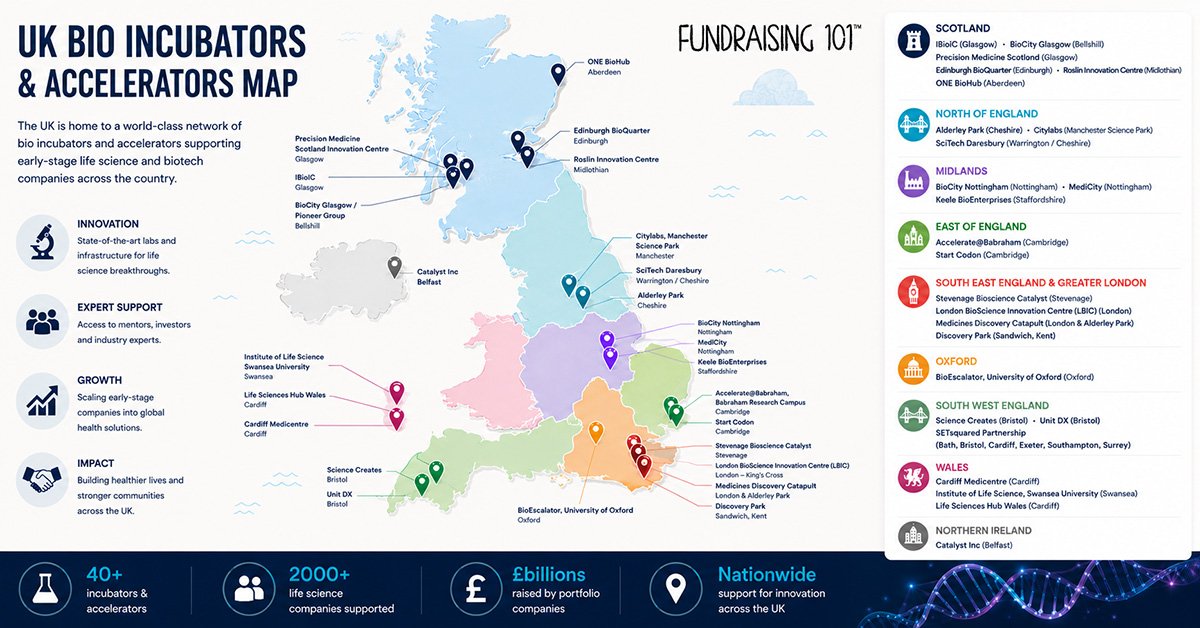
This is not an exhaustive directory. But it’s a practical starting point: a map of the key bio-focused incubators and accelerators across the UK. Where they sit. What they do. Whether they’re worth your time.
We start in Scotland, which is where Fundraising 101 is based and where we do most of our work. Then we work our way south and around. Past that is a list of Grants for Early-Stage and Pre-Proof of Concept Bio Ventures.
What This Means for You
A list is just a list. The hard part is knowing which of these is right for your stage, your science, and your funding trajectory. Some are pre-revenue incubators. Some expect an MVP. Some want a published paper. Some take equity. Some don’t. Most of them will ask to see your deck before they say hello.
That’s where Fundraising 101 comes in.
If you’re a bio-based tech founder in Scotland, or anywhere in the UK, the question isn’t just which programme. It’s: “are you ready to make the most of it”? A weak deck, a vague ask, and an unclear raise structure will get you politely declined from every on the list. We see it constantly.
Consider a Raise-Ready Deck Review before you apply to one. It covers 70 assessment points, maps your gaps, and benchmarks your deck against what the fund sift behind these programmes actually looks for. Plus a list of Investors and Grants engaged in your sector specific area. We can help you get ready. Find out more here.
Scotland
IBioIC — Biotech Innovators Accelerator (Glasgow)
The Industrial Biotechnology Innovation Centre runs Scotland’s only specialist industrial biotech accelerator — cohort-based, mentor-led, and built specifically for early-stage spinouts in the bioeconomy sector.
BioCity Glasgow / Pioneer Group (Bellshill — M8 corridor, Glasgow–Edinburgh)
A 20-acre former MSD pharma site turned biotech cluster, offering GMP-grade labs, cryostorage, and a compound management library — serious infrastructure for serious science businesses.
Edinburgh BioQuarter (Edinburgh)
One of the UK’s largest health innovation zones, co-locating clinical delivery, academic research and early-stage commercial companies on a single campus next to the Royal Infirmary of Edinburgh.
Roslin Innovation Centre (Midlothian / Edinburgh)
Part of the University of Edinburgh’s Easter Bush Campus, focused on agri-tech, livestock biology, food security and One Health — a genuine niche with a strong academic engine behind it.
ONE BioHub (Aberdeen)
Operated by Opportunity North East, this is the primary life sciences incubator for the North East of Scotland — lab and office space, commercialisation programmes, and access to Aberdeen’s growing health research ecosystem.
Precision Medicine Scotland Innovation Centre (Glasgow)
Focuses on research translation at the intersection of data science and life sciences — a strong programme for founders working in diagnostics, therapeutics personalisation, or clinical AI.
North of England
Alderley Park (Cheshire)
The former AstraZeneca R&D campus is now one of the UK’s largest life sciences clusters — over 200 companies on site alongside Cancer Research UK Manchester Institute and the Medicines Discovery Catapult, with an Accelerator programme pairing 200+ mentors with serious lab infrastructure.
Citylabs, Manchester Science Park (Manchester)
Purpose-built for health tech and life sciences in the heart of Manchester’s hospital district — co-located with the Manchester University NHS Foundation Trust, giving it a clinical adjacency few UK incubators can match.
SciTech Daresbury (Warrington / Cheshire)
STFC-backed science and technology campus with life sciences capability alongside deep tech — worth knowing if you’re in the North West and your work has a physics or engineering biology crossover.
Midlands
BioCity Nottingham (Nottingham)
One of the UK’s original dedicated biotech incubators — flexible lab and office space with a track record in drug discovery, med-tech and healthcare startups, and a pipeline of investable companies to its name.
MediCity (Nottingham)
A collaboration between Alliance Healthcare (Boots) and BioCity, focused on diagnostics, consumer healthcare and medical technology — particularly relevant if your product has a consumer health or OTC pathway.
Keele BioEnterprises (Staffordshire)
University of Keele’s life sciences incubator — smaller scale, but a useful option for founders based in the Midlands who want proximity to a research institution without the London or Cambridge price tag.
East of England
Accelerate@Babraham, Babraham Research Campus (Cambridge)
One of the top 25 biotech incubators in Europe (Labiotech, 2022) — 40+ companies supported, £72.5m raised across alumni, and a campus community that genuinely behaves like one. Pre-seed focused. This should be on your list.
Start Codon (Cambridge)
Based at the Milner Therapeutics Institute, Start Codon is focused on therapeutics, diagnostics and platform technologies — and one of the few UK accelerators offering meaningful early investment up to £250k.
Nucleate UK (Cambridge / London / Oxford — Golden Triangle)
A non-profit accelerator programme, US-proven and now UK-active — not a physical incubator, but focused on education and early-stage venture building for researchers looking to translate their science into fundable companies.
South East England & Greater London
Stevenage Bioscience Catalyst (Stevenage, Hertfordshire)
Home to GSK, LifeArc, the Cell and Gene Therapy Catapult and Cytiva — resident companies have raised over £4bn collectively. One of the strongest sites in Europe for advanced therapies. Underrated by founders outside the Golden Triangle.
London BioScience Innovation Centre (LBIC) (London — King’s Cross)
Founded in 2000, now home to 60+ life science companies in the King’s Cross Knowledge Quarter alongside the Francis Crick Institute, AstraZeneca and Google DeepMind. Physical lab space and virtual client packages available.
Medicines Discovery Catapult (London & Alderley Park)
Government-backed and focused on accelerating drug discovery — less an incubator and more a strategic partner for companies that need scientific infrastructure and expert network access at the pre-clinical stage.
Discovery Park (Sandwich, Kent)
A former Pfizer R&D campus repurposed as a life sciences cluster — purpose-built labs, strong heritage infrastructure, and growing momentum as a hub for pharma, biotech and diagnostics businesses outside London.
Oxford
BioEscalator, University of Oxford (Oxford)
Co-located with Oxford’s medical research infrastructure at the Old Road Campus — companies here have collectively raised over £1.4bn. Focused on early-stage therapeutics, diagnostics and platform technologies.
South West England
Science Creates (Bristol)
Born out of founder frustration at the absence of lab space in Bristol — runs the UKRI-backed Engineering Biology Accelerator (EngBio) and provides one of the few genuine wet lab incubator options in the South West.
Unit DX (Bristol)
A converted warehouse turned biotech lab hub — independent, founder-built, and increasingly well-regarded for life sciences startups who want proximity to Bristol’s university ecosystem without being tied to a university.
SETsquared Partnership (Bath, Bristol, Cardiff, Exeter, Southampton, Surrey)
A multi-university enterprise partnership with life sciences capability across several nodes — less specialised than the dedicated biotech options but useful for flexible support across health and bio disciplines.
Wales
Cardiff Medicentre (Cardiff)
One of Wales’s principal life sciences incubators, providing flexible lab and office space adjacent to the University Hospital of Wales — well-placed for clinical translation work.
Institute of Life Science, Swansea University (Swansea)
A dual-site academic incubator focused on biomedical research and clinical innovation — strong in digital health and medical devices, with good NHS Wales pathway connections.
Life Sciences Hub Wales (Cardiff)
Welsh Government-backed ecosystem connector for life sciences in Wales — not a traditional incubator, but the critical gateway to funding, partnerships and the NHS Wales clinical pathway for Welsh-based founders.
Northern Ireland
Catalyst Inc (Belfast)
Belfast’s principal innovation campus with a growing life and health sciences focus — the entry point for most NI-based bio founders and a gateway to Invest NI support and the Belfast–Derry innovation corridor.
Get Raise-Ready.
Pre-seed tech founder in Scotland? There’s a difference between deck-ready and Raise-Ready. We can help you get there. Fast. With No BS. Visit fundraising101.academy
Appendix: Grants for Early-Stage and Pre-Proof of Concept Bio Ventures
Incubators and accelerators get you into the right room. Grants get your science off the bench. The two work in parallel, and the smart founders pursue both simultaneously. The landscape below covers the principal grant mechanisms available to UK-registered bio companies at feasibility and proof of concept stage — including EU programmes that remain accessible to UK companies following association to Horizon Europe. Grant programmes open and close; amounts and eligibility criteria change. Always verify current status directly with the funder before investing time in an application. Where a programme is currently paused or being relaunched, we’ve said so.
UK Grants
Innovate UK Biomedical Catalyst (National)
The flagship grant mechanism for UK life sciences SMEs. Covers Feasibility Studies (early-stage exploration), Primer Awards (technical evaluation through to PoC in a model system), and Early-Stage Awards (data packages for clinical or relevant setting testing). Technology-agnostic across therapeutics, diagnostics, medtech, digital health and AI in health. Runs competitive thematic calls throughout the year.
UKRI Translation: Proof of Concept (National)
A cross-council UKRI programme (BBSRC, MRC, EPSRC, NERC and others) supporting research commercialisation activities to develop new products, processes and services. Awards of £100,000–£250,000 at 80% FEC, up to nine months duration. Open to UK research organisations. Not for discovery research — requires a clear commercialisation pathway via venture creation, licensing or equivalent.
Innovate UK Smart Grants (National)
Sector-agnostic, business-led R&D grants for UK SMEs and researchers working on genuinely disruptive innovation. Covers feasibility through to late-stage development. Runs multiple rounds per year. One of the most accessible entry points to Innovate UK funding for early-stage companies that don’t fit a specific thematic call.
Innovate UK Contracts for Innovation (formerly SBRI) (National)
Public sector challenge-driven funding — government departments commission innovative solutions through competitive phased contracts. SBRI Healthcare (NHS-focused) is the most relevant strand for bio health founders. Phases typically run from feasibility (Phase 1, up to ~£100k) through to prototype development (Phase 2). No equity taken. No repayment required.
NIHR Invention for Innovation (i4i) (National)
Translational research funding for medical devices, in vitro diagnostics and digital health technologies with an existing or emerging health or social care need. Requires demonstrated proof of concept with a clear NHS adoption pathway. The FAST stream (£50k–£100k, 6–12 months) bridges early feasibility to product development. Now open to applicants from Scotland, Wales and Northern Ireland.
SMART: SCOTLAND (Scottish Enterprise) (Scotland only)
R&D feasibility grants for Scottish SMEs undertaking high-risk, commercially-focused projects. Awards up to £100,000. Priority sectors include industrial biotechnology, life sciences, energy transition and critical technologies. Currently on hold — Scottish Enterprise is relaunching with a new fund in summer 2026. Sign up for SE newsletter updates.
Scottish Government Proof of Concept Fund (Scotland only)
University-routed funding for early-to-mid-stage commercialisation of research. Tier 1 (£50,000–£124,999) for early technical and commercial validation; Tier 2 (£125,000–£250,000) for projects with a clear commercial opportunity refining technical requirements. Applications must be channelled through a university IP and commercialisation team. The 2025–26 round awarded £2.85m across 18 projects.
IBioIC Feasibility Fund (Scotland only)
Up to £30,000 for industry-academia collaborative feasibility projects in industrial biotechnology. Must involve at least one IBioIC higher education institution partner and be led by a company with a Scottish footprint. Designed as a stepping stone to larger awards — SMART: SCOTLAND, Innovate UK KTP or BBSRC LINK. Rolling call; closes when funding is allocated.
Knowledge Transfer Partnerships (KTP) (National)
Government-funded, academically-anchored R&D partnerships placing a qualified associate into a business to lead a specific innovation project. Businesses typically contribute around one-third of costs. Strong track record in translating university science into commercial applications, and a credible route to building PoC-level evidence with academic horsepower behind it.
EU Grants Available to UK Companies
Following UK association to Horizon Europe, UK organisations are eligible for all four EIC (European Innovation Council) funding schemes. Note: UK companies cannot access the equity investment component of the EIC Accelerator — grant-only applies. Consortium rules vary by scheme. For guidance, contact the UK National Contact Points for Horizon Europe via Innovate UK Business Connect.
EIC Pathfinder (EU — UK eligible in consortium)
Grants of up to €4 million for multi-disciplinary research teams pursuing visionary, high-risk science with the potential for technology breakthroughs. UK organisations can participate as part of a minimum three-country consortium. The 2026 budget is €262 million. Relevant challenge areas include biotech, AI for health and the circular economy. Open call deadline: 12 May 2026.
EIC Transition (EU — UK eligible)
Grants of up to €2.5 million to bridge the gap between early research results and market-ready innovation. Restricted to projects building on outputs of EIC Pathfinder, ERC Proof of Concept, or eligible Horizon Europe collaborative R&D projects. Validates and matures novel technologies into investable propositions. Open to single applicants and consortia.
EIC Accelerator (EU — UK SMEs eligible (grant-only))
Grants of up to €2.5 million for high-impact SMEs and startups developing innovations with the potential to create new markets or disrupt existing ones. UK companies can apply for the grant component only — equity blended finance is not available to UK applicants post-Brexit. Applications are assessed monthly in 2026 under both Open and Challenge calls.
EIC Advanced Innovation Challenges (EU — UK eligible)
A new pilot scheme in the 2026 EIC Work Programme providing staged funding to validate and develop high-risk deep-tech innovations — including biotech and health applications. Details and deadlines are published in the EIC 2026 Work Programme. UK organisations should contact Innovate UK Business Connect’s European team for eligibility guidance before applying.
Horizon Europe Collaborative R&D — Clusters 1 and 6 (EU — UK eligible in consortium)
Cluster 1 (Health) and Cluster 6 (Food, Bioeconomy, Natural Resources and Agriculture) of Horizon Europe’s Pillar 2 fund consortia-based R&D projects directly relevant to bio-based ventures. UK organisations can participate fully as consortium partners. Budget and call schedule published annually in the Horizon Europe Work Programme.
Get Raise-Ready. Pre-seed tech founder in Scotland? There’s a difference between deck-ready and Raise-Ready. We can help you get there. Fast. With No BS. Visit fundraising101.academy.