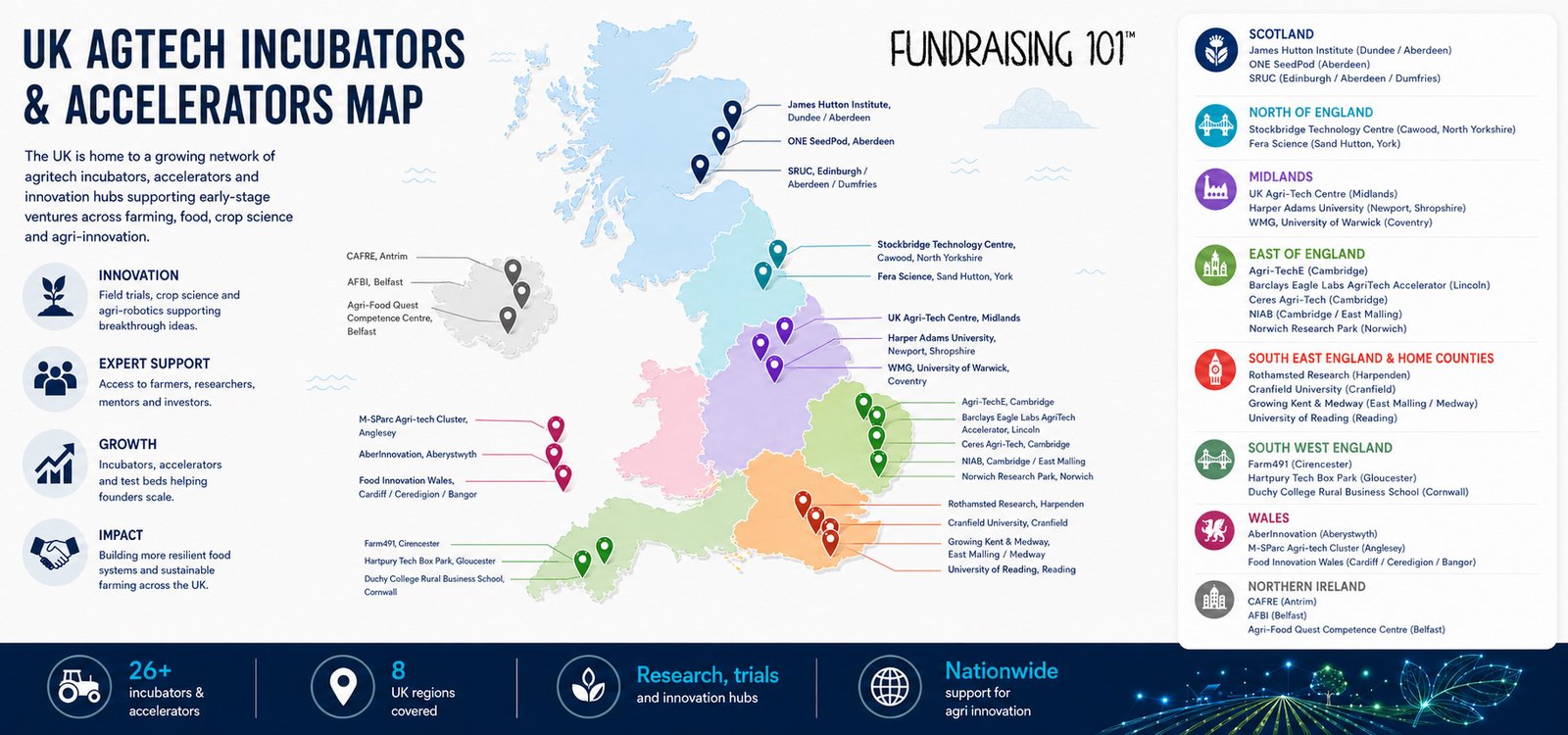
Where to Start. Who to Talk To. If you’re building in agritech, from precision farming and ag-robotics to controlled-environment growing, animal health, soil and crop science or the future of food, geography still matters.

By Robert Hokin, Managing Partner, Fundraising101
Field trials cost money. Glasshouses and robotics cost money. Proximity to working farms, test beds and the right research base matters enormously. And choosing the wrong programme can cost you a growing season you can’t get back.
This is not an exhaustive directory. But it’s a practical starting point: a map of the key agritech incubators, accelerators and innovation hubs across the UK. Where they sit. What they do. Whether they’re worth your time.
We start in Scotland, which is where Fundraising 101 is based and where we do most of our work. Then we work our way South and around. Past that is a list of grants for early-stage and pre-proof of concept agritech ventures.
What This Means for You
A list is just a list. The hard part is knowing which of these is right for your stage, your technology, and your funding trajectory. Some are pre-revenue incubators. Some expect a working prototype. Some want field data before they will talk. Some take equity. Most take none. And most of them will ask to see your deck before they say hello.
That’s where Fundraising 101 comes in.
If you’re an agritech founder in Scotland, or anywhere in the UK, the question isn’t just which programme. It’s: “are you ready to make the most of it?” A weak deck, a vague ask, and an unclear raise structure will get you politely declined from every programme on this list. We see it constantly.
Consider a Raise-Ready Deck Review before you apply to one. It covers 70 assessment points, maps your gaps, and benchmarks your deck against what the fund sift behind these programmes actually looks for. Plus a list of investors and grants active in your specific sector. We can help you get ready. Find out more here.
Scotland
James Hutton Institute (Dundee and Aberdeen) One of Europe’s leading crop and land research institutes, and a serious agritech engine. The Dundee campus houses the new Crop Innovation Centre, home to the International Barley Hub and the Advanced Plant Growth Centre, alongside the Future Farming Hub and Scotland’s first commercial vertical farm. Its commercial arm, James Hutton Limited, is the route in for companies wanting to translate the science. A genuine strength if your work touches crops, soil, potatoes, soft fruit or controlled-environment growing.
ONE SeedPod (Aberdeen) A £27m food and drink innovation hub on SRUC’s Craibstone campus, opened in 2025 and operated by Opportunity North East. Food-safe manufacturing units, new product development and demonstration kitchens, pilot plant and process testing, plus entrepreneurial support and mentoring. The place to be if you’re building a food, drink or alternative-protein product and need to scale production without buying the kit yourself.
SRUC (Scotland’s Rural College) (Edinburgh, Aberdeen and Dumfries) Scotland’s rural college, spanning research, education and SAC Consulting across multiple campuses. Its major projects include a commercial-scale vertical farm at King’s Buildings in Edinburgh and the Dairy Nexus, plus the Barony campus in Dumfries. Less a fixed accelerator, more a research and commercialisation partner with deep reach across livestock, crops, soil and net zero farming.
North of England
Stockbridge Technology Centre (Cawood, North Yorkshire) An independent, grower-led centre of excellence for controlled-environment and field crop research, with over 70 hectares of trial land and more than 40 glasshouses. Its facilities include the LED4Crops lab and the UK Agri-Tech Centre’s Vertical Farming Development Centre. The obvious test bed in the North if you’re in horticulture, protected cropping or vertical farming.
Fera Science, National Agri-Food Innovation Campus (Sand Hutton, York) A major agri-food science campus and the original home of national crop health research. Fera offers analytical science, plant health, crop protection and diagnostics services to agri-food businesses, with lab and campus space near York. More a science and testing partner than an accelerator, but critical infrastructure if your product needs validating.
Midlands
UK Agri-Tech Centre (Midlands, national remit) The national body, formed in 2024 from the merger of Agri-EPI, CHAP and CIEL, and core-funded by Innovate UK. It is the single front door to a network of 43 facilities across the UK, farm networks and funding calls, with business incubation space and SME support. If you only make one call, make it this one: it will point you to the right facility, partner or grant.
Harper Adams University (Newport, Shropshire) The UK’s leading specialist agricultural university and the launch home of the UK Agri-Tech Centre, including the Midlands Agri-Tech Innovation Hub. Strong in agricultural engineering, robotics, precision farming and controlled environments, with working farms and Agri-EPI-legacy facilities on site. The obvious base if your product is hardware, machinery or automation.
WMG, University of Warwick (Coventry) Warwick Manufacturing Group runs the AgriScale pilot with Innovate UK, the High Value Manufacturing Catapult and the MTC, aimed at late-stage agri-tech innovations that need to bridge the gap from proof of concept to manufacturing at scale. Relevant once you have a working product and a manufacturing problem, not before.
East of England
Agri-TechE (Cambridge, national network) A business-focused membership organisation and the leading agri-tech network of its kind in Europe. Not a physical incubator: it is the connective tissue, brokering introductions to farmers, corporates, researchers and investors, and running the annual REAP conference. Membership is a fast way to plug into the ecosystem from anywhere in the UK.
Barclays Eagle Labs AgriTech Accelerator (Lincoln, Greater Lincolnshire, national network) A fully funded 10-week accelerator delivered with the University of Lincoln’s Institute for Agri-Food Technology, for early-stage agritech businesses of 0 to 3 years. Participants get mentoring, sector masterclasses and access to the Eagle Labs Farm at the Riseholme campus, including Lincoln Agri-Robotics, a packhouse and a scaled strawberry farm. No equity taken, and it plugs you into the UK-wide Eagle Labs network.
Ceres Agri-Tech (Cambridge) A knowledge-exchange and commercialisation partnership founded at Cambridge Enterprise, linking Cambridge, Lincoln, East Anglia, Hertfordshire and Reading with the John Innes Centre, Rothamsted and NIAB. It has launched four agri-tech spin-outs and turns early agricultural research into licensable technology, backed by proof-of-concept funding. The right door if your innovation is university-rooted.
NIAB (Cambridge, with NIAB EMR at East Malling, Kent) One of the UK’s largest independent crop science organisations, covering plant genetics, agronomy and field trials, including the Crop Science Centre with Cambridge. Serious science infrastructure for founders working in crops, breeding or horticulture, and the research lead behind Growing Kent & Medway.
Norwich Research Park (Norwich) One of Europe’s largest single-site clusters for food, genomics and plant science, co-locating the John Innes Centre, the Quadram Institute and the Earlham Institute with managed incubation and lab space for around 33 companies. Strong if your work sits in plant science, genomics, food and health, or engineering biology for agriculture.
South East England & Home Counties
Rothamsted Research (Harpenden, Hertfordshire) The longest-running agricultural research institute in the world, working from gene to field across crop protection, soil health, plant science and engineering biology. Its commercial arm, Rothamsted Enterprises, hosts tenant agri-tech companies with access to over 1,000 square metres of glasshouse, controlled-environment and containment space, plus the North Wyke farm platform in Devon. A credible home for science-led agritech in the Home Counties.
Cranfield University (Cranfield, Bedfordshire) A specialist postgraduate university with more than 50 years in agrifood and one of the UK’s strongest bases in soil science and agri-informatics through its Soil and Agrifood Institute. Near-industrial-scale facilities and deep industry partnerships. More a research and translation partner than an accelerator, but a serious one if your work is data, soil or supply-chain heavy.
Growing Kent & Medway (East Malling and Medway, Kent) A £42.1m innovation cluster funded through UKRI’s Strength in Places fund and led by NIAB, focused on horticulture and plant-based food and drink. Its fully funded Food Accelerator runs cohorts at the Medway Food Innovation Centre, offering technical, business and financial support to take a plant-based product from concept to market. If you’re in fruit, veg, controlled-environment growing or plant-based food, this is your cluster.
University of Reading (Reading, Berkshire) One of the UK’s strongest agriculture and food faculties, with commercial farms and food processing facilities, and a partner in Ceres Agri-Tech. More a research and translation partner than an accelerator, but a credible base in the South East for crop, food and agri-environment work.
South West England
Farm491 (Cirencester, Gloucestershire) The Royal Agricultural University’s agri-tech incubator, and one of the best known in the country. More than 200 businesses supported, over £33m raised between them, with flexible membership, hot-desking and workshop space at the Alliston Centre, plus 491 hectares of farmland for trials. One-to-one support on strategy, hiring and investor readiness, and a strong farmer and investor network. Worth a serious look wherever you are based.
Hartpury Tech Box Park (Gloucester, Gloucestershire) An agri-tech and rural-innovation space at Hartpury University, running an SME accelerator in partnership with Barclays Eagle Labs. Practical, applied and farm-adjacent, with test-bed facilities for agricultural machinery, sustainable materials and livestock tech.
Duchy College Rural Business School (Cornwall) Cornwall’s applied agri-innovation base, and the body behind the Agri-tech Cornwall programme, the SW AgriTech showcase and the Devon AgriTech Alliance. It runs demonstration facilities including the Future Farm and connects South West farmers and founders with research partners at Exeter, Plymouth and Rothamsted. The route in for agri-innovation in the far South West.
Wales
AberInnovation (Aberystwyth) A £40.5m campus built specifically for agri-tech, food and drink, and bioscience, co-located with Aberystwyth University’s IBERS, the National Plant Phenomics Centre and world-leading grass and crop breeding programmes. Lab and office space, technical support and funding routes. The clear first stop for agri-tech founders in Wales.
M-SParc Agri-tech Cluster (Menai Science Park, Anglesey) Wales’s agri-tech cluster, run through the Menai Science Park in North Wales, connecting agri-tech and food-technology businesses across mid and north Wales with facilities, funding and collaboration. Useful for cluster access and Welsh funding routes even if you are not on the science park itself.
Food Innovation Wales (Cardiff, Ceredigion and Bangor) A Welsh Government-funded network of three food centres, led by ZERO2FIVE at Cardiff Metropolitan University, with the Food Centre Wales in Ceredigion and the Food Technology Centre at Coleg Menai. New product development kitchens, pilot facilities, food safety and technical support, much of it funded through the HELIX programme. The place to develop and de-risk a food or drink product in Wales.
Northern Ireland
CAFRE (College of Agriculture, Food and Rural Enterprise) (Antrim and multiple campuses) Northern Ireland’s agricultural college, delivering applied agri-food education, technology demonstration and business development support, with strong links to industry and to Queen’s University Belfast. A practical entry point for NI founders and growers.
AFBI (Agri-Food and Biosciences Institute) (Belfast) The Northern Ireland government’s agri-food research body, delivering R&D, diagnostics and scientific advice across crops, livestock, animal health and the environment. More a research and testing partner than an accelerator, but critical infrastructure if your science needs validating.
Agri-Food Quest Competence Centre (Belfast) A membership-based, industry-led innovation hub hosted through Queen’s University Belfast, linking more than 30 Northern Ireland agri-food firms, from SMEs to internationals, with university researchers to solve shared innovation challenges. The route to collaborative, co-funded R&D in the NI agri-food sector.
Appendix: Grants for Early-Stage and Pre-Proof of Concept Agritech Ventures
Incubators and accelerators get you into the right room. Grants get your technology out of the shed and into the field. The two work in parallel, and the smart founders pursue both at once. The landscape below covers the principal grant mechanisms available to UK-registered agritech companies at feasibility and proof of concept stage, including EU programmes that remain accessible to UK companies following association to Horizon Europe. Grant programmes open and close; amounts and eligibility criteria change. Always verify current status directly with the funder before investing time in an application. Where a programme is being relaunched, we’ve said so.
UK Grants
Farming Innovation Programme (Defra and Innovate UK) (National) The flagship agri-tech grant programme. Delivered through Innovate UK, it funds Feasibility Projects for early exploration and Small and Large R&D Partnership Projects for collaborative development towards commercial adoption, across horticulture, arable, livestock and controlled environments. Competitive rounds run through the year. If you’re an agritech founder chasing non-dilutive funding, start here.
UK Agri-Tech Centre SME support (National) Beyond its facilities and networks, the national centre helps assemble consortia for Innovate UK calls, signposts live funding, and runs business-facing programmes for early-stage agri-tech companies. Check its funding calls page for what is currently open.
AgriScale (National) A newer Innovate UK pilot, delivered with the High Value Manufacturing Catapult, the MTC and WMG at Warwick, supporting late-stage agri-tech innovations to close technology gaps and scale manufacturing for commercial adoption. For companies with a proven product and a manufacturing challenge.
Innovate UK Smart Grants (National) Sector-agnostic, business-led R&D grants for genuinely disruptive innovation, covering feasibility through to late-stage development. One of the most accessible entry points to Innovate UK for early-stage companies that don’t fit a specific agri call.
Innovate UK Contracts for Innovation (formerly SBRI) (National) Challenge-driven public sector funding delivered through competitive phased contracts. No equity taken, no repayment required. Watch for Defra and devolved-government agriculture and environment challenges.
Knowledge Transfer Partnerships (KTP) (National) Government part-funded partnerships that embed a qualified associate in your business to lead an innovation project with an academic partner. Businesses typically contribute around a third of costs. A credible route to building proof-of-concept evidence with academic horsepower behind it.
Defra Farming Equipment and Technology Fund (FETF) (England) Grants towards specified equipment and technology. Aimed at farmers, growers and contractors rather than tech startups, but worth knowing for adoption, on-farm pilots, and route-to-market partnerships with farm customers.
SMART: SCOTLAND (Scottish Enterprise) (Scotland only) R&D feasibility and development grants for Scottish SMEs on high-risk, commercially focused projects, with agri-tech and industrial biotechnology among the priority areas. The fund has been through a relaunch, so confirm current status and criteria with Scottish Enterprise before you plan around it.
Rural and agri innovation support (Scotland) (Scotland only) The Scottish Government and its agencies fund rural innovation and knowledge exchange through routes including the Rural Innovation Support Service and the SEFARI research institutes. Useful for Scottish founders collaborating with the research base.
EU Grants Available to UK Companies
Following UK association to Horizon Europe, UK organisations can access Horizon Europe collaborative R&D and all four EIC schemes. Note: UK companies cannot access the equity investment component of the EIC Accelerator, so grant-only applies. Consortium rules vary by scheme. For guidance, contact the UK National Contact Points for Horizon Europe via Innovate UK Business Connect.
Horizon Europe Cluster 6 (Food, Bioeconomy, Natural Resources, Agriculture and Environment) (EU, UK eligible in consortium) The agritech-relevant pillar of Horizon Europe, funding consortium R&D across sustainable farming, food systems, soil, the bioeconomy and biodiversity. UK organisations can participate fully as consortium partners. Budget and call schedule published annually in the Horizon Europe Work Programme.
EIC Accelerator (EU, UK SMEs eligible, grant-only) Grants for high-impact SMEs and startups developing innovations with the potential to create new markets or disrupt existing ones, agri-tech included. UK companies can apply for the grant component only; equity blended finance is not available to UK applicants post-Brexit. Applications are assessed on a rolling basis through the year.
EIC Pathfinder and EIC Transition (EU, UK eligible) Pathfinder funds visionary, high-risk science in multi-country consortia; Transition matures earlier research results towards a market-ready, investable proposition. Relevant for agri-tech founders whose work is still deep in the science.
Circular Bio-based Europe Joint Undertaking (CBE JU) (EU, UK eligible in consortium) Consortium funding for bio-based innovation using agricultural and forestry feedstocks and side-streams. Relevant if your agri-tech has a bio-based materials or circular-economy angle. A 2026 call for proposals is open.
Get Raise-Ready.
Pre-seed tech founder in Scotland? There’s a difference between deck-ready and Raise-Ready. We can help you get there. Fast. With No BS. Visit fundraising101.academy.