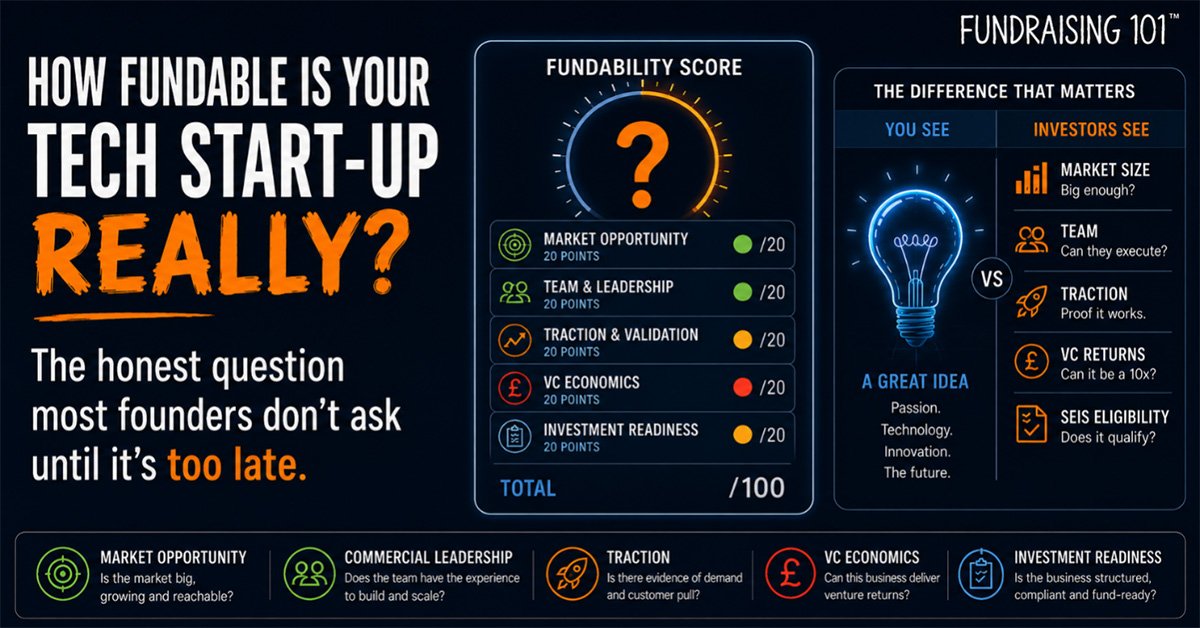
The honest question most founders don’t ask until it’s too late.

By Robert Hokin, Managing Partner, Fundraising101
The Premise
Let me be direct with you.
Most of you reading this are not VC-fundable right now. Not because your idea is bad. Not because you lack ability. But because fundability is a specific set of conditions, and the majority of early-stage tech companies in the UK do not yet meet them.
That’s not failure. It’s a diagnostic. And a diagnostic is useful, because it tells you what to fix.
Peter Dimov of 22nd Century Frontier wrote recently that not every good company deserves venture capital. That confusing fundability with quality is a mistake. He’s right. But he stops there. This article goes further. It defines exactly what fundable means, shows you where UK tech is failing the test, explains what type of capital actually fits different business types, and gives you a 100-point self-assessment so you can find out, honestly. where you stand before an investor finds out for you.
“A good company and a fundable company are not the same thing. Confusing the two is one of the most expensive mistakes an early-stage founder can make.” Robert Hokin, Managing Partner, Fundraising 101
The Scottish Context: Brilliant Research, Thin Middle, No Scale
Case in Point: Scotland has a genuinely world-class deep tech foundation. That’s not spin. The data is unambiguous.
According to the Scottish Deep Tech Report 2026 (Dealroom and University of Glasgow), Scottish VC-backed deep tech startups are now worth a combined $7.9 billion. Deep tech accounts for 57% of all Scottish venture capital, second only to Switzerland globally as a share of total VC. Four of the top 20 UK universities for deep tech spinouts are Scottish. University spinouts alone account for 56% of Scotland’s total deep tech ecosystem value.
If Scotland were a country ranked by the proportion of VC going to deep tech, it would sit at number two in the world. The research base is exceptional.
And yet. Look at the funding funnel and the picture changes.
| Stage | Number of companies | What this tells us |
|---|---|---|
| Early stage (<$15M funding) | 164 startups | The pipeline is strong. Companies are forming and getting first capital. |
| Breakout ($15M–$100M) | 42 companies | The funnel narrows sharply. Most early-stage companies never break through. |
| Scaleups ($100M+ funding) | 5 companies | Five. In the entire Scottish deep tech ecosystem. This is the gap that matters. |
| Colts ($25M–$100M revenue) | 4 companies | Almost nothing domestically owned at meaningful commercial scale. |
| Unicorns ($1B+ valuation or exit) | 1 (Exscientia) | One unicorn. Against a world-class research and early-stage base. |
The funnel is heavily concentrated at the early stage. There are over 200 VC-backed deep tech startups and breakouts in Scotland. There are five scaleups.
The report is direct about why. Stakeholders consistently pointed to two causes: Scottish tech companies plateau at 20 to 30 employees before being acquired, typically by foreign buyers — or stalling entirely. And the founders best placed to create breakthrough technologies are not always best placed to scale the businesses built around them. Great research. Weak commercial leadership. Not enough capital at the right stages.
Scotland investors are providing 73% of early-stage funding in deep tech. But for rounds above $15 million, Scottish investors provide just 17%. US investors fill 35% of that gap. The implication is stark: fundability in Scotland has two thresholds. Early-stage fundability is achievable with domestic capital. Scale-up fundability requires an international capital strategy, built from day one.
The key insight: Scotland’s deep tech pipeline is excellent at creating companies and poor at scaling them. The fundability question for most Scottish founders is not ‘can I get first money?’ but ‘can I build something that international capital will back at Series A and beyond?’ These require different answers.
UK and Scottish Tech Startup Failure Rates: What the Numbers Actually Say
Most founders dramatically underestimate the odds of success. These aren’t abstract statistics. They describe what happens to companies like yours, in markets like this, at the exact stage you are at right now.
The UK picture
According to ONS Inter-Departmental Business Register data, 71.1% of new UK businesses fail within three years. Only 39.4% reach the five-year mark. These figures are consistent across multiple sources and have been stable for a decade.
For tech startups specifically, the picture is bleaker than the general business population. Founders Forum analysis of CB Insights data places the five-year failure rate for tech startups at 63% — the highest of any industry sector. The primary cause of failure, cited in 42% of post-mortems, is no market need. Running out of cash is second at 29%. Team issues are third. Three of the top five failure causes are within a founder’s control. Two are not. Fundability is largely about the three that are.
Beauhurst’s analysis of equity-backed UK companies, the companies that did get funded, adds the most sobering data point. Even among startups that successfully raised venture capital, 54% stagnated at seed stage and never progressed in their first five years. 20.1% of high-growth equity-backed companies failed outright within five years. Raising money does not remove the failure risk. It simply reframes it.
These aren’t reasons to be discouraged. They’re reasons to be clear-eyed before you spend six to eighteen months in a fundraising process that may never work. Most startup failures are not caused by bad ideas. They are caused by running out of money before the idea is proven, pursuing the wrong type of capital for the stage the business is at, or, most relevantly for this article, being underprepared for what investors actually assess.
The question is not whether your idea is good. It is whether your business, at its current stage, can generate the return a VC fund needs. Two different questions.
What ‘Fundable’ Actually Means
Fundable does not mean your business is good. It means your business has the specific characteristics that make venture capital returns possible.
A VC fund manager invests in a portfolio of companies knowing that most will fail or return modest multiples, and that the fund’s return depends on a small number of very large outcomes. The standard model requires a fund investment to have the potential to return at least 10x the invested capital. That requires the business to become very large, very fast, or to be acquired at a very high multiple.
This means the VC model only works for a specific type of business. One with a large addressable market. One with a scalable business model that does not require proportional headcount growth. One with defensibility through IP, network effects, or switching costs. One with a credible path to very large revenues within a VC fund’s investment horizon (typically 7 to 10 years).
Many excellent businesses do not have these characteristics. A consultancy with world-class domain expertise. A SaaS product serving a niche market that will never exceed £50M in scale. A deep tech company with a technology that will take 15 years to reach market. These can all be genuinely good businesses. They are not VC-fundable in the conventional sense.
Understanding this distinction is the starting point for everything else.
The Four Types of Tech Start-up: Which One Are You?
Most founders assume they need VC equity. Many do not. Knowing which type of capital fits your business is itself a form of competitive advantage.
| Type | Characteristics | Right capital |
|---|---|---|
| VC-fundable | Large market, scalable model, defensible technology, path to £50M+ revenue, team with commercial and technical capability | Equity: angels, pre-seed funds, seed VCs. SEIS/EIS essential for UK raise. |
| Bootstrappable | Profitable early, niche market, sustainable at smaller scale, founder can fund from revenue. Many B2B SaaS and services businesses. | Revenue, founder capital, modest debt. No equity needed or appropriate. |
| Grant-fundable | R&D-intensive, pre-commercial, significant technical risk, public benefit dimension. Deep tech, biotech, cleantech at early stage. | Innovate UK SMART grants, Scottish EDGE, R&D tax credits, KTPs. Stack non-dilutive before equity. |
| Too early for any external capital | Technology not yet de-risked, no validation of market demand, solo founder with no commercial co-founder. Needs development, not money. | Time, customers, proof-of-concept. Raise when you have something to show, not before. |
Most Scottish deep tech companies at formation are in the third or fourth category. That is not a problem. It is a sequencing challenge. Get the grants first. Use R&D tax credits. Stack non-dilutive capital. De-risk the technology. Then approach equity investors with milestones proven rather than milestones promised.
The founders who confuse category are the ones who spend 12 months pitching equity investors with a company that should be applying to Innovate UK, or who spend 12 months applying for grants with a company that is genuinely VC-ready and should be in market.
For a full guide to stacking non-dilutive capital before equity, see Taking Grant Capital Before Equity in the F101 resource library.
A Note on SEIS: The Factor That Changes UK Pre-Seed Fundability
For UK tech founders raising pre-seed equity, SEIS eligibility is not a detail. It is a threshold condition for most UK angel investors.
Under the Seed Enterprise Investment Scheme, a qualifying investor receives 50% income tax relief on investments up to £200,000 per tax year, plus capital gains tax exemption on profits and loss relief if the investment fails. For an additional-rate taxpayer, a £50,000 SEIS investment has an effective net cost of £25,000 after relief. That economics change is what makes early-stage investing attractive to UK angels who would otherwise find the risk profile unacceptable.
Most UK angels will not invest in a pre-seed company without confirmed SEIS advance assurance from HMRC. The eligibility constraints: your company must be incorporated in the UK, trading for less than three years, with fewer than 25 employees, gross assets below £350,000 before the share issue, and raising no more than £250,000 in total under SEIS.
If your company does not qualify — because it has been trading too long, has already raised too much, or operates in a sector HMRC considers excluded — your pre-seed raise is structurally harder. UK angels will require a stronger story, a higher return expectation, or simply move on. This is not a nuance. It is a fundability variable that belongs in your assessment before you begin.
F101 recommends FounderCatalyst (foundercatalyst.com) for SEIS/EIS advance assurance support and all UK funding round legal documentation. Fixed price: £1,495 excl. VAT. SEIS/EIS advance assurance is included in that package at no extra cost, and can be filed immediately on engagement — the fastest way to get advance assurance in place before your raise launches.
The Seven Fundability Killers: Why Scottish and UK Tech Start-ups Fail the Investment Test
From thirty years of reviewing investments and coaching over 500 ventures through investment readiness, these are the most common reasons technically excellent companies are not fundable.
1. The Market Is Not Big Enough
This is the most common fundability failure and the hardest to hear. A VC needs each investment to have the potential to return 10x. That means your total addressable market must be large enough that capturing a realistic share produces very large revenues. A genuine, defensible market of £500M or more in the UK alone, growing at 15%+ per year, is the minimum threshold that makes the arithmetic work. Niche excellence is not a VC-fundable proposition, however impressive the technology.
2. The Commercial Leadership Gap
The Scottish Deep Tech Report flags this directly and consistently. Investors, programme directors, and ecosystem leaders all point to the same structural problem: Scotland produces exceptional scientific and engineering talent, but the commercial leadership capable of navigating the transition from lab to market to scale is scarce. A founding team of brilliant scientists without a commercially experienced CEO is a fundability problem, not just an operational one. Investors back the team as much as the technology. If no one on your team has built and sold a product before, this gap will show up in every investor conversation.
3. IP Is Not Cleanly Assigned to the Company
In spinout companies — which account for 43% of Scottish VC-backed deep tech — IP assignment is frequently the single most significant fundability blocker. If the core technology was developed at a university, the TTO may hold a licence or equity stake in the IP. If the founder created the technology before incorporation, it may still legally belong to them personally rather than to the company. If contractors or advisors contributed to the technology, their IP assignments may be missing or ambiguous. Investors will not back a company where the IP they are funding may not belong to it.
4. The Business Model Cannot Generate VC Returns
Some businesses have excellent economics for their founders but cannot produce the multiples a VC fund requires. A services business where revenue scales linearly with headcount. A SaaS product with a market cap of £30M. A technology that generates strong margins but at a modest absolute scale. These can be genuinely excellent businesses. But asking a VC to invest in them is asking them to accept the wrong return profile for their fund structure. Knowing this early saves both parties significant time.
5. SEIS Ineligibility
As detailed above. If your company does not qualify for SEIS, your pre-seed raise in the UK is structurally harder. Check eligibility early. If you are ineligible, know why, and factor it into how you are approaching investors and at what stage.
6. The Traction Gap
At pre-seed, traction does not mean revenue. It means validated demand. A customer who has agreed to a pilot. A signed letter of intent. Thirty problem-discovery conversations with named potential customers. Evidence that the market will pay your intended price point. A waiting list. Pre-seed investors at the angel and dedicated pre-seed fund level are primarily assessing founder quality and problem clarity — but they need at least one credible signal that the market exists and wants what you are building. Pure technology push without any market pull is unfundable at this stage.
7. Too Early for the Capital Being Sought
This is the most fixable fundability problem and the most common. A company at Technology Readiness Level 3 with a solo scientist-founder and no commercial validation is not unfundable forever. It is unfundable now. The right response is not to keep pitching investors. It is to identify the specific milestone that would change the fundability assessment — a co-founder with commercial experience, a first pilot customer, a SMART grant de-risking the technology — and build a 12 to 18 month plan to reach it. That plan is what Fundraising101 Academy helps founders build.
The Fundraising101 Fundability QuickScore: Where Do You Actually Stand?
This is a 100-point self-assessment across five categories. Be honest. The score is for you, not us. An inflated score that sends you into a raise before you are ready costs you months of time and a set of investor impressions you cannot undo. So here’s a safe space for you to self-assess.
Score each question from 0 to 5. 0 means ‘not at all’. 5 means ‘clearly yes, with evidence’. 3 means ‘partially or arguably’. Do not give yourself a 4 or 5 because you intend to address it. Score what exists in the ‘here and now’, today.
| # | Question | Max | Score |
|---|---|---|---|
| Category 1: Market Opportunity (25 points) | |||
| 1 | Can you credibly demonstrate a Total Addressable Market of £500M or more in the UK alone, growing at 15%+ per year? | / 5 | ____ |
| 2 | Is there a clear, specific beachhead market — a defined first wedge you can dominate before expanding — rather than a generic ‘large market’ claim? | / 5 | ____ |
| 3 | Is the problem you are solving urgent enough that potential customers will pay to address it now, not ‘someday when it becomes important’? | / 5 | ____ |
| 4 | Can you articulate specifically why now is the right moment — what regulatory, technological, or market shift has created this opportunity? | / 5 | ____ |
| 5 | Do you have evidence that your target market will pay your intended price point, based on real customer conversations rather than assumption? | / 5 | ____ |
| Category 2: Team and Founder-Market Fit (20 points) | |||
| 6 | Does at least one founder have deep domain expertise in the specific problem being solved — experience that a competitor could not easily replicate? | / 5 | ____ |
| 7 | Does the founding team have genuine commercial capability: someone who has built, sold, or scaled a product before, not just created one? | / 5 | ____ |
| 8 | Is the team complete enough to execute the pre-seed plan, or are there critical functional gaps (commercial, technical, regulatory) that will block progress? | / 5 | ____ |
| 9 | If this is a spinout, has the commercial leadership question been answered — is there a commercially experienced CEO alongside the scientific founder? | / 5 | ____ |
| Category 3: Traction and Market Validation (20 points) | |||
| 10 | Do you have at least one paying customer, signed letter of intent, or formally agreed pilot with a named organisation? | / 5 | ____ |
| 11 | Have you conducted problem-discovery conversations with at least 30 potential customers and can you articulate what you learned? | / 5 | ____ |
| 12 | Is there evidence that your customers return, expand their engagement, or refer others — even at early stage? | / 5 | ____ |
| 13 | Do you have independent evidence of market demand — a grant competition win, regulatory pathway confirmation, or third-party endorsement — beyond founder conviction? | / 5 | ____ |
| Category 4: VC Economics and Business Model (20 points) | |||
| 14 | Can this business plausibly reach £50M or more in annual revenue within 7 to 10 years, under a realistic set of market assumptions? | / 5 | ____ |
| 15 | Does your business model have the potential for gross margins above 50% at scale, without proportional cost base growth? | / 5 | ____ |
| 16 | Is the business model scalable without requiring headcount to grow in direct proportion to revenue — i.e., does the model have genuine operating leverage? | / 5 | ____ |
| 17 | Do you have a coherent funding map from now to Series A, with specific milestones that justify each round in the sequence? | / 5 | ____ |
| Category 5: Investment Readiness (20 points) | |||
| 18 | Does your company qualify for SEIS (or EIS if SEIS is exhausted), and do you have HMRC advance assurance confirmed or in progress? | / 5 | ____ |
| 19 | Is all intellectual property — technology, code, patents, know-how — cleanly and legally assigned to the company, not to founders, universities, or contractors personally? | / 5 | ____ |
| 20 | Can you articulate a specific use of funds, the milestone it delivers, and what the next funding event looks like — without hesitation? | / 5 | ____ |
| TOTAL FUNDABILITY SCORE (out of 100) | ____ | ||
Reading Your Score
| Score | Fundability verdict | What to do next |
|---|---|---|
| 80–100 | Strong fundability signal. You have the core conditions in place. | Launch raise preparation now. Get a full Raise-Ready Deck Review to stress-test your materials before investor conversations. |
| 60–79 | Conditionally fundable. There are real gaps but they are addressable. | Identify which category is pulling your score down. Address those gaps specifically before approaching investors. Most gaps at this score can be closed in 3–6 months. |
| 40–59 | Not yet fundable. The fundamentals need work before a raise makes sense. | Pause on fundraising. Focus on the business. Identify your most critical fundability gap — usually market validation or team — and build a 6–12 month plan to address it. Consider non-dilutive capital (grants, R&D credits) to fund the development required. |
| Below 40 | Pre-fundable. The business is not at a stage where equity investment is appropriate or likely. | This is not failure. This is a signal about timing. Focus on building the business, validating demand, and stacking non-dilutive capital. Return to this scorecard in 12 months. Many of the best companies in Scotland’s deep tech ecosystem were at this score before their breakthrough milestones. |
Important: This scorecard is a directional self-assessment, not a definitive investment readiness evaluation. It is designed to surface the areas that matter most before you begin a formal raise. For a comprehensive gap analysis across 136 specific investor criteria, F101’s Raise-Ready Augmented Assessment provides the full picture.
Not Fundable Right Now Does Not Mean Not Fundable Ever
This is the most important point in this article, and the one most likely to be misread.
A score below 60 does not mean your company is bad. It does not mean the technology is wrong or the market does not exist. It means the company, at its current stage and with its current team and validation, does not yet meet the conditions that venture capital requires.
That is a temporal problem, not a permanent one. The Scottish deep tech ecosystem is full of companies that were unfundable at formation and fundable two years later because they made deliberate, targeted decisions about what needed to change.
The right response to a low fundability score is a clear-eyed plan: what specific milestones, team additions, or validations would move each failing category above threshold? For most companies, the answer involves three to five specific actions and a 12 to 18 month timeline. That plan is far more useful than another round of investor meetings with a proposition that is not yet ready.
The founders who close rounds quickly are almost never the ones who pushed hardest before they were ready. They are the ones who waited until the fundamentals were in place, then moved fast.
A Note to Scottish Deep Tech Founders Specifically
The Scottish Deep Tech Report 2026 is a compelling read and a sobering one. It confirms what those of us working inside the ecosystem have observed for years: Scotland has all the ingredients — world-class research, strong universities, a growing investor base, and genuine international competitive advantage in specific sectors. What it lacks is commercial scale.
The report’s five priorities are clear: develop commercial leaders built for scale, not just scientists with entrepreneurial ambition; build commercial literacy across the whole value chain, not just in founders; fix the infrastructure access problem for companies at the critical 10 to 50 employee stage; make Scotland a first customer for its own innovations; and build a distinctively Scottish understanding of what deep tech success looks like here, rather than importing frameworks from Silicon Valley that do not apply.
For founders, the most actionable of these is the first. If you are a scientist or engineer founder building a deep tech company in Scotland, the single most important fundability question you should ask yourself is this: do I have the commercial co-founder I need to take this company to Series A and beyond? If the honest answer is no, that is the gap to fill before the pitch.
The rest of the ecosystem challenges — infrastructure, procurement, scale-up capital — are real and they are being worked on. But they are not within your control as a founder. The commercial leadership question is.
What to Do With Your Score
If you scored 80+
Your fundability fundamentals are in place. The next question is investment readiness — whether your pitch materials, investor target list, and process management are at the standard required to convert fundability into a closed round. A Raise-Ready Deck Review from F101 (£375, no VAT, 5 working days) will tell you exactly where your deck sits against the standards of a 50+ fund sift.
If you scored 60–79
You have gaps, but they are addressable. The question is which gaps are blocking your raise specifically. A Raise-Ready Deck Review will surface them in the context of your pitch materials. If you want a deeper structural assessment across 136 investor criteria, the Raise-Ready Augmented Assessment provides the full picture with a specific action plan.
If you scored 40–59
Pause the investor conversations. Use this period to stack non-dilutive capital — R&D tax credits, Innovate UK SMART grants, Scottish EDGE, Converge. Hit the specific milestones that would move your fundability score above 70. Then raise from a position of strength rather than need.
If you scored below 40
Build the business first. Validate the market. Find your commercial co-founder. Apply to a programme — Techscaler, Scottish EDGE, Converge — that can provide the mentoring, community, and non-dilutive capital to get you to the point where external equity makes sense.
The Raise-Ready Scorecard
This fundability scorecard gives you a directional read. When you are ready to go deeper — a full 136-point assessment across seven investor evaluation categories, with specific gap analysis and a prioritised action plan — F101’s Raise-Ready Augmented Assessment is the tool built for that. Visit fundraising101.academy.
Resources
Scottish Ecosystem
- Scottish Deep Tech Report 2026 — F101 Analysis — Dealroom and University of Glasgow, May 2026. The definitive data picture of Scotland’s deep tech ecosystem, with F101’s analyst commentary.
Techscaler (techscaler.co.uk) — Scottish tech community, hubs, and programme support across Scotland.
Scottish EDGE (scottishedge.com) — Scotland’s largest growth business competition. Up to £150K.
Converge Challenge (convergechallenge.com) — University spinout competition, £400K+ prize fund.
Scottish Enterprise (scottish-enterprise.com) — Grants, co-investment, and business support for Scottish companies.
Non-Dilutive Capital
Innovate UK SMART Grants (apply-for-innovation-funding.service.gov.uk) — Up to £500K for qualifying R&D projects. Check monthly for open competitions.
HMRC R&D Tax Relief (gov.uk/guidance/corporation-tax-research-and-development-rd-relief) — 20–27% cash repayment on qualifying R&D expenditure. No competition required.
SEIS / EIS
HMRC SEIS Advance Assurance (gov.uk/guidance/venture-capital-schemes-apply-for-the-seed-enterprise-investment-scheme) — Apply before your raise launches, not during it.
Legal Infrastructure
FounderCatalyst (foundercatalyst.com) — Fixed-price UK funding round legal documents (£1,495 excl. VAT). SEIS/EIS advance assurance included. F101’s recommended legal partner.
Investment Readiness
Fundraising101 Academy — Raise-Ready Deck Review (fundraising101.academy) — 70-point deck review with 50+ fund sift. £375. No VAT. 5 working days.
Fundraising101 Academy — Raise-Ready Augmented Assessment (fundraising101.academy) — 136-point deep-dive across seven investor evaluation categories with specific gap analysis and action plan.
Get Raise-Ready.
Pre-seed tech founder in Scotland? There’s a difference between deck-ready and Raise-Ready. We can help you get there. Fast. With No BS. Visit fundraising101.academy.