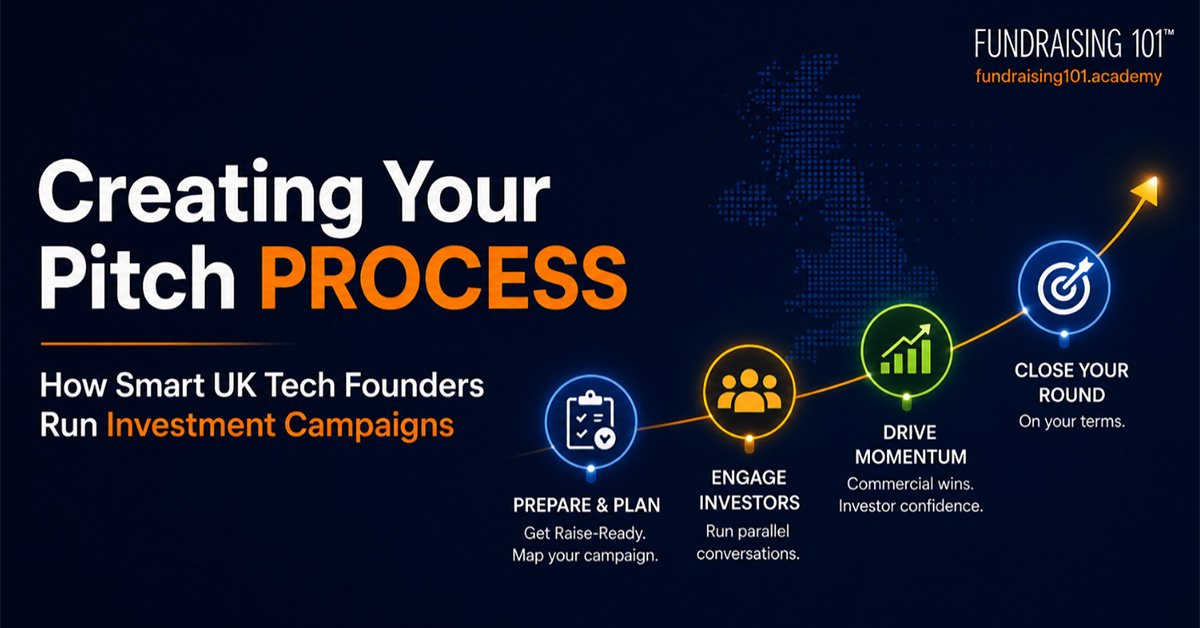
How Smart UK Tech Founders Run Campaigns

By Robert Hokin, Managing Partner, Fundraising101
“The fundraising process: a structured campaign of investor engagements run over a defined period, with one goal: securing enough commitments to close your round on a planned date.” F101 working definition
Why This Matters
Every round I was involved in that closed cleanly had the same characteristic: the founder was running the process, not reacting to it. They knew who was in, who was out, what the timeline was, and what needed to happen next. They had identified a lead investor early and were prioritising that relationship above everything else.
The rounds that drifted had a different quality. Each investor meeting was treated as a separate, disconnected event. No lead investor identified. No closing date communicated. No coordinated sense of progress across parallel conversations. Founders in these rounds were reacting to whoever contacted them last rather than advancing a plan they controlled.
Most UK tech founders think of fundraising as a series of pitch meetings. Experienced founders treat it as a campaign: a managed process with a defined objective, a timeline, a pipeline of prospects at different stages, and a deliberate strategy for reaching a close. The difference in outcomes is material. This article covers what a proper fundraising process looks like, from preparation to close.
Preparation: Launch Only When Ready
The most expensive mistake UK tech founders make is launching before they are ready. A premature approach to the right investor, before the deck is final, before the data room is built, before HMRC advance assurance is in place, is worse than no approach. You rarely get a second chance with a fund you’ve already met, and the perception that you struggled to close your round follows you into subsequent raises.
Before you launch: your deck should be reviewed by at least two experienced investors or advisors and genuinely final, not “good enough for now.” Your data room should be built and ready to share within 24 hours of a request. Your HMRC advance assurance should be in hand. Your co-founders should be aligned on raise amount, valuation range, acceptable terms, and closing date. Your warm introduction pathways should be mapped for all shortlist investors.
Parallel vs Sequential: Why Parallel Is Almost Always Right
A sequential raise, engaging one or two investors at a time and moving to the next only if they pass, is simpler to manage but significantly slower and produces no momentum. A fund that takes six weeks to make a decision means your raise takes at least six weeks per investor you approach. At three investors, that’s potentially 18 weeks of purely sequential conversations.
A parallel raise, engaging 10 to 15 investors simultaneously, creates the conditions for genuine momentum. One investor’s engagement can accelerate others. A term sheet from one fund can prompt a decision from a second. Your timeline is determined by your most engaged investor, not your slowest. This requires more coordination, but the tools to manage it are straightforward. A simple CRM, clear status tracking, and regular brief updates to all active prospects are all you need.
Finding and Closing Your Lead Investor
The most important tactical decision in your raise is identifying your lead investor early and prioritising that relationship above all other pipeline management. Once you have a lead investor with a committed term sheet, closing the rest of the round is substantially easier. Other investors who were wavering have a clear signal of validated credibility. Angels who were “waiting to see who leads” have their answer.
Your lead investor is likely to be the fund or individual with the strongest sector fit, the most active engagement during the process, and, practically, the willingness to lead price and take a board seat or observer right. At pre-seed, your lead may not be an institutional fund at all. It is often a respected angel or a small syndicate willing to anchor the round and let others follow. The mechanism is the same whatever the label: one credible commitment that de-risks the decision for everyone still on the fence.
Identify the most likely candidate from your pipeline early. Spend proportionally more time on that relationship. Bring them to conviction faster than anyone else in the process.
Commercial Milestones: Your Strongest Momentum Tool
The most underused lever in a live raise is your own business. A signed customer, a letter of intent, a usage milestone, or a notable hire announced while investors are actively watching does more to move a round than another tranche of cold meetings. It converts your pitch from a forecast into evidence.
Where you have any control over timing, hold back a credible piece of news and release it into the raise window rather than before it. A new customer announced mid-process is worth more than ten additional first meetings, because it gives every investor already in your pipeline a fresh reason to act now rather than wait.
Closing: Set a Date and Hold It
Rounds without closing dates drift. Investors who have not committed can always find reasons to wait another two weeks. The most effective closing mechanism is a credible date communicated to all active investors, with clear signals that the round will close on that date regardless of whether they are in.
To close efficiently: give investors a clear deadline and hold it. Have your solicitor prepared and briefed before the legal process starts. Legal documentation takes longer than founders expect, and a well-briefed solicitor compresses the timeline significantly. Address the “we’ll follow if you get a lead” problem early by closing your lead investor first. Investors who have been in active dialogue throughout the process should be ready to commit when the deadline approaches. Those who aren’t were probably not going to commit regardless.
Checklist
Work through this before your next investor conversation. Be honest about the gaps. If you can’t answer any of these confidently, that’s a signal. Fix the gap before the investor finds it.
Pre-Launch
- Has your deck been reviewed and is it genuinely final, not still being updated?
- Is your data room built and ready to share within 24 hours?
- Is HMRC advance assurance in place for SEIS/EIS?
- Have you and your co-founders aligned on raise amount, valuation range, terms, and closing date?
- Have you mapped warm introduction pathways for all shortlist investors?
Running the Process
- Are you running a parallel process with at least 10 active conversations?
- Have you identified your lead investor and are you prioritising that relationship?
- Are you sending brief regular updates to all active prospects?
- Are commercial milestones timed to support the active raise window where possible?
Closing
- Have you communicated a clear closing date to all investors?
- Is your solicitor briefed and ready to begin legal documentation?
- Do you have a plan for investors who say they need to follow a lead?
- Have you confirmed all investor commitments in writing before beginning legal documentation?
Takeaways
- Launch only when you’re ready. A premature approach to the right investor is worse than no approach. You rarely get a second chance at a fund you’ve already met.
- Find your lead investor first. Everything else follows a lead commitment. Prioritise this relationship above all other pipeline decisions.
- Parallel beats sequential. Your raise timeline is determined by your most engaged investor. Multiple parallel conversations create the conditions for genuine momentum.
- Set a closing date and hold it. Rounds without deadlines drift. Investors who haven’t committed by your date should be deprioritised in favour of those who have.
- Brief your solicitor before you need them. Legal documentation takes longer than founders expect. A solicitor briefed in advance compresses the timeline significantly.
- Commercial milestones are your best momentum tool. A new customer announcement during the raise is worth more than ten additional investor meetings.
Additional Resources
FounderCatalyst. foundercatalyst.com. UK platform for SEIS/EIS advance assurance and full round documentation, from term sheet to share certificates, with hands-on support that can compress a standard round to days rather than weeks.
F101 Raise-Ready Blueprint Bundle. fundraising101.academy. The Blueprint Bundle covers fundraising process management, raise structure, and investor targeting.
The Fundraising Field Guide. seedcamp.com/resources. Carlos Espinal’s practical framework on milestone-based fundraising process.
DocSend. docsend.com. Track who is engaging with your deck and data room materials, and for how long.
Get Raise-Ready.
Pre-seed tech founder in Scotland? There’s a difference between deck-ready and Raise-Ready. We can help you get there. Fast. With No BS. Visit fundraising101.academy.