What Every UK Tech Founder HAS to Understand Before Signing Anything

By Robert Hokin, Managing Partner, Fundraising101
“A non-binding document summarising the principal terms and conditions of a proposed investment, including valuation, investor rights, governance arrangements, and the conditions under which the investment will be made.” British Venture Capital Association, Standardised Documents Guidance
Why This Matters
The best time to understand a term sheet is before you get one. I’ve seen founders sign term sheets they didn’t fully understand, discover the implications only when the legal docs landed, and find themselves in a position they had to accept because the no-shop clause prevented them from going back to other investors.
A term sheet is the first formal expression of investment intent. It is typically non-binding: neither party is legally committed until final documents are executed, but it sets the framework for everything that follows. The legal documents will reflect the term sheet, not improve on it. The time to negotiate is the term sheet, not the documentation stage, when the lawyers are billing and the investor is expecting to be moving towards a close.
Term sheets also contain provisions that can restrict your freedom of action from the moment you sign. Most include a no-shop clause preventing you from continuing to raise from other investors while the term sheet is in place. Understanding every element of what you are agreeing to, including what you’re temporarily giving up, isn’t optional.
The UK Standard and Why It Matters
UK term sheets are generally simpler and more founder-friendly than their US equivalents. The BVCA publishes model term sheet documentation representing a balanced UK standard. Seedcamp and Seedlegals both publish their standard terms openly. These documents exist precisely so that founders can benchmark any term sheet they receive against a known standard.
If the term sheet you receive deviates materially from BVCA model terms, that deviation warrants a specific explanation from the investor. Not necessarily a refusal, there are legitimate reasons for non-standard terms, but an explanation. Any investor who becomes defensive when you ask for one is giving you useful information as to why to proceed with caution.
The five deviations most commonly encountered in non-standard UK term sheets, and my suggested one-line position on each, are as follows:
- Participating preferred shares: push back, request non-participating.
- Full ratchet anti-dilution: push back hard, accept weighted average only.
- Cumulative dividends on preference shares: push back, dividends should not accrue.
- Board seats before Series A: push for observer rights rather than full board seats where possible.
- Broad drag-along provisions without matching tag-along rights: push for symmetry between drag and tag rights.
Valuation and Dilution: The Numbers That Actually Matter
The pre-money valuation is the agreed value of the company before the investment is made. The post-money valuation is the pre-money valuation plus the investment amount. Your resulting ownership percentage as a founder is your shares divided by all shares outstanding after investment, on a fully diluted basis: meaning including all shares that could exist if every option and warrant were exercised.
The option pool is where most founders get surprised. Investors almost always require that an employee option pool be created or topped up before their investment is made, not after. This means the pool dilutes the founders, not the investors. The practical effect is that a 10 percent option pool created pre-investment at a £2 million pre-money valuation reduces the founders’ effective pre-money valuation, even though the headline number stays the same.
The following example uses a £500,000 raise at a £2 million pre-money valuation. The table shows what happens to founder ownership under three different scenarios: no option pool, a 10 percent option pool created before investment, and a 10 percent option pool created after investment.
| Scenario | Pre-Money | Option Pool | Post-Money | Investor % | Founder % |
|---|---|---|---|---|---|
| No option pool | £2,000,000 | — | £2,500,000 | 20.0% | 80.0% |
| 10% pool pre-investment (standard) | £2,000,000 | 10% pre-money | £2,500,000 | 20.0% | 72.0% |
| 10% pool post-investment (rare) | £2,000,000 | 10% post-money | £2,500,000 | 20.0% | 72.0% |
| The difference | — | — | — | — | Up to 8% of the company |
The key question to ask when you see a term sheet is: is the option pool being created before or after investment, and is it included in the pre-money or post-money capitalisation? Standard BVCA terms include the option pool in the fully diluted pre-money calculation. Non-standard terms that create the pool post-investment are rare but exist and dilute founders further. Always model the impact on your actual ownership percentage before agreeing to any valuation.
Share Type and What It Actually Means
Ordinary shares carry equal voting rights and economic rights. They are the simplest structure and the most EIS-compatible. Many angel investors and early-stage UK funds invest on ordinary shares, particularly at pre-seed.
Preference shares carry additional rights over ordinary shares. The most common are liquidation preference, the right to be paid first in an exit, and anti-dilution protection. They may also carry enhanced information rights, consent rights over certain decisions, or the right to appoint a board observer. Not all of these are harmful to founders. Some are standard and reasonable. The liquidation preference and anti-dilution type are the two that can cause serious economic harm if structured unfavourably.
Preference shares must be structured carefully for SEIS & EIS compliance. HMRC requires that S/EIS-qualifying shares carry no preferential rights to assets on a winding up beyond the amount subscribed, and no cumulative dividend rights. A liquidation preference that returns more than the amount originally invested, or preference shares that accrue unpaid dividends, can jeopardise EIS eligibility for your investors. If any investor in your round is relying on EIS relief, get specialist advice before agreeing to any preference share structure.
Liquidation Preference: Why the Structure Matters More Than the Multiple
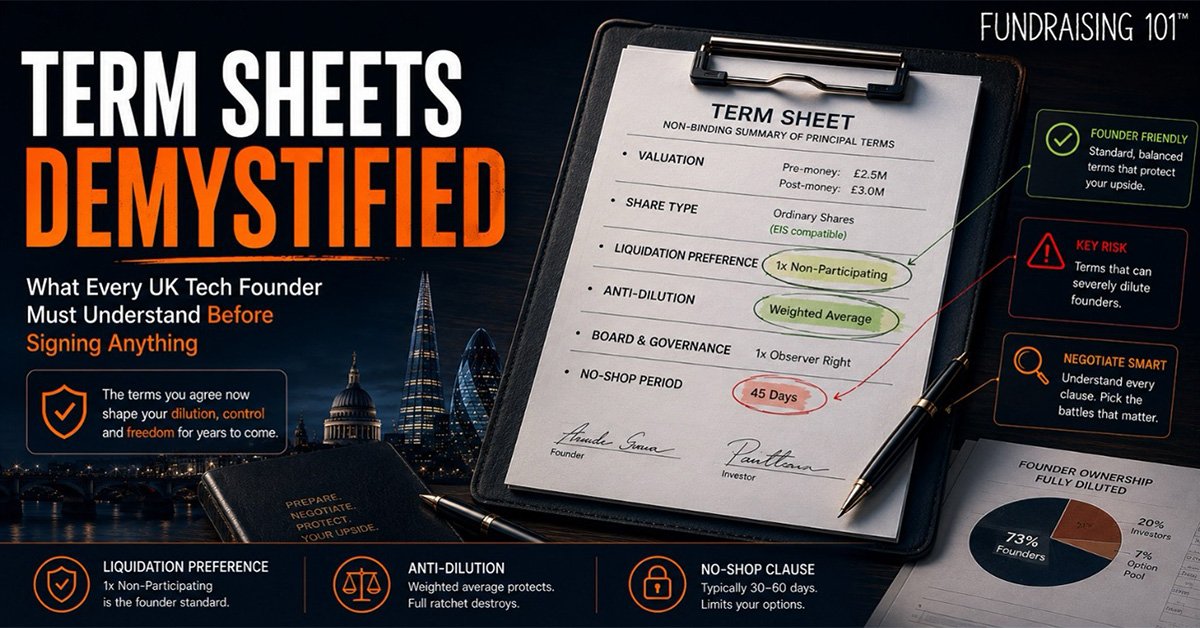
The liquidation preference determines who gets paid what, and in what order, when a company is sold or wound up. At pre-seed and seed, a 1x non-participating liquidation preference is the standard and the most founder-friendly form. Understanding what this means in practice, and what alternatives look like, requires working through the numbers.
The following example assumes a company raised £500,000 at a £2 million pre-money valuation. The investor owns 20 percent. The company is later sold. The table shows what the investor and founders receive at three different exit values under three different liquidation preference structures.
| Exit Value | Ordinary Shares (no preference) | 1x Non-Participating (standard) | 1x Participating (push back) | 2x Participating (resist strongly) |
|---|---|---|---|---|
| £750,000 (1.5x raise) | Investor: £150k Founders: £600k | Investor: £500k Founders: £250k | Investor: £500k Founders: £250k | Investor: £750k Founders: £0 |
| £2,500,000 (5x raise) | Investor: £500k Founders: £2,000k | Investor: £500k Founders: £2,000k | Investor: £900k Founders: £1,600k | Investor: £1,400k Founders: £1,100k |
| £5,000,000 (10x raise) | Investor: £1,000k Founders: £4,000k | Investor: £1,000k Founders: £4,000k | Investor: £1,400k Founders: £3,600k | Investor: £2,400k Founders: £2,600k |
How the calculations work. Under 1x non-participating preferred, the investor receives the higher of their preference (£500k) or their pro-rata share of the proceeds. In a modest exit at £750k they take the preference and founders receive the remainder. In a strong exit at £5 million, converting to ordinary shares produces more — so they convert and take 20 percent. Under participating preferred, the investor takes their preference first and then participates pro-rata in the remainder. At a £750k exit with 1x participating preferred, the investor takes £500k, leaving only £250k for founders despite founders owning 80 percent. At 2x participating preferred at a £750k exit, the investor takes the full £750k and founders receive nothing.
The practical lesson: at a modest exit, which is the most common outcome, a participating preference with a multiple can transfer most or all of the founder’s proceeds to the investor. Resist participating preferred. If you cannot avoid it, insist on a conversion threshold, a provision that automatically converts the preference to ordinary shares at a specified exit value, to protect your upside.
Anti-Dilution: The Provision That Can Destroy Founder Ownership in a Down Round
Anti-dilution provisions protect investors if the company raises a subsequent round at a lower valuation than the round at which they invested. The two most common types are weighted average anti-dilution and full ratchet anti-dilution. The difference between them, in a down round, can be the difference between founders retaining a meaningful stake and founders losing most of what they own.
The following example assumes the same company: £500k raised at £2 million pre-money, investor owns 20 percent on 1 million shares, founders own 4 million shares. Eighteen months later the company needs to raise £500k at a £1 million pre-money valuation, a down round at half the original price. The anti-dilution provision determines how many additional shares the original investor receives to compensate for the lower price.
| No Anti-Dilution | Weighted Average (standard) | Full Ratchet (resist) | |
|---|---|---|---|
| Original investor shares | 1,000,000 | 1,000,000 | 1,000,000 |
| Adjustment shares issued | 0 | ~333,000 | 1,000,000 |
| Investor total shares | 1,000,000 | 1,333,000 | 2,000,000 |
| Founder shares (unchanged) | 4,000,000 | 4,000,000 | 4,000,000 |
| New investor shares | 1,000,000 | 1,000,000 | 1,000,000 |
| Total shares outstanding | 6,000,000 | 6,333,000 | 7,000,000 |
| Founder % after down round | 66.7% | 63.2% | 57.1% |
| Original investor % after down round | 16.7% | 21.1% | 28.6% |
Under weighted average anti-dilution, the adjustment reflects the size of the down round relative to the total capitalisation. A small down round causes a small adjustment. Under full ratchet, the investor is retroactively repriced as if they had invested at the down round price, regardless of how small the down round is, even a single share issued at a lower price can trigger a full ratchet adjustment. In practice, full ratchet anti-dilution has left founders with single-digit ownership percentages in UK companies following relatively modest down rounds. It is not standard. Push back on it. If you encounter it, ask the investor to explain their justification for deviating from the BVCA standard.
EIS Compatibility: The Clause That Can Invalidate Your Investors’ Tax Relief
For the majority of UK pre-seed raises, EIS eligibility is not a secondary consideration. It is a prerequisite. If the terms of your investment are structured in a way that disqualifies your shares from EIS, every investor relying on EIS relief loses that relief — and with it, in most cases, their economic rationale for investing.
HMRC sets specific requirements for EIS-qualifying shares. The shares must be ordinary shares or preference shares that do not carry any preferential right to dividends, any right to dividends other than dividends that are also paid on other shares, or any preferential right to the company’s assets on a winding-up beyond the amount subscribed. This means that certain liquidation preference structures are problematic. A standard 1x non-participating liquidation preference that simply returns the invested amount, no more, is generally compatible with EIS. A 1.5x or 2x preference, or any participating preference, may not be.
Cumulative dividends: where unpaid dividends accrue over time, will disqualify shares from EIS. Don’t accept this. Certain veto rights and investor consent provisions can also create problems if HMRC concludes that the investor has preferential economic rights beyond what the rules permit. The complexity here is real and the consequences of getting it wrong are significant. If any investor in your round is relying on EIS or SEIS relief, have a specialist tax adviser review the share structure before the term sheet is finalised. FounderCatalyst (foundercatalyst.com) includes SEIS and EIS advance assurance as part of their fixed-price legal package and can flag structural issues before they become expensive.
Founder Vesting: What It Is and Why It Is Reasonable
Most institutional seed investors and many experienced angels will require founder shares to be subject to reverse vesting, sometimes called a founder vesting schedule or good leaver and bad leaver provisions. If you have never encountered this before, it can feel like an attack on your ownership. It’s not. But understanding what it is and why investors require it will prevent unnecessary friction in the term sheet negotiation.
Reverse vesting works as follows. The company acquires an option to repurchase some or all of a founder’s shares if the founder leaves the company before a specified vesting schedule is complete. The standard structure is a four-year vesting schedule with a one-year cliff: if the founder leaves in the first year, the company can repurchase all their shares. After the cliff, shares vest monthly or quarterly over the remaining three years. A founder who stays for the full four years retains all their shares with no repurchase right outstanding.
The reason investors require this is straightforward. They are investing in the team as much as the idea. If a co-founder leaves six months after investment, taking their twenty-five percent of the company to the departure lounge, the company has lost a key person and an investor who expected to back four full-time founders now has a significant inactive shareholder whose equity provides no benefit to the business. Reverse vesting protects against this. It aligns founder incentives with the long-term interests of the company.
What to negotiate: leaver provisions, not the principle. The distinction between a good leaver, typically someone who leaves due to illness, disability, or with board consent, and a bad leaver, someone who resigns or is dismissed for cause, determines what price the company pays to repurchase shares. Good leaver provisions typically allow repurchase at fair value. Bad leaver provisions often allow repurchase at cost or nominal value, which can be significantly below fair value by the time the right is exercised. The definitions of good leaver and bad leaver matter. Get them right. A resignation to take another job should generally be a good leaver provision, not a bad leaver one.
One further point: if your company was incorporated some time ago and founders have been working on it for two years before raising, it is entirely reasonable to ask for credit for that prior service against the vesting schedule. An investor asking a founder who has been working full-time for two years to restart a four-year clock from zero is asking for more than is reasonable. Negotiate for the vesting schedule to begin from the date the company was incorporated or the date the founder went full-time, whichever is more appropriate.
Board Composition and Governance Rights
Board seat provisions determine how much formal control investors have over your company. At pre-seed, the most founder-friendly structure is an observer right, the investor attends board meetings and receives information but does not vote. A full board seat gives the investor a vote on all board decisions and, depending on your articles of association, a veto over certain major decisions.
Investor consent matters, the list of decisions that require investor approval, is where governance provisions can become operationally constraining. A narrowly defined list covering major decisions only is standard and reasonable: issuing new shares, changing the articles, making acquisitions above a certain value, taking on material debt, approving the annual budget. A broadly defined list that includes ordinary commercial decisions such as hiring above a certain salary level, entering into contracts above a certain value, or changing business direction, gives investors day-to-day operational control that is not appropriate for a pre-seed investor.
Push for a consent matters list that mirrors the BVCA model documentation. If the investor wants broader consent rights, ask them to explain specifically what decision they are trying to protect against. The answer usually reveals whether their concern is legitimate or whether the provision is a standard overreach to be pushed back on.
The No-Shop Clause and What It Means
Almost every term sheet includes a no-shop clause, a period during which you agree not to solicit or consider competing investment. This is typically 30 to 60 days. From the moment you sign, you cannot continue talking to other investors about the same round.
The practical implication is this: do not sign a term sheet from an investor you are not prepared to accept unless the terms change materially. Once the no-shop is in place, your leverage is reduced and your other conversations are on hold. Your other potential investors, who may have been warm, go cold because they stop hearing from you.
Sign when you have either a deal you are happy with or a clear view of the specific terms you will ask to change before proceeding. If you have multiple investors interested simultaneously, try to get them to the term sheet stage at the same time so you can evaluate competing offers before any no-shop takes effect. A term sheet from one investor that triggers a no-shop while you are waiting for a second term sheet from a better-suited investor is a common and avoidable mistake.
What to Push Back On and What to Accept
Terms worth pushing back on: participating preferred shares — push for non-participating.
- Full ratchet anti-dilution: push for weighted average.
- Full board seats before Series A: push for observer rights.
- Veto rights over ordinary commercial decisions: push for a narrowly defined major decisions list only.
- Vesting schedules with no credit for prior service: push for backdating to incorporation or full-time commencement.
- Liquidation preference multipliers above 1x: push back to 1x.
- Cumulative dividends: push to remove entirely.
Terms not worth fighting over.
- Information rights requiring quarterly management accounts: this is standard and reasonable.
- Pro-rata rights at a standard level: your investors following their money into future rounds is healthy.
- 1x non-participating liquidation preference: this is the founder-friendly standard, accept it.
- Standard drag-along provisions matched to tag-along rights: symmetry here is the right outcome for both parties.
- Reverse vesting with credit for prior service: this is reasonable; negotiate the leaver definitions, not the principle.
A founder who contests every clause signals to an experienced investor that the working relationship will be difficult. Pick the battles that genuinely matter to your long-term economic position. Liquidation preference structure, anti-dilution type, and participating versus non-participating: these matter. Whether the board meets quarterly or monthly probably does not.
Checklist
Work through this before your next investor conversation. Be honest about the gaps. If you cannot answer any of these confidently, that is a signal. Fix the gap before the investor finds it.
Valuation and Economics
- Do you understand the pre-money valuation, post-money valuation, and your resulting ownership percentage?
- Is the option pool being created before or after investment and have you modelled the impact on your actual ownership?
- Is the ownership calculation on a fully diluted basis including all options and warrants?
- If preference shares are being issued, do you understand every right they carry?
- Do you know what the liquidation preference means in three different exit scenarios: modest, good, and strong?
- What type of anti-dilution protection is included: weighted average or full ratchet?
- Have you modelled the impact of a down round on your ownership under the proposed anti-dilution terms?
EIS and Share Structure
- Is the share structure compatible with EIS and SEIS for your qualifying investors?
- Does the liquidation preference exceed 1x the amount subscribed, and if so, have you taken specialist tax advice on EIS compatibility?
- Are there any cumulative dividend rights that would disqualify the shares from EIS?
- Have you confirmed EIS advance assurance status before agreeing to the share structure?
Founder Vesting
- Is reverse vesting required and do you understand how it works?
- Is credit being given for prior service, from incorporation or full-time commencement?
- Are the good leaver and bad leaver definitions specific and fair, particularly the treatment of voluntary resignation?
- What price does the company pay to repurchase shares under good leaver versus bad leaver provisions?
Rights and Governance
- What information rights are investors receiving? What format and frequency?
- Do investors have pro-rata rights in future rounds? What are the conditions?
- What board seats or observer rights do investors receive?
- What decisions require investor consent or approval, and is the list narrow or broad?
- Are there any restrictions on your ability to operate the business day-to-day?
Process
- How long does the no-shop clause last, and what does it prevent you from doing while it is in place?
- What are the conditions precedent? Are they achievable in the stated timescale?
- Have you had a tech-specialist lawyer review this term sheet?
- Have you benchmarked the terms against the BVCA model documentation?
- Does the term sheet comply with EIS and SEIS requirements for your qualifying investors?
Takeaways
A term sheet is non-binding but sets the framework for everything. Negotiate it, not the legal documents that follow.
Model the numbers before you respond to any term sheet. Pre-money versus post-money, option pool timing, liquidation preference in three exit scenarios, and anti-dilution in a down round are the four calculations every founder must be able to do before signing.
The option pool is almost always created before investment and dilutes founders, not investors. Understand the impact on your actual ownership percentage.
1x non-participating liquidation preference is your target. Participating preferred with a multiplier can transfer most of the founder’s proceeds to investors in a modest exit. Resist it.
Full ratchet anti-dilution can reduce founder ownership to single digits in a down round. Weighted average is the acceptable standard. Know which one you are agreeing to.
Preference share structure must be EIS-compatible if any of your investors are relying on EIS relief. Cumulative dividends and liquidation preferences above 1x can jeopardise eligibility. Get specialist tax advice before agreeing to any preference structure.
Reverse vesting is reasonable. The principle is not worth fighting. Negotiate the leaver definitions and ensure credit is given for prior service.
Always get a tech-specialist lawyer to review a term sheet before signing. The cost is typically £1,500 to £3,000 and is negligible compared to signing something you did not fully understand.
The no-shop clause limits your options from the moment you sign. Know the duration and implications before you accept it.
The UK standard exists. Benchmark every term sheet against BVCA model documentation. Ask for an explanation of any material deviation.
Choose which terms to contest. Liquidation preference structure, anti-dilution type, and participating versus non-participating matter most. A founder who fights every clause signals to experienced investors that the working relationship will be difficult.
Additional Resources
BVCA Model Documents: bvca.co.uk/standardised-documents: UK standard term sheets and investment agreements, the benchmark for any UK raise
FounderCatalyst: foundercatalyst.com. Fixed-price legal infrastructure for early-stage UK companies including SEIS/EIS advance assurance and shareholders’ agreement at £1,495 excluding VAT
Venture Deals: Feld and Mendelson: venturedeals.com. The definitive guide to venture term sheets. US-focused but the most comprehensive resource available
Seedcamp Standard Documents: seedcamp.com/resources. Published standard investment documents for European seed rounds
HMRC EIS Share Requirements: gov.uk/guidance/enterprise-investment-scheme-introduction: Official HMRC guidance on qualifying share conditions for EISance.
Get Raise-Ready.
Pre-seed tech founder in Scotland? There’s a difference between deck-ready and Raise-Ready. We can help you get there. Fast. With No BS. Visit fundraising101.academy.