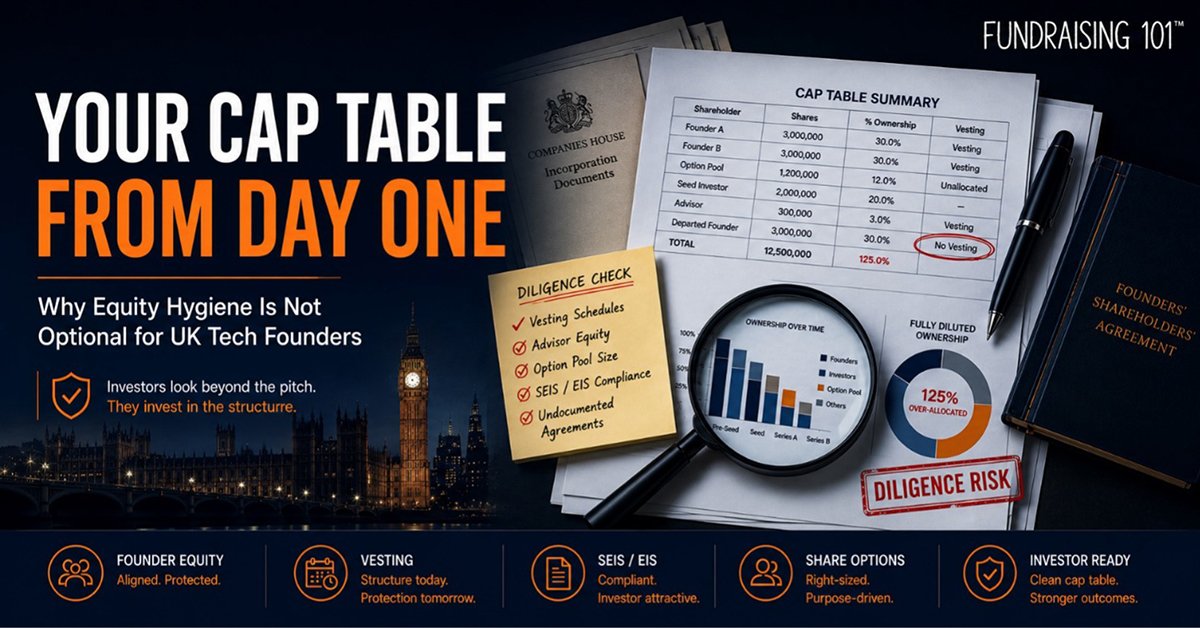
Why Equity Hygiene Is Not Optional for UK Tech Founders

By Robert Hokin, Managing Partner, Fundraising101
“A capitalisation table is a record of all shareholders in a company, the types of equity they hold, the percentage of the company each represents, and the value of that equity at each stage of the company’s development.”
Financial Conduct Authority – Equity Finance Guidance
Why This Matters
As a VC I’ve reviewed hundreds of cap tables. I can usually tell within a few minutes whether the founding team has thought carefully about their equity structure or whether they’ve got to incorporation, issued some shares, and moved on. The second type invariably creates problems. Sometimes small, fixable problems. Sometimes deal-breaking ones.
The cap table is the legal record of who owns what in your company. It starts the moment you incorporate. Every share issued to a co-founder, every option granted to an early employee, every agreement made with an advisor over a coffee…it all ends up there or should do. Most UK tech founders treat it as an administrative task. Professional investors treat it as a risk assessment.
The number one reason early-stage deals fall apart in diligence, ahead of IP assignment, ahead of regulatory gaps, ahead of almost anything else, is a cap table that doesn’t make sense. Disproportionate equity for departed co-founders. Options without vesting schedules. Informal agreements that were never documented. Convertible notes from friends and family that were never properly structured. By the time an investor flags these issues, fixing them is expensive, time-consuming, and occasionally impossible without the cooperation of people who no longer have an incentive to help you.
What a Cap Table Contains
A basic cap table records: who holds shares, what type they hold, ordinary, preference, A ordinary, B ordinary, how many, at what price, and when they were issued. As your company grows through funding rounds, it also records convertible instruments: SEIS/EIS qualifying notes, ASAs, and any share option pool reserved for employees.
At pre-seed, most UK tech founders have a simple cap table with two or three founding shareholders. That simplicity is an asset. Every complexity added from now to Series A, every undocumented side agreement, every equity promise made verbally at a startup event, every advisor given shares without a vesting schedule, reduces your optionality and increases your diligence risk.
Your cap table should live in a dedicated tool. Seedlegals is the standard for UK early-stage companies and handles Companies House filings at the same time. A spreadsheet is not a cap table. A spreadsheet is a spreadsheet that will disagree with your Companies House records at the worst possible moment.
The Most Common Cap Table Mistakes I See
A departed co-founder holding significant equity with no vesting mechanism. Someone helps found the company, leaves after eight months, sometimes amicably, sometimes not, and walks away with 30% of a business they’re no longer contributing to. I have walked away from companies I was otherwise excited about because of exactly this situation. Not because the remaining team weren’t capable. Because the cap table was structurally broken and fixing it required getting a 30% shareholder to agree to something that was no longer in their interest.
Advisor equity granted without vesting. An advisor receives 1% for introductions they promised to make. They make two introductions in the first month, then disappear. Two years later they own 1% of your company for no ongoing contribution. Multiply this across four early advisors and you’ve given away 4% for work you can’t point to. Keep total advisor equity below 3-5% fully diluted, always use vesting, always include a sunset clause.
Informal arrangements that were never documented. An email saying “if you help us close this round I’ll sort you out with a small slice” is not a shareholder agreement. Until it’s properly documented it’s a liability sitting off your official cap table, visible to no one except the person who received the email and a judge if it ever comes to that.
Vesting: The Most Important Mechanism in Your Cap Table
Vesting schedules tie equity to continued contribution. The standard format in the UK is a four-year vest with a one-year cliff: nothing vests in the first year, 25% vests on the anniversary, and the remaining 75% vests monthly over the following three years.
UK founders implement this through reverse vesting, shares are issued immediately but the company retains a right to buy them back at par if a founder departs before the schedule completes. This must be documented correctly in your founders’ shareholders agreement from day one. Without it, a co-founder departure is a potential catastrophe for your cap table. With it, it’s a managed event.
Reverse vesting also needs to address what happens in an acquisition, whether unvested shares accelerate on a change of control, and under what conditions. Single trigger acceleration means all unvested shares vest on acquisition. Double trigger requires both acquisition and subsequent dismissal. Get legal advice on which is appropriate for your circumstances. But have the conversation now, not in the data room.
What a Clean Cap Table Looks Like to a UK Investor
A clean cap table for a UK tech company at pre-seed has four characteristics. All shareholders are current contributors or have earned their position through documented historical contribution. All equity is subject to vesting with clearly documented schedules filed at Companies House where required. There are no undocumented side agreements or verbal promises outstanding. The fully diluted share count, including any option pool, accurately reflects the total equity obligation of the company.
For EIS and SEIS purposes, the share structure matters beyond just looking clean. Ordinary shares with no preferential rights are required for EIS/SEIS qualification. If you’ve issued shares with preferential rights, or if your articles give certain shareholders rights they shouldn’t have for EIS purposes, your advance assurance application will either be refused or granted with conditions. Sort the structure before you raise, not during it.
Checklist
Work through this before your next investor conversation. Be honest about the gaps. If you can’t answer any of these confidently, that’s a signal. Fix the gap before the investor finds it.
Structure and Documentation
- Is your cap table held in a dedicated tool — Seedlegals or equivalent — not a spreadsheet?
- Does it reflect every shareholder including advisors, angels, and convertible note holders?
- Are all share types clearly defined in your articles of association?
- Is your fully diluted share count accurately calculated, including all reserved options?
- Does your Companies House record match your cap table tool exactly?
Founder Arrangements
- Do all co-founders have a signed shareholders agreement in place?
- Do all founders’ shares have a documented reverse vesting schedule?
- Has all IP developed by founders been formally assigned to the company entity?
- Have you documented what happens to founder shares if a co-founder leaves?
- Have you addressed single vs double trigger acceleration on acquisition?
Advisors and Early Investors
- Are all advisor equity grants documented with vesting schedules and a sunset clause?
- Is total advisor equity below 5% fully diluted?
- Are all convertible notes or ASAs formally documented?
- Is there any verbal equity promise outstanding that has not been formalised?
- Have you verified there are no undisclosed encumbrances on any shares?
Takeaways
- Your cap table starts the moment you incorporate. Every informal arrangement made before proper documentation creates a liability that will surface in diligence — always at the worst possible time.
- A departed co-founder with unvested equity is one of the most common deal-breakers at pre-seed and seed in the UK. I have seen this kill deals that deserved to close. Sort vesting before you raise.
- Advisor equity without vesting is a gift, not an arrangement. Document every grant, include vesting, and cap total advisor equity below 5% fully diluted.
- Ordinary shares with no preferential rights are required for EIS and SEIS qualification. Get your share structure right before you apply for advance assurance.
- A clean cap table is a competitive advantage. It signals to investors that you can run a business, not just pitch one.
- Use FounderCatalyst. The cost of getting this right professionally is a fraction of the cost of fixing it in diligence.
Additional Resources
- FounderCatalyst: foundercatalyst.com/knowledge_base — UK-specific guides on round mechanics, cap tables, SEIS/EIS, and term sheets.
- BVCA Model Documents: bvca.co.uk/standardised-documents — Standard UK shareholders’ agreement templates for early-stage investment.
- HMRC EMI Guidance: gov.uk/tax-employee-share-schemes/enterprise-management-incentives-emis — Enterprise Management Incentive option schemes for UK employees
- Companies House: companieshouse.gov.uk — Verify your shareholder filings and confirmation statements are current
Get Raise-Ready.
Pre-seed tech founder in Scotland? There’s a difference between deck-ready and Raise-Ready. We can help you get there. Fast. With No BS. Visit fundraising101.academy.