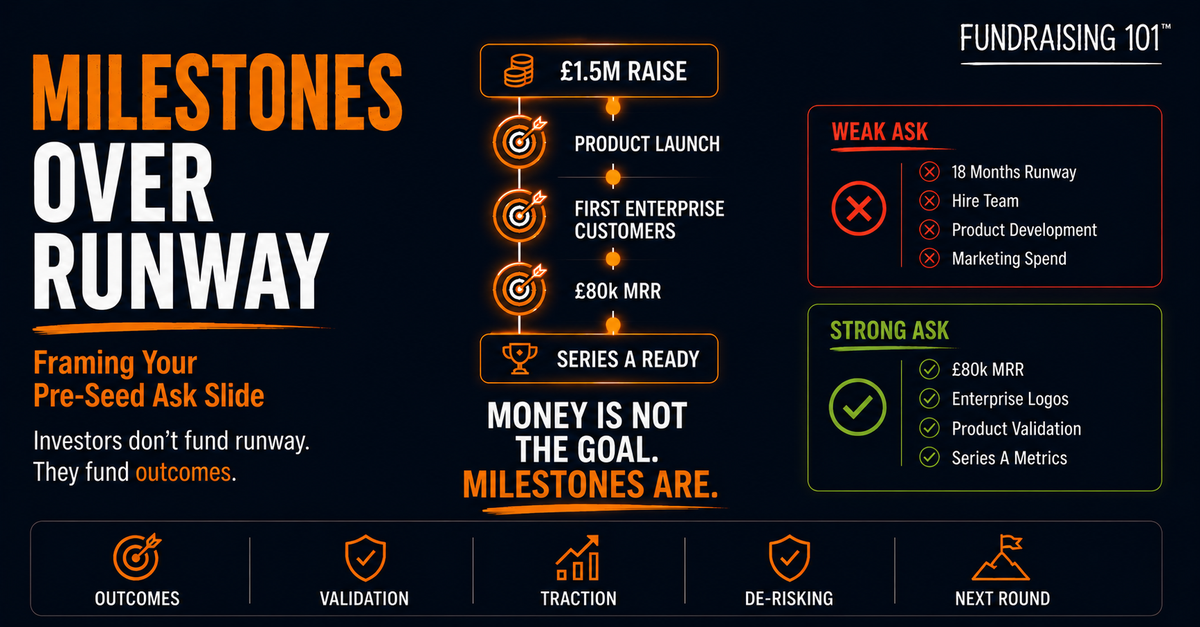
Most pre-seed decks have a slide called “Use of Funds.” Most of them are useless.
“Raising £1.5M: 40% product, 35% sales, 25% G&A.” That’s not a plan. That’s a budget spreadsheet dressed up as investor communication. Any investor who’s seen more than ten decks spots the difference immediately.
Here’s the real problem. Founders confuse where the money goes with what the money does. Not the same thing. Understanding that distinction is the difference between a slide that closes rounds and one that politely ends conversations.
According to DocSend’s 2024 analysis, the average investor spends under three minutes reviewing a pitch deck. For pre-seed decks that figure is even lower. There is no margin for ambiguity. Vague capital allocation doesn’t get a second look, it gets a pass.
Investors don’t fund time. They fund outcomes.
“We’re raising £1.5M for 18 months of runway.” No.
Runway is not a milestone. Survival is not a return. No serious investor writes a cheque so you can exist for another 18 months. They write a cheque because your plan converts their capital into a measurable, verifiable leap in company value — one that makes the next raise easier, cheaper, and more competitive.
The question every investor is silently asking when they read your Ask slide isn’t “can they spend this money?” It’s “what does this company look like on the other side of this raise, and is that outcome worth the risk?”
If your deck doesn’t answer that, you’ve already lost the room.
What a milestone-linked Ask actually looks like
Compare these two versions of the same raise:
Weak: “£1.5M to build the product and grow the team.”
Strong: “£1.5M to reach £80k MRR, onboard three enterprise logos, and achieve the metrics required for a £5M Series A in Q3 2027.”
Every pound is now pulling in the same direction. Every hire, every sprint, every campaign is tethered to a specific outcome. That’s not just better investor communication, it’s better company management.
The milestone logic works for any sector. A deep tech company raising pre-seed might frame it as:
£1.2M to reach TRL 6, complete a paid pilot with a Tier 1 industrial partner, and de-risk the IP position ahead of a Series A backed by Innovate UK co-investment.
A SaaS business:
£900k to hit 200 paying customers, reduce churn below 3%, and sign two channel partnerships that accelerate ARR growth.
Different sectors. Same discipline. Show the outcome, not just the outlay.
Here’s a fully worked example: from weak to investor-grade
Abstract principles only go so far. Here is a complete before-and-after transformation of a real Ask slide type, with the reasoning behind every change.
The original slide (weak)
Company: B2B SaaS, HR tech, UK-based, pre-revenue, two founders
Raise: £750k
- Use of funds: 50% product development, 30% sales and marketing, 20% operations
- Runway: 18 months
- Team hires: 2 engineers, 1 sales hire
What’s wrong with that:
- The raise amount appears to be a guess, not a calculation. Why £750k and not £600k or £1M?
- 50/30/20 says nothing about what those categories produce. It’s accounting, not strategy.
- 18 months of runway is a constraint, not an outcome.
- Three hires are listed with job titles but no explanation of what each one unlocks.
- There is no bridge to the next round. What does this company look like when the £750k is spent?
The revised slide (investor-grade)
The Raise: £750k
What this capital delivers: Three specific outcomes by Q4 2026: (1) live product with 50 paying customers at £299/month ACV, (2) MRR of £15k with <5% monthly churn, (3) two signed channel partner agreements with regional HR consultancies.
Why £750k: Based on 18-month milestone cost model: £480k salaries (CTO hire to complete core product + one AE to run channel sales), £120k infrastructure and tooling, £75k GTM (events, content, outbound), £75k contingency (20%).
Each hire earns its place: CTO hire unblocks product completion by Q1 2026. AE hire targets three HR consultancies already in warm pipeline, first signed partnership unlocks referral volume.
Bridge to Series A: At 50 customers and £15k MRR with demonstrable churn below 5%, we have the proof-of-retention story required for a £2–3M seed round in Q1 2027. The metrics we’re targeting are consistent with what UK seed investors currently require as a minimum bar for SaaS.
What changed: Every number is now derived from something. Every hire has a specific unlock. The bridge to the next round is explicit. An investor reading this knows exactly what they’re buying with their capital and what success looks like.
Build your milestone framework before you build your pitch deck
The mistake most founders make is building the Ask slide last, as a summary of decisions already made. The milestone framework should come first. It is the operating logic of your next 18 months. The deck is how you communicate it.
Work backwards from your next round. Answer four questions in order:
- What metrics does a Series A investor need to see from a company like yours? For UK B2B SaaS: demonstrable product-market fit, repeatable revenue, and early signs of scalable CAC. For deep tech: credible technical milestone, pilot validation, de-risked IP. For life sciences: clinical stage progress, regulatory pathway clarity, named partner conversations. Know the bar you are aiming at before you set your milestones.
- Which of those metrics can this raise credibly move? Not all of them. This is the most important filtering question. Pick the two or three outcomes this specific capital is designed to shift. If your milestones require more progress than the money can plausibly buy, you have either the wrong raise amount or the wrong milestones.
- What are the specific, measurable, binary outcomes that prove the move happened? Revenue targets. Customer logos. Technical milestones. Regulatory clearances. TRL levels. Each milestone should be binary — either you hit it or you didn’t. If it requires interpretation to assess, it’s not investor-grade.
- What does it cost to get there — with a 20% contingency? Build the cost model from the milestones up, not from a round size down. That’s your raise amount.
Now you have an Ask slide. Everything else is decoration.
The burn maths: show it, don’t hide from it
Pre-seed founders routinely avoid hard numbers on the assumption that vagueness is safer. It isn’t. Vagueness signals that either you haven’t done the work, or that the numbers don’t hold up under scrutiny. Neither reading helps you close a round.
Here are the maths an investor wants to see reconciled, in your head if not on the slide:
Current burn rate
According to Carta’s 2025 data, pre-seed startups typically burn between £20k–40k per month (roughly $25–50k). If your current burn is significantly above this, be prepared to explain why. If it’s below it, that’s a capital efficiency story worth telling.
Post-raise burn rate
Show what happens to monthly burn once the raise closes and the hires are made. Founders frequently show a raise amount and a milestone set without acknowledging that hiring four people immediately changes the burn picture. Investors do this calculation themselves. Do it for them, transparently.
The formula is straightforward: Post-raise burn = (Current burn) + (New payroll costs) + (New infrastructure/tooling) + (GTM spend)
Check that your raise amount ÷ post-raise burn gives you at least 18 months of runway — ideally 20–22 months to allow buffer for the next fundraise. The fundraising process itself typically takes 3–6 months. You want to start your next raise with at least 9–12 months of runway remaining, not 3.
The 20% contingency
Build it in. Not as a vague safety buffer, but as a named line item. “We have included £75k contingency, representing 20% of our non-salary spend, because our experience shows GTM and infrastructure costs typically run 15–25% above initial estimates in the first 12 months.” That is the language of a founder who has done this before, or who has been well advised.
A real-world cautionary note: a fintech startup that raised £1.6M with £56k monthly burn assumed 28 months of runway. By month nine, headcount had grown and spend had increased to £124k per month. They had nine months of runway left, not nineteen. They didn’t realise until month twelve. Don’t be that founder.
The burn multiple
Investors increasingly scrutinise burn multiple: the ratio of capital burned to net new ARR generated. A burn multiple below 2x means you’re generating £1 of new ARR for every £2 burned. According to Bessemer Venture Partners, companies with burn multiples under 1.5x are 2.8x more likely to successfully raise their next round. If your post-raise model produces a burn multiple above 3x, you either have a pricing problem, a CAC problem, or a milestone problem. Fix it before the meeting.
Building the bridge to your Series A
This is the section of the Ask slide that most founders omit entirely. It is also the section that separates pre-seed raises that close in weeks from those that stall for months.
The investor is always running a mental model: if this team hits these milestones, who writes the next cheque, at what valuation, and does my return work? If you can’t show that bridge, they can’t run that model. And if they can’t run that model, they can’t say yes.
What UK Series A investors actually want in 2026
The bar has risen significantly since 2021. Based on current market data:
- B2B SaaS: £1–2M ARR (£85k–£170k MRR), 150%+ year-on-year growth, net revenue retention above 110%, CAC payback under 18 months. The median Series A company in 2025 had $1.5M ARR per Carta data, with top-quartile deals at $2–3M.
- Deep Tech / Hardware: TRL 7–8 or equivalent, a commercial pilot with a named Tier 1 partner, UKRI or Innovate UK validation, IP position de-risked. Series A timeline typically 24–36 months from pre-seed close.
- Life Sciences: Pre-clinical proof of concept, regulatory pathway confirmed, named pharma or medtech strategic discussions underway. Series A often co-led with a strategic.
- Consumer / Marketplace: Demonstrated liquidity (supply and demand finding each other without founder intervention), DAU/MAU above 30%, CAC/LTV ratio proven at scale, evidence of organic growth.
Only 15% of seed-funded startups graduate to Series A within 24 months. The median time from seed to Series A in 2025 extended to approximately 19 months. Your pre-seed milestones need to get you to the Series A starting line, not the finish line.
How to frame the bridge on your slide
One sentence is enough. It goes at the bottom of your Ask slide or on a dedicated bridge slide immediately after:
Achieving these milestones positions us for a £3–5M Series A in Q3 2027, targeting UK-based deep tech funds with a history of Innovate UK co-investment. The proof points this round generates — TRL 6, named pilot, IP position — are the specific criteria those funds require at first meeting.
That sentence tells an investor three things: you know what the next round looks like, you know who writes it, and you know what evidence they need. That’s investable.
Best practices: what strong Ask slides consistently do
Name the milestones explicitly and make them binary
Vague milestones are not milestones. “Product development” is not a milestone. “Ship v2.0 with enterprise SSO and land three design partners by Q3 2026” is a milestone. The test: can an investor independently verify, six months from now, whether you hit it? If not, rewrite it.
Two or three milestones is the correct number. More than three suggests you haven’t prioritised, or that you’re trying to make the raise look more ambitious than it is. Fewer than two suggests the raise doesn’t generate enough proof to justify the next round.
Make every hire earn its place
Vague headcount signals vague thinking. “60% product, 40% sales” says nothing about what stage those hires are, what they unlock, or why that ratio is right at this moment. “Two senior engineers to complete the core API and one enterprise AE to land three healthcare accounts by Q2” — that shows exactly what’s blocking you and that you’ve sized the solution precisely. Each planned hire should unlock a specific outcome. If you can’t articulate what a hire unblocks, you don’t need the hire yet.
Leave valuation off the slide
Unless you have priced the round and have a lead investor, the moment you anchor a valuation in the deck, you’ve opened a negotiation you’re not ready to win. Leave it off. Valuation is a discussion. Progress is proof. Let the market respond to what you’ve built.
If an investor pushes you on valuation early in the process, the right answer is:
We’re focused on finding the right partner at this stage. Happy to discuss terms once there’s mutual interest.
That’s not evasiveness. That’s discipline. Investors respect it. The ones who don’t are not the right investors for a pre-seed round.
Include SEIS/EIS Advance Assurance status
Roughly 80% of UK early-stage investment is SEIS or EIS eligible, providing investors with 30–50% income tax relief. Some funds run dedicated SEIS or EIS vehicles and will not invest without Advance Assurance in place. If you don’t have it, note on your slide that your application is in progress.
Apply before you start fundraising. It’s a straightforward HMRC process and its absence closes doors. Valuation is also directly sensitive to SEIS/EIS mechanics — get legal advice before committing to a number. FounderCatalyst offers fixed-price legal infrastructure for pre-seed rounds at £1,495 and is our recommended starting point.
What investors actually look for
“What matters at pre-seed is the story you tell. Instead of evidence-based assertions about unit economics, you’ll need to demonstrate the potential of your solution, and the capacity of yourself and your team to realise it.” Octopus Ventures, Pre-Seed Pitch Deck Guidance (2025)
This framing matters for your Ask slide specifically. At pre-seed you don’t have three years of audited financials. What you have is a credible narrative about what this capital produces. Milestones are how that narrative becomes verifiable. They are the mechanism by which your story becomes a contract with the investor.
“Funders are, for the most part, betting on the CEO. The milestone framework you present is as much a test of your operational thinking as it is a financial disclosure.” Carlos Espinal, Managing Partner, Seedcamp — The Fundraising Field Guide
DocSend’s 2024 data reinforces this: investors spent 40% more time on Team slides and 30% more time on pre-seed Team slides year-on-year, while spending significantly less time on Market Size and Competition slides. The implication is clear: investors are pressure-testing founder judgement above all else. A milestone-linked Ask slide is one of the most direct signals of that judgement in the deck.
UK market context: seed funding reached £1.8B across 1,604 inaugural rounds in 2025, with average seed round sizes hitting a record £2.59M in H2 2024 per Beauhurst and PitchBook data. The market is active — and more selective. Founders with vague capital allocation are being filtered out earlier than ever.
Handling investor objections on your Ask slide
Investors who are interested push back. The questions below are not obstacles — they are buying signals. Here is how to handle the five most common:
“Why this amount?”
What they’re really asking: Did you derive this number from your milestones, or did you pick it based on what you think you can raise? The wrong answer is “we benchmarked comparable rounds.” The right answer is: “We cost-modelled each milestone. £480k covers the two hires required to hit the product milestone, £120k infrastructure, £75k GTM, and £75k contingency. That’s your £750k.” Every number justified from the bottom up.
“Your milestones seem ambitious”
What they’re really asking: Have you stress-tested these, or are they aspirational? The answer is to show your assumptions. “We’re projecting 50 customers in 18 months. Our current conversion rate from demo to paid is 28%. We have 12 warm prospects in active conversation right now. We need to maintain that pipeline cadence to hit the number — here’s the GTM plan that delivers it.” Specific, grounded, honest about the dependencies.
“What if you miss a milestone?”
What they’re really asking: Do you have a plan B, or are you fragile? Show prioritisation: “Milestone one — the product completion — is non-negotiable. Milestone two, the 50 customers, is the upside scenario. We’ve sized the raise to get to milestone one with room. Milestone two is what gets us to Series A on the timeline we’ve described.” That shows intellectual honesty and scenario thinking. Both are investable signals.
“What’s the valuation?”
What they’re really asking: Are you ready for this conversation, or will you either capitulate or overclaim? Do not anchor. “We’re focused on finding the right partner first. Once there’s mutual interest we’re happy to discuss terms — we have a view.” That last phrase (“we have a view”) is important. It signals confidence without commitment.
“What happens after this round?”
What they’re really asking: Can I model my return? Show the bridge explicitly. “Hitting these milestones puts us at [metric] by [date]. That’s the threshold at which [named fund type] typically leads a [£X–Y] Series A. We’ve had early conversations with [two or three named firms] who invest at that stage in our sector.” The more specific and credible this answer, the stronger the signal you’re sending.
How to stress-test your Ask slide before the meeting
Most founders do one of two things before an investor meeting: polish the deck, or practice the pitch. Neither is as useful as adversarial stress-testing of the Ask slide specifically. Here is a process that works.
The five-minute red team
Give your Ask slide to someone who has not seen your deck before, ideally a founder who has raised, or an advisor with investor experience. Ask them to read only the Ask slide, then answer these questions from memory:
- What is this company raising, and what will the capital produce?
- What does this company look like when the money is spent?
- What does the next round look like, and what triggers it?
- Why this amount and not more or less?
- What happens if the primary milestone is missed?
If they cannot answer questions one to three clearly, the slide is not doing its job. If they cannot answer four and five at all, the underlying thinking hasn’t been done yet.
The internal reconciliation check
Before you send a deck to any investor, confirm the following internally:
- Raise amount = milestone cost + 20% contingency. If it doesn’t, recalculate.
- Post-raise burn × 18 months ≤ raise amount. If it doesn’t, your burn model is wrong.
- Each hire has a named outcome attached. If not, it’s not a necessary hire yet.
- Milestone 1 is achievable on budget alone. Milestone 2 is the stretch that earns the premium valuation.
- The bridge to the next round is one sentence. If you can’t write it in one sentence, the logic isn’t tight enough yet.
The 60-second investor test
Read your Ask slide out loud. If it takes more than 60 seconds to describe the raise, the milestones, and the bridge to the next round, it’s too complex. The best Ask slides can be summarised in three sentences:
Sentence 1: What are you raising and what does it cost to produce.
Sentence 2: What specific, verifiable outcomes does that capital deliver.
Sentence 3: What those outcomes make possible next.
If you can’t write those three sentences cleanly, go back to the milestone framework.
Sector-specific milestone language
B2B SaaS
Centre milestone language on revenue metrics (MRR, ARR), customer counts, retention rates, and proof of repeatable sales motion. UK seed investors currently require £10k–50k MRR and at least two reference customers willing to speak to future investors as a minimum Series A bar. Your pre-seed milestones should credibly point toward the lower end of that threshold.
Deep Tech and Hardware
Centre milestone language on TRL progression, pilot agreements with named Tier 1 partners, IP status (filings, freedom-to-operate), and grant validation (Innovate UK, UKRI Smart Grants). Series A timelines are longer in this sector — typically 24–36 months from pre-seed close — so the milestone set for your pre-seed round should reflect that trajectory, not compress it unrealistically.
Life Sciences and BioTech
Centre milestone language on clinical or pre-clinical stage progress, regulatory pathway clarity (MHRA, FDA IND filing), partnership or licensing discussions with named counterparties, and data readiness. The bridge to the next round is usually a specific data readout that enables a Series A or strategic partnership conversation. Named the data event explicitly.
Consumer and Marketplace
Centre milestone language on engagement metrics (DAU/MAU, retention cohorts), unit economics (CAC payback period, LTV), and supply-side or demand-side critical mass. For marketplace businesses, the milestone that matters most is usually proof of liquidity: the point at which supply and demand find each other without founder intervention. That is the metric that defines Series A readiness in this category.
The Raise-Ready Ask Slide: your pre-flight checklist
Before you finalise the slide, confirm every item:
- Raise amount is milestone-derived, not a time period, not a benchmark comparison.
- Two or three specific, binary outcomes are named. Verifiable. Unambiguous. Not open to interpretation.
- Each hire or team expansion is tied to a specific unlock, not a job title.
- Burn rate maths reconcile with the narrative. Current burn, post-raise burn, runway, milestone timeline — all consistent.
- 20% contingency is built in as a named line item, not a vague buffer.
- Valuation is absent from the slide. It will be discussed separately.
- The bridge to the next round is explicit, in one sentence, with named metrics and a plausible timeline.
- SEIS/EIS Advance Assurance status is noted or confirmed in progress.
- The red team test has been passed: a cold reader can answer the five stress-test questions from the slide alone.
If you can’t check every box, the slide isn’t done.
Further reading and resources
Pitch deck structure and Ask slides
- Octopus Ventures: Pre-Seed Pitch Deck Perfection Lessons — Published guidance from one of the UK’s most active pre-seed investors.
- Carlos Espinal, Seedcamp: The Fundraising Field Guide — The definitive European pre-seed fundraising reference. Third edition updated 2024.
- DocSend: Annual Pitch Deck Metrics and Fundraising Reports — Data on how investors actually engage with decks by stage. Updated annually.
- Visible.vc: Seed Round Pitch Deck Guide — Practical template and benchmark data for seed-stage Ask slides.
UK market data and benchmarks
- Beauhurst: The Deal — UK Startup Funding Reports — Authoritative UK equity funding data, deal volumes, and investor activity. The standard reference for UK pre-seed market context.
- British Business Bank: Small Business Finance Markets Report — Annual overview of UK early-stage capital markets, including regional breakdowns.
- Carta: State of Private Markets — Quarterly data on burn rates, round sizes, valuations, and dilution by stage.
- Robot Mascot: UK Pre-Seed and Seed Investment Trends H1 2025 — Independent analysis of current UK early-stage conditions.
Series A benchmarks
- CRV: Series A Metrics VCs Expect in 2026 — Current ARR, NRR, and growth benchmarks. Updated for 2025–2026 market conditions.
- Spectup: Series A Traction Metrics and Benchmarks — Detailed breakdown of what investors require at Series A by sector.
SEIS/EIS and UK legal infrastructure
- HMRC: Apply for SEIS/EIS Advance Assurance — Official HMRC guidance. Apply before you start fundraising.
- FounderCatalyst: Fixed-Price Legal for Pre-Seed Founders — F101’s recommended legal partner. £1,495 fixed-price for pre-seed rounds. CEO Sam Simpson, Director Max Heal.
Related F101 resources
- How to Build an Investor Pipeline That Actually Works
- Warm Introductions: Why They Matter and How to Get Them
- Running a Pre-Seed Round in the UK
- What Investors Notice on LinkedIn, But Don’t Tell You
Get Raise-Ready. Pre-seed tech founder? There’s a difference between deck-ready and Raise-Ready. We can help you get there faster. With no nonsense. Capital is for speed, not comfort. No founder debt repayment. No inflated salaries. Every pound earns its place by moving the company measurably closer to the outcome that justifies the next cheque. That’s what raise-ready looks like. Get in touch if you need help framing the argument. We can help.