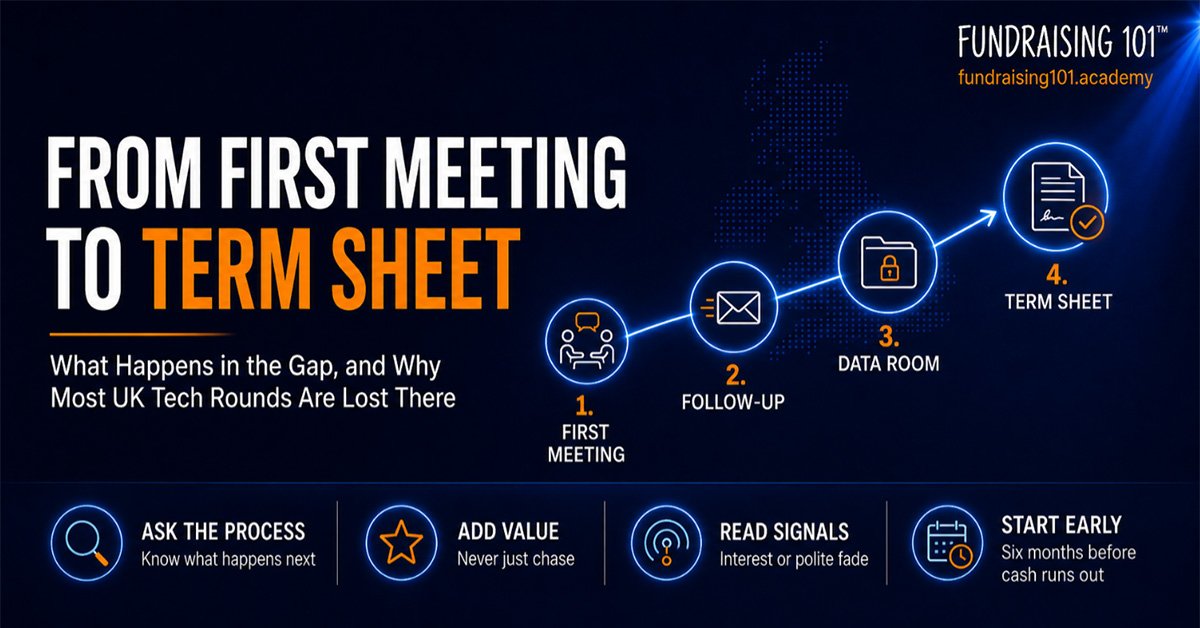
What Happens in the Gap, and Why Most UK Tech Rounds Are Lost There

By Robert Hokin, Managing Partner, Fundraising101
“An investor relationship arc is the sequence of interactions, communications, and evaluations that occur between an investor and a founder from initial introduction through to the execution of a term sheet and the close of a funding round.”
Standard investment process definition, aligned with UK Private Capital (formerly BVCA) and Invest Europe deal process frameworks
Why This Matters
The gap between a strong first meeting and a term sheet is where most UK tech funding rounds die. Not because the investor lost interest. Because the founder lost control of the process.
I have seen this from both sides. A founder leaves the meeting with genuine investor interest in the room. Then they wait. And they wait. Or mebbe they follow up daily. Or they send an updated deck every week with marginal changes. By the time the investor makes a decision, the enthusiasm that was present after the first meeting has been replaced by a question about whether this founder can manage a process. That question is a reasonable one. If you can’t manage the process of a fundraise, which is a time-bounded project with clear milestones, stakeholders who need managing, and a defined close, what does that say about how you will manage the business?
Understanding how the investor side of this process works changes everything. This article covers what happens inside a UK VC fund after your first meeting, what genuine interest looks like versus polite deferral, what to send and when, what a UK term sheet actually contains and how to read it, what two parts of the UK ecosystem say about it, and the single most important tactical decision in the arc from first meeting to term sheet.
What Happens Inside a UK Fund After Your First Meeting
After your first meeting, the partner you met will typically do one of four things: pass internally without telling you, the polite fade; refer the deal to colleagues for a second opinion; request a second meeting or additional information; or move you into their formal process.
In most UK institutional funds, a second meeting is required before a term sheet is issued. In many, including most of the established Scottish and UK regional funds, a full partnership presentation where you present to all or most partners is required before terms can be offered. Understanding where you are in a fund’s process is critical to managing your own timeline. Ask explicitly after a positive first meeting: “What does your process typically look like from here?” Investors who are genuinely interested will tell you clearly. Investors who are not will give you a vague answer that tells you something useful too.
Follow-Up Cadence: Present Without Being Annoying
The right cadence: a same-day thank you email that is specific to the conversation and not a template, then one follow-up after a week if there has been no substantive response, and one final follow-up two weeks after that. Three touches, then park the conversation and redirect your energy.
Do not increase frequency when you receive no response. This signals desperation and reduces your negotiating position for every subsequent conversation. The content of your follow-up emails should add value, not simply ask for a status update. “I thought this was relevant given what you said about X in our meeting,” followed by a specific piece of news or evidence, is far more effective than “just checking in.”
Reading Investor Signals Accurately
Investors who are genuinely interested respond quickly and specifically, ask detailed follow-up questions about your business, request additional materials proactively and follow up on receipt, introduce you to other people in their network, and move meetings forward rather than rescheduling.
Investors who are not interested but are being polite respond slowly or not at all, ask generic questions that could apply to any company, request follow-up materials and do not acknowledge receipt, and reschedule meetings once or twice before they fade.
The clearest signal of genuine intent in a UK VC process is a request for your data room combined with a reference to their legal advisors. That is the immediate precursor to a term sheet. Everything before that is encouraging, but it is not commitment. Do not start counting chickens until the data room request arrives.
The Timeline and What to Expect
A realistic timeline for a well-managed process with a genuinely interested UK institutional investor: first meeting one to two weeks after a warm introduction; second meeting two to three weeks after the first; partnership presentation two to three weeks after that; term sheet one to two weeks after the partnership presentation. Total: six to ten weeks from first meeting to term sheet.
Real-world UK timelines are frequently longer. Three to six months is common even for successful raises, mainly because of investor scheduling constraints, internal fund governance, and the difficulty of creating simultaneous momentum across several parallel conversations. The practical implication is straightforward: start your raise at least six months before you need the capital. If you need to close by September, start in March. The optimistic timeline is rarely the actual timeline, and running out of runway while negotiating a term sheet is one of the most avoidable and most damaging situations a founder can be in.
What a UK Term Sheet Actually Contains
A term sheet is a short document, usually four or five pages, that summarises the key terms of the deal. It is mostly not legally binding: it does not oblige the investor to invest or you to accept, with the usual exception of the confidentiality and exclusivity (no-shop) clauses, which do bind once signed. Its job is to align both sides on the commercial shape of the deal before anyone spends money turning it into the full hundred-plus pages of subscription and shareholders’ agreement and articles. Signing it is a statement of intent on both sides, and in practice neither party likes to reopen something already agreed in principle. The terms fall into three groups.
Economic terms
Valuation is stated as pre-money (your company’s worth before the new money) and post-money (after it). The investment divided by the post-money valuation sets how much of the company the investor owns. Liquidation preference governs who gets paid first on an exit. Investors take preference shares that rank ahead of ordinary shares, and the UK market standard at seed is a one times non-participating preference: the investor gets their money back first, then the rest flows to ordinary shareholders. A multiple above one times, or a participating preference where the investor takes their money back and then shares in the rest, is founder-unfriendly and not standard at early stage. Anti-dilution protects the investor if you later raise at a lower price. Broad-based weighted average is the accepted norm; a full ratchet is aggressive and should be resisted.
The option pool
Investors expect a pool reserved for future employees, often in the region of 10 to 20 percent on a fully diluted basis. The negotiation point that quietly costs founders the most is timing. If the pool is created pre-money and priced into a fully diluted share price, you bear that dilution and your effective valuation drops. If it is created post-money, the cost is shared. This is sometimes called the option pool shuffle. Know which one you are agreeing to, because it can move your ownership by several percentage points.
Control and founder terms
Control terms cover board composition (founder-led boards are common at seed, often moving to founders plus one investor director, sometimes with an independent), the investor consent or reserved matters list (the decisions that need investor approval), drag-along and tag-along rights, pre-emption rights on future issues, and information rights. Founder terms cover vesting and leaver provisions, typically a four-year vest with a one-year cliff, which exist to protect the cap table and the investment, not to express distrust.
Reading a Term Sheet at UK Pre-Seed and Seed
Most pre-seed and much seed investment in the UK uses SEIS and EIS, and this quietly protects founders. The aggressive preference and anti-dilution terms that cause trouble in later rounds are generally not compatible with the schemes, so in a tax-advantaged round they are usually off the table. Where they do appear, treat them as a flag. As a rough guardrail, expect to give up somewhere around 10 to 20 percent per priced round; once you are handing over much more than that, your long-term ownership erodes faster than most founders expect.
Before you sign anything: model your exit at several different sale prices and see what you actually keep after the preference stack is paid; understand the no-shop clause and how long it locks you into a single investor; and have the term sheet reviewed by someone who knows UK early-stage terms. The good news is that the cost of producing one has collapsed. FounderCatalyst, for example, will generate a customised term sheet for free, and because the full legal documents are produced alongside it on the platform, you avoid the old model of paying a lawyer thousands to convert a signed term sheet into the binding paperwork. Its documents are based on UK Private Capital (formerly BVCA) templates, so they are familiar to investors and their lawyers.
What the UK Ecosystem Says
Two very different parts of the UK funding landscape, an accelerator and a venture fund, point at the same truth: the gap to a term sheet is a process to be managed, and the term sheet is where you choose a partner, not just a price.
Seedcamp (Carlos Espinal, Managing Partner and author of The Fundraising Field Guide): Espinal has been part of more than 500 fundraises and describes early-stage fundraising as “an opaque and daunting world,” full of terms founders have never seen. His advice is to treat it as a process to navigate deliberately: keep momentum, and choose the right plan and the right partner rather than simply the highest number on the page.
Octopus Ventures (Edward Keelan, Partner): Octopus is one of the most active early-stage investors in Europe. Keelan frames a first meeting around whether this is someone he could work with for around five years, and his instruction to founders cuts both ways: “diligence your investors.” The term sheet is the moment you commit to a partner for the next several years, so check what practical support they bring and talk to founders they have backed, including any where things did not go to plan.
The Raise-Ready Process Checklist
Work through this before your next investor conversation. Be honest about the gaps. If you can’t answer any of these confidently, that’s a signal. Fix the gap before the investor finds it.
After the First Meeting
- Have you sent a same-day thank you email that is specific to the conversation?
- Have you asked “what does your process typically look like from here?”
- Have you logged this conversation in your pipeline tracker with the next step and timeline?
- Have you identified any questions raised in the meeting that you should address in writing?
Between Meetings
- Are you limiting follow-up to three attempts before parking an unresponsive prospect?
- Are your follow-up communications adding value rather than just chasing a response?
- Are you sending a monthly update to all active prospects rather than individual chasing emails?
- Are you tracking who is engaging with your materials and who is not?
Reading the Process
- Do you know which stage of this fund’s process you are currently in?
- Has the investor requested your data room? This is the strongest pre-term-sheet signal.
- Has the investor introduced you to colleagues or others in their network?
- Did you start your raise at least six months before you need the capital?
Reading the Term Sheet
- Is the liquidation preference one times and non-participating, not a higher multiple or participating?
- Is anti-dilution broad-based weighted average rather than a full ratchet?
- Do you know the option pool size, and whether it is created pre-money or post-money?
- Do you understand the board composition and the investor consent (reserved matters) list?
- Have you modelled your exit across the preference stack at several sale prices?
- Have you checked that the terms are compatible with SEIS and EIS where relevant?
Choosing the Partner and Closing
- Have you diligenced the investor and spoken to founders they have backed?
- Do you understand the no-shop clause and how long it locks you in?
- Has the term sheet been reviewed by someone who knows UK early-stage terms?
- Is your legal platform lined up to turn a signed term sheet into binding documents quickly?
Takeaways
- Ask about the fund’s process after every positive first meeting. “What does your process look like from here?” is not aggressive. It is how you manage your raise intelligently.
- Three follow-up attempts, then park the conversation. Continued chasing of an unresponsive investor is a misuse of your time and signals desperation. Move on and come back with news.
- Add value in every communication. Commercial progress, sector evidence, direct answers to specific questions. Never “just following up.”
- A data room request is the strongest pre-term-sheet signal. When it arrives, respond within 24 hours and treat it as a near-term close.
- Start your raise six months before you need the capital. Even a fast, well-managed UK process takes around three months, and running out of runway during term sheet negotiation is one of the most damaging and most avoidable situations in a raise.
- Know the term sheet before you negotiate it. The UK standard is a one times non-participating preference and broad-based weighted-average anti-dilution. A higher multiple, participation, or a full ratchet is a flag, and at SEIS or EIS stage those terms are usually off the table anyway.
- The term sheet is where you choose a partner, not just a price. Diligence the investor, model the exit, and understand the no-shop lock-in before you sign.
Additional Resources
- F101 Raise-Ready Deck Review, fundraising101.academy. Includes investor engagement strategy, follow-up guidance, and a 50-plus fund sift to focus your pipeline on the funds most likely to move.
- FounderCatalyst, free term sheet and funding-round documents, foundercatalyst.com. Generates a customised term sheet for free in about 30 minutes, and produces the full binding paperwork (subscription and shareholders’ agreement, articles, and more) alongside it for a fixed fee with no percentage of the raise. Documents are based on UK Private Capital (formerly BVCA) templates. FounderCatalyst is Fundraising101’s legal infrastructure partner.
- Osborne Clarke, UK term sheets explained for founders, osborneclarke.com. A clear, plain-English walk through the jargon in a UK term sheet from a leading UK law firm. A good primer before you read the terms an investor sends you.
- UK Private Capital (formerly the BVCA), model documents, bvca.co.uk. The standardised UK term sheet, shareholders’ agreement, and articles that most funds and platforms build on. Useful for understanding what a market-standard set of terms looks like.
- DocSend, docsend.com. Track who opens your deck, how long they spend on each slide, and whether they forward it. A practical way to read engagement between meetings rather than guessing.
- Beauhurst, beauhurst.com. UK deal data to identify which funds are actively deploying and who the relevant partners are, so you target the investors most likely to lead at your stage.
This article is general guidance for UK pre-seed and seed founders and is not legal or financial advice. Term sheet terms, tax schemes, and their consequences depend on your specific circumstances, so confirm the detail with a qualified solicitor or adviser before you sign or act.
Get Raise-Ready.
Pre-seed tech founder in Scotland? There’s a difference between deck-ready and Raise-Ready. We can help you get there. Fast. With No BS. Visit fundraising101.academy.