The Numbers That Matter and How to Defend Them in a UK Investor Meeting

By Robert Hokin, Managing Partner, Fundraising101
“A founders’ agreement is a legally binding document between the founding members of a company that establishes each founder’s roles, responsibilities, equity ownership, vesting schedule, intellectual property assignment, and rights upon departure from the business.” Standard UK company law and corporate governance definition
Why This Matters
I have walked away from companies I was genuinely excited about. Not because the technology wasn’t working. Or because the market was too small. Because the co-founder arrangement was undocumented or unclear, and I couldn’t see how the cap table would survive Series A diligence and there was no mechanism to resolve it.
More early-stage UK tech companies are derailed by undocumented founder arrangements than probably any other single issue. The equity split agreed over a coffee in a Glasgow cafe that was never formalised. The co-founder who left eight months in but still holds 30% of the company. The IP that one founder developed before incorporation that has never been formally assigned. These are not edge cases. They are patterns that appear in diligence with remarkable frequency.
This article covers a conversation most founding teams avoid until they HAVE to have it. So have it now, before the company is worth anything and before the stakes make it hard.
Why Have This Conversation Before You Incorporate?
The equity split and co-founder arrangement conversation is least painful at the very beginning, before the company has any value and the relationship is at its strongest. Every month that passes without documentation increases the potential difficulty, because as the company acquires value, the stakes of any disagreement increase.
Have this conversation before you incorporate. Before you take any investment. Before you bring in your first employee. Before you start talking to investors. The conversation is ten times easier when the company is worth nothing than when it’s worth £500K and everyone has a different memory of what was agreed two years ago.
There’s a low-cost way to capture it. FounderCatalyst publishes a free Founder Collaboration Agreement, a short pre-incorporation document that records who owns what and at what point, the vesting or reverse vesting intent, who will be a statutory director, and which IP each founder will assign to the company. It is not the final binding paperwork, that comes later in your articles, shareholders’ agreement, founder service agreements, and IP assignment, but it forces the conversation early and leaves a clear record of what was agreed.
Equity Splits: The Framework
Equal splits, 50/50 for two founders or even thirds for three, are the common default and often the right answer. The mix of skills required to build a company is rarely so lopsided that a material difference is justified at the outset. The evidence on whether equal splits help or hurt fundraising is mixed, so do not treat an equal split as automatically safe or automatically a red flag. What investors actually scrutinise is whether the split reflects a real conversation about contribution, commitment, and risk, rather than a hasty handshake nobody wants to reopen. A rushed 50/50 with no way to break a deadlock is itself a risk.
The exception to an equal split is where one founder holds critical IP, contributes significant capital, or brings a demonstrably different level of relevant experience. Some teams handle genuine uncertainty about future contribution with a dynamic or milestone-based approach, allocating equity as contribution is proven rather than guessing on day one. Whatever you decide, pair the split with a deadlock-resolution mechanism so a disagreement between two equal holders cannot freeze the company.
Whatever the split, document it formally. Not in an email. In a signed shareholders’ agreement reviewed by, or generated through a platform built on, UK early-stage legal standards. The difference in cost between getting this right at the start and fixing it in diligence is significant. The difference between getting it right at the start and dealing with a dispute after the company has grown is potentially enormous.
Vesting: How to Structure It Under UK Law
Vesting schedules tie equity to continued contribution. The standard format for UK tech companies is a four-year vest with a one-year cliff: nothing vests in the first year, 25% vests on the one-year anniversary, and the remaining 75% vests monthly over the following three years.
UK founders implement this through reverse vesting. Shares are issued in full at incorporation, but the company retains the right to recover the unvested portion if a founder departs before the schedule completes. There are two mechanics in common use. The traditional one is a buyback, where the company or the other shareholders repurchase the unvested shares, often at par value. The more modern and tax-efficient approach, and the FounderCatalyst default, is to have the unvested shares automatically convert into deferred shares: still legal shares, but stripped of voting, dividend, and exit rights, so they are effectively worthless. Either way, the mechanism must be set out correctly in your articles of association and supported by your shareholders’ and founder service agreements.
Modern UK articles do not stop at good leaver and bad leaver. FounderCatalyst’s balanced default, for example, uses four categories, and the consideration a departing founder receives depends on which one applies. A very bad leaver leaves due to fraud or criminal dishonesty. A bad leaver is dismissed for cause but short of that. A voluntary leaver resigns. A good leaver is everyone else, including those leaving on health grounds, through redundancy, or at normal retirement. Agree where the lines sit before anyone leaves, not after.
What a Founders’ Agreement Must Contain
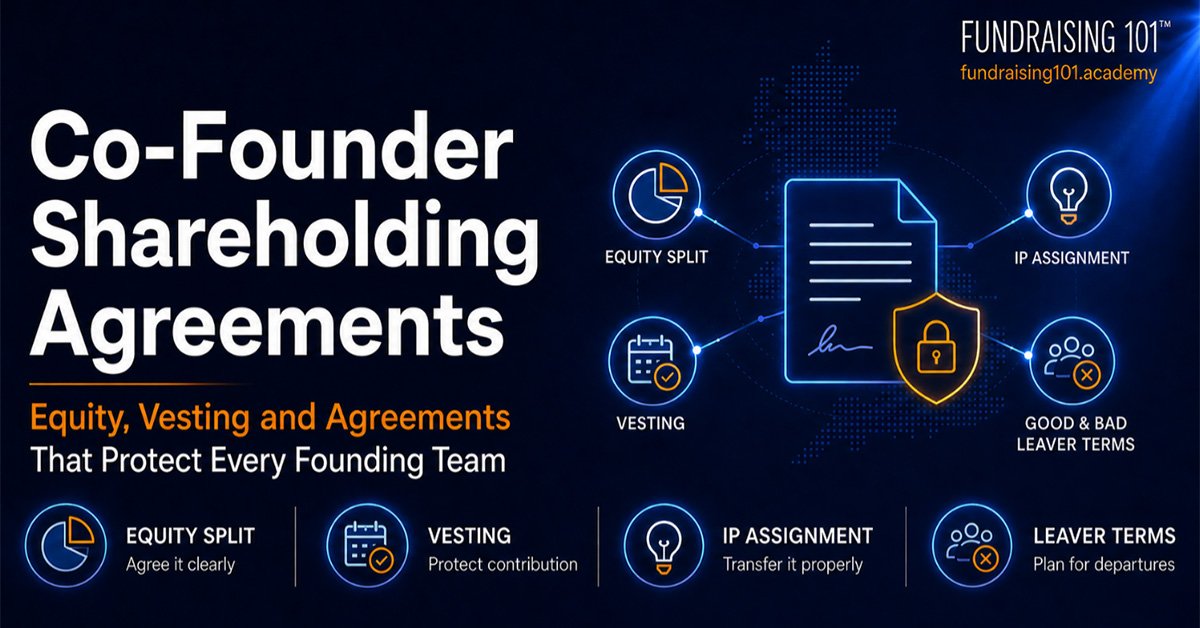
At minimum, a UK tech company founders’ arrangement should contain: the equity split and the legal mechanism by which shares are held; the vesting schedule and reverse vesting terms, including the buyback or deferred-share mechanism; IP assignment from each founder to the company, which is a separate deed, not just a clause in the shareholders’ agreement; roles and responsibilities for each founder; the decision-making process and how deadlocks are resolved; the four-tier leaver provisions above; confidentiality and restrictive covenants appropriate under UK employment law; and what happens on acquisition, including any accelerated vesting triggers.
On a platform like FounderCatalyst these live across a small set of documents: the Articles of Association (which carry the reverse vesting and leaver provisions), a Founder Service Agreement for each founder (vesting, IP, confidentiality, exit terms, and the restrictive covenants the articles alone do not provide), a separate IP Assignment, and the Shareholders’ Agreement. Its documents are based on UK Private Capital (formerly BVCA) templates, tailored by its legal team. One practical point founders miss: if you want your founder shares to qualify for SEIS or EIS, they generally need to be paid for rather than received for free, so how you issue founder equity and how you plan to raise are linked decisions.
The IP assignment is the most commonly omitted element in UK tech company founding documentation. It is also the most commonly flagged issue in diligence. Every piece of IP that any founder developed before the company was incorporated, whether code, designs, algorithms, data, or research, must be formally assigned to the company entity by a signed assignment deed. Not a clause in the shareholders’ agreement. A separate deed. Get this done before you raise. If any of that IP originated at a university or a prior employer, establish that the position is clean and documented, because an investor’s lawyer will ask.
The Departed Co-Founder Problem
Picture the most common version. Two founders each take 50%. They work hard for six months, then one decides a startup is too much like hard work and leaves. Without vesting, that departed founder keeps half the company for six months of effort, and the founder who stays now has to build, and raise, with a passenger on the cap table who contributes nothing. Reverse vesting is what prevents this. It is not an expression of distrust. It is the mechanism that ensures the cap table reflects actual contribution, and it protects the founder who stays as much as anyone. A departed co-founder sitting on unvested equity is one of the most common deal-breakers in UK tech diligence, and it is entirely avoidable.
Checklist
Work through this before your next investor conversation. Be honest about the gaps. If you can’t answer any of these confidently, that’s a signal. Fix the gap before the investor finds it.
Equity and Splits
- Is your equity split documented in a signed shareholders’ agreement, not an email or a verbal understanding?
- Does the split reflect a real conversation about contribution, commitment, and risk?
- If you are equal holders, do you have a clear mechanism to break a deadlock?
- Have you decided whether founder shares need to be paid for so they can qualify for SEIS or EIS?
- Have you planned an option pool (often around 10%) for future employees, kept separate from founder equity?
Vesting and Leavers
- Have all founders agreed a vesting schedule, including the cliff and the monthly vest that follows?
- Is vesting implemented through reverse vesting in your articles of association?
- Do you know whether your unvested shares are recovered by buyback or by conversion to deferred shares?
- Are your leaver categories defined, from good leaver through to very bad leaver, with the treatment for each?
- Have you discussed and documented accelerated vesting on acquisition?
IP Assignment
- Has every co-founder signed a separate IP assignment deed transferring all relevant IP to the company?
- Does the IP assignment cover work done before the company was incorporated?
- If any IP originated at a university or prior employer, is the position clean and documented?
- Do all employment and consultancy agreements contain appropriate IP assignment provisions?
Governance and Agreements
- Have you documented how deadlocks between co-founders will be resolved?
- Does each founder have a Founder Service Agreement covering role, vesting, IP, confidentiality, and restrictive covenants?
- Is the drag-along mechanism in your shareholders’ agreement appropriate for your stage?
- Are confidentiality and non-compete obligations appropriate and enforceable under UK law?
Investor Readiness and Diligence
- Would your cap table survive Series A diligence with no surprises?
- Is there anyone holding equity who no longer contributes to the company?
- Are all share allotments and transfers filed correctly at Companies House?
- Are your founder documents consistent with each other and with what you tell investors?
Takeaways
- Have this conversation before the company is worth anything. The hardest version of the co-founder equity conversation is the one you have after three years of building, when every percentage point is worth real money. A free Founder Collaboration Agreement is an easy way to capture it early.
- Treat the split as a conversation, not a reflex. Equal splits are common and often right, but what investors scrutinise is whether the split reflects real contribution and whether you can break a deadlock, not the ratio itself.
- Vesting protects everyone, including the founder who stays. It is not an expression of distrust. It is the mechanism that ensures the cap table reflects actual contribution, whether through buyback or conversion to deferred shares.
- A departed co-founder with unvested equity is one of the most common deal-breakers in UK tech diligence. I have seen this kill deals that deserved to close. Sort vesting before you raise.
- IP assignment is a separate deed, not a clause. Every founder must sign an assignment deed covering all relevant IP, including pre-incorporation work. This is the most commonly missing document in UK tech company diligence.
- Use FounderCatalyst for standard UK founder documentation. The free Founder Collaboration Agreement captures the early conversation, and the binding documents come through its fixed-fee funding-round service. The cost is a fraction of what a dispute or a diligence failure costs.
Additional Resources
- FounderCatalyst, Founder Collaboration Agreement and founder documents, foundercatalyst.com. A free pre-incorporation Founder Collaboration Agreement, plus the binding founder paperwork (Founder Service Agreement, a separate IP Assignment, Articles of Association, and Shareholders’ Agreement) generated through its fixed-fee funding-round service, with no percentage of the raise. Documents are based on UK Private Capital (formerly BVCA) templates. FounderCatalyst is Fundraising101’s legal infrastructure partner.
- UK Private Capital (formerly the BVCA), model documents, bvca.co.uk. Standardised UK early-stage templates, including the term sheet, shareholders’ agreement, and articles of association that many platforms and law firms build on. Useful for understanding the structures your own documents should follow.
- HMRC, Enterprise Management Incentives (EMI), gov.uk. The tax-advantaged option scheme for UK employees, and the standard mechanism for employee equity. This is distinct from founder shares, but it is how you will reward the team you hire after the founders.
- Companies House, gov.uk/companies-house. File all share allotments (form SH01) and transfers correctly and on time. Your Companies House record is the legal record of who owns the company, so it must match your cap table and your agreements.
- F101 Blueprint Bundle, fundraising101.academy. Structured guidance on getting the founder, equity, and IP foundations Raise-Ready before you open a conversation with investors.
This article is general guidance for UK pre-seed founders and is not legal or tax advice. Company law, share schemes, and tax treatment depend on your specific circumstances, so confirm the detail with a qualified solicitor or adviser before you act.
Get Raise-Ready.
Pre-seed tech founder in Scotland? There’s a difference between deck-ready and Raise-Ready. We can help you get there. Fast. With No BS. Visit fundraising101.academy.