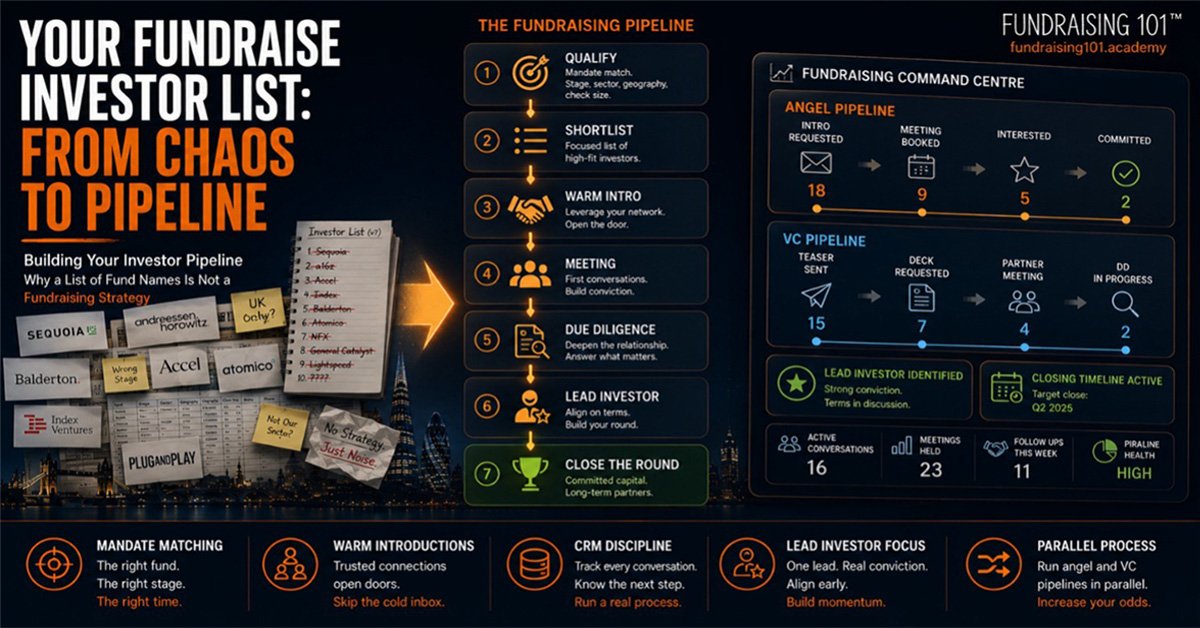
Or Why a List of Fund Names Is NOT a Fundraising Strategy (Long Read)

By Robert Hokin, Managing Partner, Fundraising101
Why This Matters
I have reviewed hundreds of investor outreach lists from UK tech founders over the years. Most of them are long on names and short on thinking. A list of 40 funds found on Google, LinkedIn or a BVCA directory, with a bulk email to each one, is not a fundraising strategy. It’s noise. The funds on the receiving end have seen thousands of versions of it. And their now screening it out with AI tools. Wake up.
A pipeline is a managed process. A set of qualified prospects at different stages of engagement, advanced deliberately, with a clear understanding of where each one stands and what the next step is.
The numbers make the stakes clear. On average, it takes UK founders 39 investor meetings to close a seed round. Only 3% of pre-seed applications receive funding. Over 70% of active seed funds now focus on specific verticals. Approaching the wrong fund, in the wrong way, at the wrong stage is not just wasted effort. It burns a first impression at a fund that’ll still be investing when you raise your next round.
The founders who run a proper pipeline close rounds faster, with better terms, and with more control over their investor mix than those who work reactively. Not because they approach more investors. Because they approach the right ones, in the right way, at the right time.
The question is never who’s on the list. It’s why they are there.
What a Well-Run Pipeline Looks Like From the Other Side of the Table
Before building your pipeline, it is worth understanding what experienced investors are seeing on their end, because the signals you send through how you run your process are almost as important as what you are pitching.
When a well-prepared founder enters a conversation, investors notice specific things immediately. They know exactly how much they are raising and why that number. They can say who else they are talking to without being evasive. They have a closing timeline and they mean it. They follow up with specifics, not generic check-ins. They send materials when asked without delay. They advance the conversation rather than waiting to be pulled through it.
When a poorly-prepared founder enters a conversation, the signals are equally clear. They can’t say who else they are talking to. They have no closing date in mind. Their follow-ups are ‘just checking in’ emails with no new information. They send a 40-slide deck before anyone asked for it.
So consider the fundraising process as a proxy for how you will manage investor relationships, commercial negotiations, and business development conversations after the money is in. Investors already know this. They are watching for it from the first interaction.
The rule: How you run your pipeline is the first piece of evidence an investor has about how you run your business.
Angel vs Institutional: Two Different Pipeline Processes
Most pipeline guides treat all investors as interchangeable. They aren’t. Angel investors and institutional VC funds require meaningfully different pipeline mechanics, and conflating them is a common source of wasted time.
| Dimension | Angel investors | Institutional VC funds |
|---|---|---|
| Decision speed | Days to weeks | Weeks to months |
| Decision maker | Individual — one conversation can be enough | Partnership — requires champion plus committee |
| Check size | Typically £10K–£100K | Typically £150K–£1M+ at pre-seed |
| Due diligence | Light — references, deck, call | Structured — model, legal, commercial DD |
| SEIS/EIS | Critical — most UK angels require it | Important but not always decisive |
| Process formality | Informal — relationship-driven | Formal — IC memo, process milestones |
| Lead likelihood | Rarely leads — usually follows | May lead but requires strong conviction |
| Pipeline cadence | Move fast, close fast | Build patience into your timeline |
Run two parallel pipelines, not one. Your angel pipeline is faster-moving and more relationship-driven. Your institutional pipeline is slower and more process-intensive. Manage them separately, with different cadences and different closing expectations.
For Scottish pre-seed founders, the angel network is a critical first-money resource. Archangels (archangels.com), Scotland’s largest angel syndicate, and the Scottish Investment Bank’s LSIP co-investment facility mean that a well-constructed Scottish angel round can attract institutional co-investment simultaneously. Build for that structure.
Fund Mandate Matching: The Most Skipped Step
Every UK VC fund has a mandate: the parameters within which they invest. Stage, sector, geography, check size, and investment thesis. Approaching a growth-stage fund with a pre-seed ask, or a climate fund with a pure enterprise SaaS pitch, wastes your time and theirs, and permanently uses up your first impression.
Before adding any fund to your pipeline, confirm five things:
- They invest at your stage
- Their typical check size is compatible with your raise amount
- They have at least one named comparable portfolio company in your sector
- They invest in your geography — UK-wide, Scotland-specific, or pan-European
- Their current fund is actively deploying capital
That last point matters more than most founders realise. Use Beauhurst (beauhurst.com) and the BVCA member directory (bvca.co.uk/members) to check. A fund posting about new investments is deploying. A fund posting about portfolio company exits is harvesting. A fund that closed three years ago and made its last investment 18 months ago may be preparing to raise its next vehicle. You are not on their priority list.
The sunk-cost trap: Approaching a misaligned fund is worse than not approaching them. You have consumed your first impression at a fund that will still be investing when you raise your Series A. The cost is not the time you spent. It is the door you closed.
For Scottish founders, the geographic mandate question is particularly important. Not all UK funds that describe themselves as UK-wide have meaningful deal flow outside London. Use Beauhurst to filter for funds with actual completed investments in Scotland or the North of England, not just stated intentions.
The Scottish-specific investor landscape worth qualifying against:
- Par Equity (parequity.com) — Edinburgh-based, pre-seed and seed, technology sector focus, SEIS/EIS
- Archangels (archangels.com) — Scotland’s largest angel syndicate, technology and life sciences, SEIS/EIS
- Scottish Investment Bank / LSIP (scottishenterprise.com) — Co-investment facility alongside qualifying private investors
- Equity Gap (equitygap.co.uk) — Scotland-focused early-stage fund, SEIS/EIS, co-invests with angels
- Old College Capital (oldcollegecapital.co.uk) — University of Edinburgh spinout and affiliated ventures
- Techstart Ventures (techstart.vc) — Northern Ireland and Scotland, pre-seed technology
- Kelvin Capital (kelvincapital.com) — Glasgow-based, technology sector, seed and early growth
- Epidarex Capital (epidarex.com) — Life sciences and healthtech, Scotland and US
Building Your Long List and Shortlist
Your long list should contain 30 to 50 qualified prospects, all of whom pass the mandate check. For each entry: fund name, relevant partner name, a recent comparable investment demonstrating sector fit, your introduction pathway tier, and an honest assessment of fit strength.
Your shortlist is 10 to 15 of those: the funds where fit is strongest, a warm introduction pathway exists, and the timing works. These are the investors you focus on in the first six weeks of your raise. Your long list is the reserve, activated when shortlist prospects pass or stall.
Most founders have one undifferentiated list. The best fundraising processes have two. The shortlist is your offensive line. The long list is your bench.
When building the shortlist, apply three filters beyond mandate fit: introduction pathway quality (Tier 1–4 from the Warm Introduction Playbook), timing alignment (actively deploying now), and strategic value (what does this investor bring beyond capital — network, sector expertise, follow-on capacity, board quality?).
Fit strength is an honest self-assessment. Strong means you have a named portfolio comparable, a warm introduction, and a clear thesis match. Possible means some overlap but you need to make a case. Speculative means you are stretching. Speculative prospects belong on the long list, not the shortlist.
The CRM: Spreadsheet vs Dedicated Platform
A spreadsheet is how most founders start tracking their investor pipeline. A spreadsheet is not how most successful raises finish.
For a pipeline of under 20 prospects, a well-structured spreadsheet is workable. Once you cross 30 to 50 prospects — which is where a properly constructed pre-seed pipeline sits — the limitations become operational liabilities:
- No automatic reminders when a conversation goes cold
- No email integration — every interaction must be logged manually
- No visibility into what materials have been shared with whom
- No collaborative access without version control problems
- No contact enrichment — LinkedIn profiles, company data, and email addresses require separate manual research
- No pipeline view that shows at a glance where each conversation sits across 40+ prospects
A dedicated CRM eliminates most of these friction points. It runs alongside your process rather than requiring constant manual maintenance. And in a raise that can run for 12 to 15 months across 50 investor relationships, the accumulated time saving is substantial.
What F101 Uses: Folk CRM
Fundraising101 Academy uses Folk CRM (folk.app) to manage its own relationship pipeline, and it is the tool we recommend to founders running a structured raise.
Folk is built specifically for relationship-driven workflows — not traditional sales cycles with large SDR teams. That makes it a better fit for fundraising than conventional enterprise CRMs like HubSpot or Salesforce. Folk is designed for the kind of managed, high-touch process a pre-seed raise actually is: a small team managing a large number of individual relationships over an extended period, each requiring personalised attention and precise timing.
The interface is Notion-style, an intuitive from day one, no training block required. It is available on web, iOS, and Android, and connects natively to Gmail, Outlook, WhatsApp, Google Calendar, and 30+ additional tools via Zapier and Make.
Key features relevant to a fundraising pipeline:
| Feature | What it does for your fundraise |
|---|---|
| folkX Chrome extension | Captures investor profiles from LinkedIn, Sales Navigator, and Gmail with one click. No manual data entry. Add to pipeline without leaving the page. |
| Pipeline stage view | Kanban-style board showing every prospect’s current status at a glance. Drag and drop as conversations advance. |
| Gmail / Outlook sync | Email conversations with investors log automatically against the contact record. No copying and pasting into notes. |
| Bulk personalised outreach | Write and send personalised investor update emails to your full pipeline in one action. Tracks opens and responses. |
| Reminders and follow-up alerts | Automated notifications when a follow-up is due or a conversation has gone cold. The system manages the cadence so you don’t have to. |
| Collaborative notes | Shared interaction history across your founding team with @mentions. No crossed wires. No missed updates. |
| AI contact enrichment | Queries Apollo, Clearbit, and Dropcontact simultaneously to surface email addresses, LinkedIn profiles, and company details automatically. |
| Custom fields | Configure the full CRM field specification from this guide without needing a developer or admin. Flexible, Notion-style interface. |
| 30+ native integrations | Connects to Google Calendar, WhatsApp, PandaDoc, Zapier, Make, and more. Links your investor CRM to the rest of your workflow. |
Folk offers a 14-day free trial. Paid plans start at accessible price points for a single founder or small founding team. For a raise that requires managing 30 to 50 concurrent investor relationships over 12 to 15 months, the difference between a spreadsheet and Folk is the difference between a list and a pipeline.
The F101 recommendation: Start with Folk before your raise begins, not during it. Configure your pipeline stages, set up the field specification below, and import your long list before you send your first outreach. A CRM you set up in week three of an active raise is a CRM you will never fully trust.
The Full CRM Field Specification
Whether you use Folk or a well-structured spreadsheet, every prospect needs these fields populated and maintained:
| Field | What to record | Why it matters |
|---|---|---|
| Fund / investor name | Full name + website URL | Basic identification |
| Partner name | Named contact, not just fund name | Funds don’t reply — people do |
| Stage / check size | Their typical range | Mandate qualification check |
| Sector fit | Named comparable portfolio company | Evidence of thesis alignment |
| Geography | UK-wide / Scotland / pan-European | Eliminate geographic mismatches early |
| Fund status | Actively deploying / harvest mode / fundraising new vehicle | A fund raising its next vehicle is not deploying now |
| Introduction pathway | Tier 1–8 rating + introducer name | Links to the Warm Introduction Playbook |
| Fit strength | Strong / Possible / Speculative | Drives shortlist prioritisation |
| Outreach status | Not contacted / Teaser sent / Deck sent / Meeting booked / DD / Passed / Closed | Single source of truth for pipeline state |
| Last contact date | Date of last substantive interaction | Flags conversations going cold |
| Last contact summary | One sentence: what happened | Context without re-reading full threads |
| Next action | Specific action + owner + date | Keeps the process moving |
| Meeting date(s) | Dates of all meetings held | Tracks process velocity |
| Materials shared | Teaser / Deck / Model / Data room | Prevents re-sending or missing a step |
| Follow-up count | Number of follow-ups sent | Enforces the two-follow-up maximum |
| Investor notes | Tone, concerns raised, questions asked | Informs how you handle the next conversation |
| Lead / Follow | Likely lead / Likely follow / Unknown | Shapes process prioritisation |
| Check size expected | Specific amount if discussed | Tracks round construction progress |
| Close probability | High / Medium / Low | Honest forecast of conversion likelihood |
Operational rules that make the CRM work in practice:
- Update within 24 hours of every investor interaction. Memory degrades fast.
- Review the full pipeline every Monday. Look for anything where last contact was more than two weeks ago with no next action scheduled.
- Use the outreach status field as your pipeline stage — it is how you know at a glance what proportion of your pipeline is active versus stalled.
- Share the CRM summary (not full detail) with co-founders weekly. Alignment on pipeline state prevents crossed wires and duplicate outreach.
The Monday review rule: If you cannot describe the status of every active conversation in 60 seconds per prospect, your CRM is not doing its job.
Teaser vs Full Deck: Protect Your Materials
Pipeline management starts before the deck goes out. Most founders send their full deck at the first point of contact. This is a mistake for two reasons.
First: a deck sent to 40 unqualified prospects will circulate. UK VC is a small community. Within weeks, your deck will have been forwarded to people you did not choose to show it to, seen by competitors you did not intend to brief, and read by junior analysts who will make snap judgements based on a partial reading with no context from you.
Second: sending a full deck before interest has been established removes a natural filter. The investors who ask for a full deck after seeing a teaser are more engaged than those who passively receive one. That signal matters.
The teaser — one to two pages — covers the minimum required to spark genuine interest: what the company does and for whom, the problem, the solution and key differentiator, your single most compelling traction number, the ask (amount, stage, SEIS/EIS status), and team headlines. Send the teaser first. When the investor responds with interest, send the deck.
The two-step rule: Teaser to spark interest. Deck to build conviction. Never send the deck before the interest has been established.
The Outreach Sequence: What the Cadence Actually Looks Like
Weeks 1–2: Warm Introduction Activation
Send introduction requests to your Tier 1–4 introducers for all shortlist prospects. Use the double opt-in protocol from the Warm Introduction Playbook. Do not send a single cold outreach yet.
Weeks 2–3: First Touch — Teaser
As warm introductions land, respond within hours and send the teaser. For shortlist prospects where no warm introduction exists after two weeks, send a targeted cold outreach with the teaser attached. Three paragraphs: why this specific fund, what the company does and the traction headline, the specific ask. Subject line: [Company] — [Sector], [Stage], [Raise amount].
Weeks 3–4: Full Deck
For prospects who responded positively to the teaser, send the full deck with a brief covering note: what they are looking at, what the key metrics are, and what you want to discuss on a call.
Weeks 4–6: First Meetings
First meetings are 20 to 30 minutes. Your job is not to close — it is to create enough conviction to secure a second meeting. Come prepared with one specific question: what would need to be true about this company for you to get excited? The answer tells you exactly how to run the next conversation.
Weeks 6–13: Second Meetings, Due Diligence, Offer
Second meetings involve more partners, more detailed questions, and early DD requests. The investor is building their internal case. Fast responses, clean materials, specific answers. Slow responses at this stage are interpreted as a signal about how you will run the business.
Follow-Up Cadence
After each touchpoint, follow up within 48 hours with a brief note summarising what was discussed and the agreed next step. One follow-up after one week of silence. One final follow-up after a second week of silence. After two unanswered follow-ups, park the conversation.
The follow-up rule: One sentence, specific to the last conversation, with a clear proposed next step. Not ‘just checking in’. Never ‘just checking in’.
Running the Process: Parallel Beats Sequential
Parallel process: engage 10 to 15 investors simultaneously. Requires more coordination but creates genuine momentum. One investor’s engagement accelerates others. The timeline of your raise is set by your most engaged investor, not your average one.
Sequential process: focus on one or two investors at a time. Simpler to manage but significantly slower and produces no momentum. At pre-seed, parallel is almost always the right approach. Most professional UK investors expect it.
Creating real momentum requires real news. New customers, product milestones, grant awards, partnership announcements — time these to coincide with your active raise window. Manufactured urgency is immediately visible to experienced investors. UK VC is a small community. Investors talk to each other.
The FOMO rule: You cannot manufacture urgency. You can manufacture the conditions for genuine urgency: real milestones, real conversations, real timelines.
Lead Investor Dynamics: The Most Important Relationship in Your Round
Most pre-seed rounds have a lead investor — the fund or individual who sets the terms, takes the largest single cheque, and anchors the round for others to follow. Getting a lead is usually the hardest part of closing a pre-seed raise, and it deserves the most focused attention in your pipeline.
Signals that identify a likely lead: they have made a comparable investment in your sector at your stage within the last 18 months; they have engaged substantively after the first meeting; they have asked for references; the partner you are speaking to has the authority and track record to champion internally.
Once identified, run your pipeline differently for lead candidates. Give them more time. Answer their questions faster. Offer founder references proactively. When a lead commits — even informally — use it. ‘We have a lead investor in place and are completing the round’ converts speculative interest from follow-on investors into active conversations almost immediately.
If no lead is emerging after six to eight weeks of active process, read it honestly. It usually means the story is not yet compelling enough for someone to take the first risk, the round structure or valuation needs revisiting, or you are talking to the wrong investors. Do not push through without addressing the underlying issue.
| Lead investor signal | What it means in practice |
|---|---|
| Asks for a second meeting unprompted | Genuine interest — advance this relationship |
| Introduces you to a portfolio company | Strong signal — testing fit proactively |
| Asks for references | Early DD — building internal case |
| Asks detailed questions about the model | Conviction-building — respond fast and fully |
| Reschedules meetings repeatedly | Low priority — manage expectations down |
| Generic questions after first meeting | Low conviction — do not prioritise |
| No response to two follow-ups | Passed internally — park immediately |
The Investor Update During the Raise
One of the highest-leverage tools in a fundraising process is one most founders ignore or get badly wrong: the regular investor update sent to all active pipeline prospects during the raise.
The logic is simple. Investors who have shown interest but not yet committed are watching. They want to see whether your business is moving. A regular update demonstrating momentum does more to advance multiple pipeline conversations simultaneously than individual follow-up emails to each investor.
Send the raise-period investor update every three to four weeks during an active raise. Four to six bullet points maximum. Only things that have actually happened — no projections or intentions. End with a single call to action.
Update structure
- One sentence on overall business momentum — the headline
- Two to three specific milestones reached since the last update
- One sentence on raise progress: ‘we are in active conversations with X investors and targeting a close by [date]’
- A single call to action: ‘happy to jump on a 20-minute call if you’d like to re-engage’
The update rule: If nothing has happened since your last update, do not send the update. Silence is better than an update that signals stagnation.
Managing the Close
Setting a credible closing date
A closing date is credible when anchored to something real: the date you need funds to hit your next milestone, or the date your current runway requires capital to be in the bank. Communicate it clearly and repeatedly to all active prospects. It converts passive interest into active decision-making.
Set your closing date six to eight weeks from the point at which you have your lead committed.
Handling extension requests
When an investor asks for more time, ask one question: ‘What would you need to see to be able to move by the original date?’ The answer either surfaces a genuine concern you can address or reveals there is no specific obstacle — in which case the extension request is a soft pass dressed as a timing issue.
If you grant an extension, grant it once, for a defined period, with a specific commitment attached. ‘I can extend to [date] if you can confirm by then’ is a boundary. ‘Let’s keep talking’ is not.
The final push
In the final two weeks before your closing date, contact every active prospect directly with a personal message. State where the round stands — how much is committed, how much is remaining — and give a clear deadline for commitment. Most rounds close in the final days of their stated timeline. The final push gives investors who want to participate the permission and urgency to say yes.
Knowing When to Move On — and How to Handle Rejections
After two follow-ups with no substantive engagement, park the conversation. Redirect that time to conversations that are moving.
| Signal | What it likely means |
|---|---|
| Fast response + specific questions | Genuine interest — advance actively |
| Meeting rescheduled once | Busy but interested — hold the conversation |
| Meeting rescheduled twice | Low priority — manage expectations down |
| Generic questions after first meeting | Polite engagement, low conviction |
| One-line responses to detailed follow-ups | Drifting — one more direct attempt then park |
| No response to two follow-ups | Passed internally — park immediately |
Handling a rejection gracefully
A no from a fund today is not a no forever. When an investor passes, do three things. Thank them genuinely and briefly. Ask one specific question: ‘What would need to change for this to be a different conversation at Series A?’ Ask permission to keep them updated on progress. Then do it. A brief update email six months later — ‘we’ve hit the milestones we discussed, wanted to keep you in the loop’ — occasionally reopens a door you thought was permanently closed.
The UK VC community is small. How you handle a rejection is remembered. Graciousness under pressure is a founder quality that investors notice and respect.
The Raise-Ready Pipeline Checklist
Work through this before your raise goes live.
Fund Qualification
- Have you confirmed each target fund invests at your stage?
- Is their typical check size compatible with your raise amount?
- Have you confirmed sector fit through at least one named comparable portfolio investment?
- Have you confirmed they invest in your geography?
- Is their current fund actively deploying capital?
- Have you split your pipeline into separate angel and institutional tracks?
Scottish Investor Landscape
- Have you qualified Par Equity, Archangels, Equity Gap, and Scottish Investment Bank LSIP against your company?
- Have you used Beauhurst to identify UK-wide funds with actual completed investments in Scotland?
- Have you mapped Techscaler, Converge, and EDGE programme directors as introduction pathways?
CRM and Pipeline Architecture
- Have you set up Folk CRM (or equivalent) with all pipeline stages configured before your raise begins?
- Is every prospect in the CRM with all 20 fields populated?
- Do you have a long list of 30–50 qualified prospects and a shortlist of 10–15?
- Have you identified your one or two most likely lead investor candidates?
- Have you sent your teaser before your full deck to all prospects?
Process Management
- Are you running a minimum of 10 simultaneous conversations?
- Are you sending raise-period investor updates every three to four weeks?
- Have you set a credible closing date anchored to a real milestone?
- Are you following up within 48 hours of every investor interaction?
- Are you applying the two-follow-up maximum before parking unresponsive prospects?
Discipline
- Are you spending time on commercial milestones that create real news during the raise?
- Have you communicated your closing date to all active investors?
- Are you prioritising the lead investor relationship above all other pipeline conversations?
- Do you have a plan for handling rejections gracefully and keeping those doors open?
Key Takeaways
- Mandate matching is not optional. Every cold approach to a misaligned fund wastes a first impression you will need at your next round. Qualify every prospect before approaching them.
- Run two pipelines. Your angel pipeline is faster and relationship-driven. Your institutional pipeline is slower and process-intensive. Manage them separately.
- Use Folk CRM (folk.app), not a spreadsheet. For 30–50 investor relationships over 12 to 15 months, a dedicated CRM is not a luxury — it is how you avoid losing control of the process.
- Send the teaser before the deck. The two-step process filters genuine interest and protects your materials.
- Parallel beats sequential. Run conversations in parallel to create conditions where one investor’s engagement accelerates others.
- The lead investor relationship is the most important in your pipeline. Identify your lead candidates early and give them bespoke attention.
- Investor updates during the raise are high-leverage. Real milestones communicated every three to four weeks advance multiple conversations simultaneously.
- Manage the close actively. Set a credible closing date, hold to it, and make a direct personal ask in the final two weeks.
- Handle rejections gracefully. A no today is not a no at Series A. Ask one useful question, seek permission to update, and keep the door ajar.
Resources for Scottish and UK Pre-Seed Founders
Research and Pipeline Building
- Beauhurst (beauhurst.com) — The definitive UK equity deal database. Filter by stage, sector, geography, and investor to build a qualified long list.
- BVCA Member Directory (bvca.co.uk/members) — Full directory of BVCA member funds with stated investment focus and contact details.
- Dealroom (dealroom.co) — European deal database with fund mandate and portfolio company data.
Pipeline Management
- Folk CRM (folk.app) — The CRM Fundraising101 Academy uses and recommends. Relationship-driven, Notion-style interface, folkX LinkedIn capture, Gmail/Outlook sync, bulk personalised outreach, automated reminders. 14-day free trial.
Scottish Investor Networks
- Par Equity (parequity.com) — Edinburgh-based VC, pre-seed and seed technology focus, SEIS/EIS.
- Archangels (archangels.com) — Scotland’s largest angel syndicate. Technology and life sciences.
- Scottish Investment Bank / LSIP (scottishenterprise.com) — Co-investment facility alongside qualifying private investors.
- Equity Gap (equitygap.co.uk) — Scotland-focused early-stage fund, SEIS/EIS, co-invests with angels.
- Kelvin Capital (kelvincapital.com) — Glasgow-based, technology sector, seed and early growth.
- Techstart Ventures (techstart.vc) — Northern Ireland and Scotland, pre-seed technology.
- Epidarex Capital (epidarex.com) — Life sciences and healthtech, Scotland and US.
Scottish Ecosystem Introduction Networks
- Techscaler (techscaler.co.uk) — Scottish tech community, investor events, and peer founder introduction network.
- Scottish EDGE (scottishedge.com) — Grant programme with active alumni network across hundreds of funded Scottish ventures.
- Converge Challenge (convergechallenge.com) — University spinout network with active investor introduction infrastructure.
- IBioIC (ibioic.com) — Industrial biotech and life sciences investor and industry connections.
Legal Infrastructure
- FounderCatalyst (foundercatalyst.com) — Fixed-price UK funding round legal documents (£1,495 excl. VAT). SEIS/EIS advance assurance included. Secure data room. F101’s recommended legal partner.
Investment Readiness
- Fundraising101 Academy — Raise-Ready Deck Review (fundraising101.academy) — 70-point deck review with a 50+ fund sift and tailored investor target list for your sector and stage. £375. No VAT. 5 working days.
Get Raise-Ready.
Pre-seed tech founder in Scotland? There’s a difference between deck-ready and Raise-Ready. We can help you get there. Fast. With No BS. Visit fundraising101.academy.